


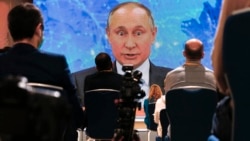
Next question is "why weren't Russian hackers able to secure the reelection of U.S. President Trump" and will Russia give Trump political asylum? Putin says the question is a "provocation." Says Russian hackers have never interfered in U.S. affairs and that such claims are aimed at ruining relations between the two countries and weakening Trump's political position. Putin hopes the new U.S. president, who is "experienced," will settle problems in relations. Putin says Trump won't need any help because he still has a large following and does not plan to leave U.S. politics.
- By Mike Eckel
Trash.
Sixth question is about trash (garbage) from a reporter from Magnitorgorsk.
This is a surprisingly stubborn and emotional issue that has had political resonance for years now, as Russians in various regions fight proposals for landfills and similar trash disposal locations.
The northern region of Shiyes has seen some of the most longstanding protests, over a landfill there, and it's become shorthand for the larger national question of what to do with cities' and towns' trash.
More broadly, environmental issues regularly galvanize Russians in a way that many other political issues do not.
Putin also asked his own question: about air pollution in Magnitorgorsk, a city in the Ural Mountains.
The city, which is home to a massive steel smelter, is known for some of the country's worst air pollution, though the reporter who responded said she didn't think it was bad as people were making it sound.
Next question comes from the Yekaterinburg call center. Peskov calls on a journalist from Magnitogorsk holding a sign saying, "Garbage." Question is about why the issue of dealing with trash and waste is such a problem for the whole country.
Putin says the country needs to develop a "closed system" for processing and reusing waste. Russia needs to introduce trash separation and recycling. Putin says more must be done to work with producers of products and producers of packaging to reduce waste and to move responsibility for dealing with waste from the state to the producers, "like the rest of the world is doing."
Putin says the federal and regional governments are working on these issues. Putin says he received a question from a resident of Magnitogorsk about air pollution. He asks the reporter if there is a problem with air pollution in the city. Reporter says a lot of local people confuse ordinary fog and steam with pollution.
"I don't think the situation is as bad as people on the Internet make it sound," she says.
Putin says that he knows the smelter at Magnitogorsk has reduced its emissions, so he was surprised by the question.
A journalist calls Putin's erroneous reference to a coronavirus vaccine as an antidote a "Freudian slip" -- presumably a wry suggestion that Putin's got Aleksei Navalny's poisoning with the nerve agent Novichok, which an investigative report this week alleged state security agents carried out, on the brain.
Putin now talking about unemployment, about aid to large families, etc. Says aid to families set to increase on January 1. Putin says that the main thing is to "develop the entire economy" -- create new jobs, develop artificial intelligence and new technologies, etc. That is what the National Projects are for, Putin says.
In line with Putin's frequent portrayal of the 1990s as a modern-day time of troubles. His first two four-year terms coincided with economic growth fueled mainly by high world oil prices.
Putin says the situation is "complicated." Pandemic closed a lot of production and reduced real incomes. "We see this and understand it," Putin says. Putin takes exception to the reporter's claim that things have never been so bad, by saying that Russia has indeed seen much worse problems.
Putin says the government is working to reduce the percentage of the population living in poverty. Putin says that some price increases are justified. But in some cases, increases are "not connected with real circumstances." Notes that Russia had a "record harvest" this year, but bread and pasta prices have gone up. Says government is helping sugar producers, but sugar prices still increasing. Same problem with cooking oil.
Says that Russian producers are increasing prices simply because world prices have increased. Says the government has been slow to react to these changes with "market mechanisms," but he hopes that it will correct this.
"I hope this reaction will come in the next few days or weeks," he says.
"Now he'll talk about macaroni" -- in recent days, Putin has been voicing anger about rising pasta prices, seemingly eager to indicate he is addressing Russians' day-to-day economic worries.
- By Mike Eckel
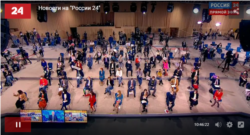
Here’s a shot of the Moscow auditorium, where journalists are seated, socially distanced and masked, waiting to ask questions of Putin: