



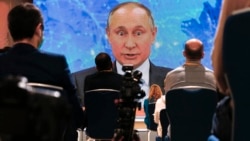
- By Mike Eckel
Putin was also asked about the South Caucasus, in particular the recently ended war over Nagorno-Karabakh. The answers he gave were some of the most extensive he's made since Russia brokered a cease-fire between Armenia and Azerbaijan, about seven weeks ago.
"The situation went out of control after the problem was there for many years. Russia's position was always to reach agreement... via talks... We have always said that seven districts adjacent to Nagorno-Karabakh must be returned under Baku's control and then start discussing the status of the region. From the international point of view, all these territories, including Nagorno-Karabakh, are part of Azerbaijan."
The deal cemented in place the battlefield wins of the Azerbaijani armed forces, who took back control of the territories surrounding the mountainous enclave, and much of the region itself. It also resulted in the deployment of 2,000 Russian troops to monitor (and enforce) the cease-fire.
It did NOT, however, decide on the future status of Nagorno-Karabakh: The region had been controlled by ethnic Armenian forces since the early 1990s, but the recent war all but reversed that situation.
By many accounts, Russia has turned out to be the big winner, asserting itself decisively in what it sees as its historic sphere of influence, and holding the original regional power, Turkey, at arm's length. It also elbowed out the other foreign powers who had long been involved in trying to resolve the conflict: France and the United States.
It's unclear, however, if the situation on the ground is viable for the long term.
- By Current Time
Last year @CurrentTimeTv dug up and published video of the very first press conference that Putin gave as president, some 20 years ago.
Next question is from RT (Russia Today). Asks about the Charlie Hebdo case in France, noting that Russia condemns terrorism but also doesn't allow the publication of caricatures of Muhammad.
Putin says one freedom ends when it violates the freedom of others. At the same time, he says reactions to such incidents can't be violent. Putin says that Russia evolved as a multi-confessional state and so has great experience with tolerance. He notes there have been problems and mentions the mass deportations of ethnic groups under Stalin, but claims there has never been repression based on religious intolerance.
Says that Stalin's repressions were against all religions, not a particular one. Says that multiculturalism in Western Europe has been a failure compared to the tolerance that he claims has developed in Russia "over centuries."
Next question is from Yekaterinburg. Asks how the economy is going to recover from the pandemic and when will Russia return to what it was before the lockdowns.
Putin says transportation (rail and air), retail sales, and services (restaurants, gyms, etc.) have been most badly hit. Federal and local governments have worked out programs to help these sectors -- a tax holiday, direct grants, interest-free loans, low-interest loans for businesses that don't lay off workers, subsidies for renting state-owned property, etc.
Then mentions programs to help large-scale production (cars, ships, airplanes, etc.) and agrobusiness. Says government spent 4.6 trillion rubles on supporting the economy during the pandemic, which is "unprecedented for the country." Says this money was "effectively used."
As for the question when will the country emerge from the crisis -- this depends on how quickly mass vaccination is carried out. "We all need to work actively," Putin says.
Putin says Russia is overall in favor of withdrawing its forces from Transdniester, a Russian-backed breakaway region of Moldova, but only once there is a “normal dialogue” between Transdniester and Moldova. Moldovan President-elect Maia Sandu has stated that she wants Russian troops out of the country – Russian Foreign Minister Sergei Lavrov said earlier this month that such a withdrawal would “hardly help resolve the issue” and called the demand “irresponsible.”
Putin says Russia was close to agreeing to withdraw its forces and blamed the EU for the lack of such an agreement, without going into details.
Next question is about problems within the CIS -- Kyrgyzstan, Belarus, Moldova. "Will Russia lose some of its allies?"
Putin notes that the events in Kyrgyzstan are not new and such crises happen there all the time. Says that problems in the region are because these countries are new to democracy. Not like France, where institutions developed over centuries, he said.
Putin praises Moldovan President-elect Maia Sandu, but says that she is a "citizen of Romania." Says Russia is working for a peaceful settlement to the Transdniester conflict in Moldova, says they were close to a settlement under President Dodon, but the U.S. interfered "for some reason."
As for Belarus, Putin supports Lukashenka's calls for constitutional changes and a peaceful resolution of the crisis there without outside interference. Says there is currently "informational and financial" support coming from outside the country to destabilize Belarus.
- By Mike Eckel
The Khabarovsk protests, sparked by the arrest of the popular Governor Sergei Furgal, have continued almost daily -- an unusually stubborn and persistent political expression of discontent.
Furgal continues to be hugely popular in Khabarovsk, and his supporters have been intensely critical of the Kremlin for its handling of his case. (Among other things, they're asking why are prosecutors just now getting around to filing these charges.)
It's unclear why exactly the Kremlin hasn't moved more aggressively to squelch the protests: By one theory, it's because Khabarovsk is VERY far away from Moscow (8 time zones away, on the Pacific coast) so the protests are unlikely to metastasize in other regions; by another, nonmutually exclusive theory, the Kremlin is happy to let the protests run their course as a political pressure valve, and to try and show the world that the Kremlin does allow for free political speech and assembly.
"The charges against Furgal are very serious. We are talking about murders. Investigations are under way. I understand people who were frustrated about Furgal's arrest. But it is not a political persecution. There were many similar cases against members of other political parties. Investigators and courts must be impartial."