




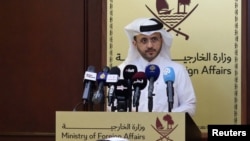
Qatar's Foreign Ministry said no high-level meeting between US and Iranian officials is scheduled in Doha in the coming days, after US President Donald Trump said Iran had requested talks and the White House announced senior US envoys would travel to Qatar for negotiations.
"To the best of my knowledge, there are no direct meetings scheduled between the two parties in the coming days," Qatari Foreign Ministry spokesman Majed Al Ansari told reporters on June 30, adding that the American delegation would meet with Qatari mediators.
The comments came after the White House announced that US envoys Steve Witkoff and Jared Kushner would travel to Qatar for top-level talks. US President Donald Trump said on June 29 Iran had "requested a meeting" that would take place in Doha the following day.
Iran has also said no talks are scheduled with the United States this week.
Foreign Ministry spokesman Esmail Baqaei said on June 30 that the Iranians would not be prepared to meet for negotiations on ending the war, nearing its fifth month, until certain criteria are met. He said such talks are subject to the "implementation of the clauses of the memorandum of understanding" (MOU) by the United States, specifically regarding the conflict in Lebanon.
"We must evaluate the current process in the coming days and decide based on that how and when to begin negotiations for a final agreement," Baqaei said at a press conference.
He referred to the first paragraph of the MOU signed between Iran and the United States on June 17 and announced that the "main criterion" for Tehran is that Washington "force" Israel to stop its attacks on Lebanon.
The interim agreement was intended to halt fighting that erupted after US and Israeli strikes on Iran at the end of February and to reopen the Strait of Hormuz to commercial traffic while broader negotiations continued.
Baqaei said the US has pledged to end the war on all fronts, including Lebanon, and added: "For us, the main criterion is America's adherence to these commitments and America's forcing the Zionist regime to implement these commitments."
The day before, he said an Iranian technical team would visit Doha this week but that it had no relation to US officials visiting the Arab country.
"We will not have any negotiations at any level with the American side in the coming days, and the fact that American representatives are traveling to Qatar has nothing to do with the Iranian delegation's trip," Baqaei said on June 29.
Qatar, along with Pakistan, has been acting as a mediator between Washington and Tehran.
The conflicting statements come after the United States and Iran traded tit-for-tat strikes over the weekend, further straining the fragile cease-fire and casting doubt on efforts to resume negotiations.
Iran, citing US attacks on the country and what it said were violations of the recently agreed MOU, refused to meet with US negotiators as scheduled on June 28.
"One of the reasons is checking if we have access to the unfrozen funds. If there is no access, then this condition has not been fulfilled," said Mehdi Fazaeli of the Iranian supreme leader's office.
The release of the funds is part of the MOU.
Baqaei said on June 29 the Iranian technical team would be in Doha to discuss the release of around $6 billion in frozen Iranian assets held in Qatar. US officials say no frozen Iranian assets have been released to date.
Meanwhile, White House spokeswoman Karoline Leavitt said on June 29 that Witkoff and Kushner would be attending talks with Iran in Doha.
"Special Envoy Witkoff and Jared Kushner will be flying to Doha for high-level meetings this week, as we continue to discuss the memorandum of understanding. On the sidelines of those high-level talks, there will be the technical talks," she said in an interview with Fox News.

Iran fired on commercial vessels in the strait over the weekend, leading US forces to strike Iranian coastal radar and military sites in an effort to protect shipping.
On June 28, Iran's Foreign Minister Abbas Araqchi claimed Tehran had regained sole control over shipping in the Strait of Hormuz for the next 30 days, warning against any attempt to bypass Iranian-approved routes.
Earlier that day, Iran launched missiles and drones targeting US military sites in Kuwait and Bahrain shortly after Trump warned Washington could escalate its military campaign if Tehran failed to abide by the cease-fire.
The escalation followed US strikes on Iranian military sites hours earlier, which Washington said were carried out in response to Iranian attacks on commercial shipping in the Strait of Hormuz.
US Central Command said its forces targeted Iranian drone storage facilities, radar installations, and coastal surveillance infrastructure after a tanker was hit by an Iranian drone on June 27.

