




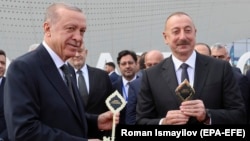
When Turkish President Recep Tayyip Erdogan hosted a dinner in Ankara this week ahead of the 13th summit of the Organization of Turkic States (OTS), it wasn't a surprise as to who was there. It was a surprise, however, who wasn't: Azerbaijani President Ilham Aliyev.
While the leaders of Kazakhstan, Kyrgyzstan, Uzbekistan, Turkmenistan and the Turkish Republic of Northern Cyprus wined and dined -- and US President Donald Trump phoned Erdogan during the dinner -- Aliyev, one of Erdogan's closest allies, was nowhere to be seen.
Not only has the absence brought Turkey-Azerbaijan tensions into focus, it has raised questions about their impact on major US- and EU-backed transport and energy projects in the region as countries scramble to find alternative route as wars continue in Ukraine and Iran.
“Even if diplomatic tensions do not lead to the cancellation of projects, they may slow down bureaucratic coordination, technical consultations, financing processes, and political agreements," said Hasan Oktay, a Turkish political analyst who attended the summit as an observer and called Aliyev's absence “a loss for Azerbaijan itself.”
According to Azerbaijani media, Aliyev's schedule didn't allow him to attend: He was to present awards at the closing ceremony of the inaugural FIFA U-15 World Cup and Festival in Baku that day.
His absence at the dinner, and subsequently a summit where Azerbaijan was handing over the rotating OTS chairmanship to Turkey, has raised questions amid growing friction between the two over domestic affairs and foreign policy.
One point of contention is Azerbaijan's close relationship with Israel.
While Turkey has adopted an increasingly confrontational stance toward Israel over the war in Gaza, Baku has maintained strategic ties with Tel Aviv, including in defense and energy.
Criticism intensified after an Azerbaijani representative attended Israeli Prime Minister Benjamin Netanyahu's address to the United Nations in September.
Baku has objected to what it considers interference by Turkish politicians and media in its domestic and foreign-policy decisions. In recent months, Azerbaijan's Foreign Ministry has declared 31 Turkish citizens persona non grata over statements it said targeted the country's sovereignty, constitutional order, and leadership.
Adding to tensions was criticism by Oktay Saral, an adviser to Erdogan, earlier this month of Azerbaijani school regulations concerning headscarves. Saral was subsequently removed from his advisory position.
Despite the disputes, diplomatic contacts have continued with Turkish Foreign Minister Hakan Fidan meeting his Azerbaijani counterpart Jeyhun Bayramov at the summit.
Azerbaijani analyst Farman Aydin, writing for the pro-government outlet AzerNEWS, said Aliyev's "absence from a summit is not, in itself, evidence of a rupture.”
“A summit can be missed. A relationship built over decades should not be discarded over a political storm. But neither should that relationship be taken for granted,” Aydin wrote.
The dispute comes at a crucial time for transport and energy projects linking the Caspian region to Europe.
Russia's war against Ukraine has weakened the Northern Corridor through Russia, while the US-Iran war has highlighted vulnerabilities in southern energy and transport routes, increasing the importance of alternative South Caucasus connections.
The European Union has prioritized the Middle Corridor under its Global Gateway strategy, reporting that trade along the route has quadrupled since 2022.
The World Bank estimates that at least $25 billion in infrastructure investment could more than triple trade volumes and halve transit times by 2040.
The route connects China and Central Asia to Europe through Kazakhstan, the Caspian Sea, Azerbaijan, Georgia, and Turkey.
Another major initiative is the US-backed TRIPP (Trump Route for International Peace and Prosperity), which aims to connect mainland Azerbaijan with Nakhichevan through southern Armenia, with onward access to Turkey.
The United States and Armenia published an implementation framework in January 2026 and signed a framework agreement in June.
Washington says the initiative will expand trade, strengthen supply chains, and create new transit links between Central Asia, the Caspian region and Europe.
Energy cooperation is equally significant.
The Southern Gas Corridor, comprising the South Caucasus Pipeline, TANAP and TAP, carries Azerbaijani gas through Georgia and Turkey to European markets.
The Baku-Tbilisi-Ceyhan oil pipeline and Baku-Tbilisi-Erzurum gas pipeline are also key components of bilateral energy cooperation.
Oktay said he believes existing pipelines are unlikely to be disrupted, but warned future investments and cooperation could suffer.
“These projects are based on long-term commercial agreements, international consortia and extensive investment relationships. Therefore, a temporary diplomatic chill is unlikely to directly disrupt the operation of these pipelines," he said.
"However, new investments, capacity expansions and additional cooperation in the energy sector may be affected by the course of political relations.”