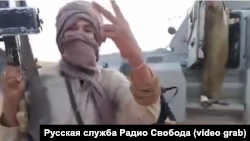
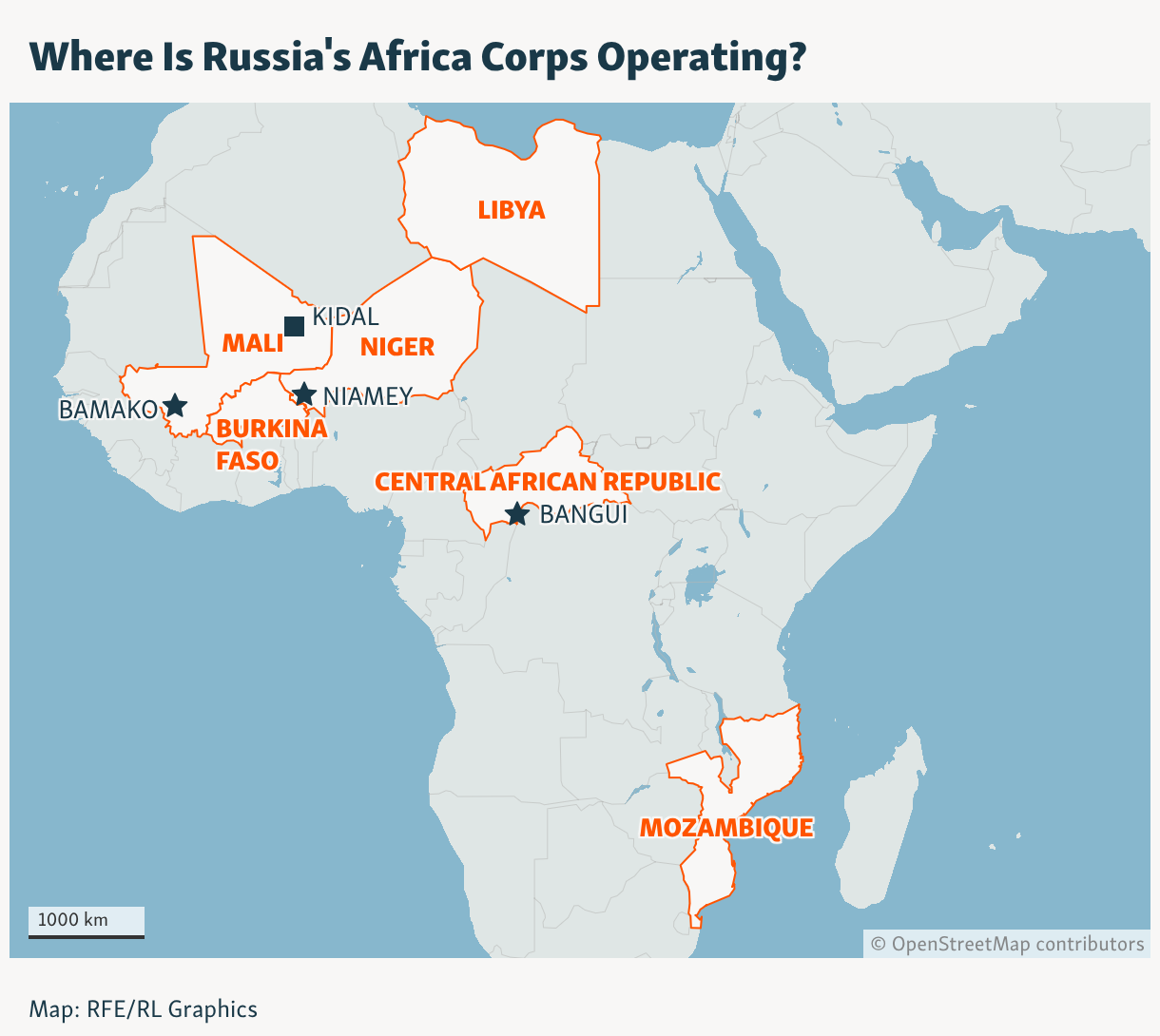
Hundreds of masked Russian soldiers rumbled out of the northern Mali city of Kidal over the weekend, leaving in their wake huge caches of weaponry, equipment, and a downed helicopter -- not to mention major questions for the future of the Russian Defense Ministry mercenary group known as Africa Corps.
The Russian abandonment of Kidal came amid a lightning offensive by a jihadist militia along with ethnic Tuareg secessionists, who have clashed with Russian forces in the past. The Malian government called the attacks, which also took place in the capital Bamako and other towns, an attempted coup.
The pullout came almost 30 months after the Russian mercenaries staged a victorious photo op, hoisting their flag after fighting alongside government forces to capture the city, known as a stronghold of the Tuareg rebels.
It was unclear if the pullout was a precursor to a complete withdrawal of the Africa Corps from Mali; Russian military officials suggested it was not.
What was clear, experts said, is that the Russian operation is in disarray.
"The Russians, they were there to improve the security situation. I mean, they claimed they were achieving the goals, and now they're leaving in a very humiliating way," said Ulf Laessing, a Mali-based analyst at the Konrad Adenauer Foundation, a Berlin-based think tank.
"If you see what they're leaving behind, like entire drone stations," Laessing said in an interview from Cairo. "I mean, the Africa Corps, Russia pretended to do a lot of things, but in the end, they failed."
"It is the most consequential battlefield setback Russia's African project has suffered," said Justyna Gudzowska, executive director of The Sentry, a Washington-based research organization. "It is a major reputational and political blow."
"The situation in Mali remains challenging," Africa Corps said in its own statement.
Heir To Wagner
Africa Corps was set up by the Defense Ministry following the dissolution of Wagner Group, Russia's best-known, and most notorious, private military company.
Under its founder Yevgeny Prigozhin, Wagner had grown across nearly a dozen countries in Africa and the Middle East, building lucrative commercial operations and frequently employing brutal military tactics.
In the Central African Republic, Wagner and its related commercial divisions mined and exported diamonds, gold, and hardwood timber -- and, with the government's blessing, used its soldiers to terrorize the local population.
Wagner troops played a key role in Russia's intervention in Syria to bolster dictator Bashar al-Assad and later in Ukraine, where Wagner units battled alongside regular troops to capture the city of Bakhmut after months of scorched-earth fighting.
In June 2023, an emboldened Prigozhin staged a brief mutiny, sending a convoy of troops toward Moscow in what was seen as the biggest challenge to President Vladimir Putin in his two decades in power.
Two months later, Prigozhin was killed in a plane explosion that Western intelligence believes was an assassination.
In the wake of his death, Wagner was dismantled, with various military units incorporated into other entities. The Defense Ministry took over Wagner's Africa portfolio.
Into Africa
Wagner forces were invited into Mali by the military junta that seized power in 2021 amid growing threats by Islamic extremists with links to Al-Qaeda. French forces, which had been present in the former French colony for nearly a decade, withdrew in 2022. UN forces were also kicked out.
The Malian government described the Russian contingent as a training force.
In November 2023, Wagner mercenaries helped government forces capture Kidal, located in what is historically considered territory of the ethnic Tuaregs. That appeared to be a high-water mark for the Russian presence.
Eight months later, in the northern border town of Tinzaouaten, Tuareg fighters killed and wounded dozens of government soldiers along with Russian mercenaries. Russian war bloggers said at least 20 Wagner soldiers were killed.
In early 2025, as Wagner Group was rebranded as Africa Corps, three major convoys of equipment -- including Russian-made trucks, tanks, heavy armored vehicles, and other materiel -- were reported to have been shipped into Bamako.
"These new weapons deliveries suggest that the Russian government is doubling down on Mali, despite the concurrent withdrawal -- and multiple failures -- of the Wagner Group," according to a report released earlier this month by The Sentry.

It's unclear if there had been any forewarning of the coordinated assault on Kidal, Bamako, and other targets, which started on April 25. Gudzowska said there had been potential signs, but the Malian forces and Africa Corps clearly missed the scale and coordination of attack.
Multiple videos posted by militant fighters showed abandoned tanks and other vehicles, as well as what appeared to be a drone operating station.

Some observers said the amount of equipment that had been left behind suggested a hasty withdrawal. A Russian helicopter was also reportedly shot down, its crew killed.
In its statement, Africa Corps said that the decision to withdraw from Kidal was made jointly with the government and that a number of wounded soldiers had been evacuated. The group also said the attacking force had numbered between 10,000 and 12,000 men, including "Ukrainian and European mercenaries in Africa."
That claim could not be verified.

Mali has served as a model for Africa Corps operation in other countries in West Africa, such as Burkina Faso and Niger, Gudzowska said -- held up as potential proof that kicking out the United Nations and French and replacing them with Russian mercenaries was the way to go.
"The loss of Kidal inverts that premise," she said in written comments to RFE/RL.
The Russian Defense Ministry issued its own statement two days after the pullout, claiming that the mercenaries inflicted "irreparable losses…forcing the enemy to abandon its plans, and prevented a coup, preserving the power of the legitimate government and preventing mass civilian casualties." It also suggested Africa Corps would not be withdrawing entirely from Mali.
A Russian deputy foreign minister told lawmakers on April 28 that the seizure of Kidal "creates a big problem."
The attacking fighters likely assumed that the Russians did not intend to put up a fight, Laessing said.
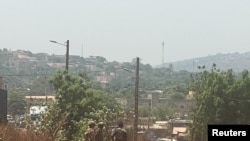
"They probably banked on the fact that the Russians wouldn't be fighting for them at the end. They're mercenaries. They get paid, but it's not a passion to fight for Mali," he said.
"This is strategic defeat because Russia has been marketing this Africa Corps as the security provider and reliable partner: 'We never abandoned allies,'" he said. "But they abandoned Assad in Syria, and now they do very little to save this regime in Mali."