


Russia's Supreme Court has rejected an appeal by the Yabloko party, the sole officially registered party to openly oppose Moscow's war on Ukraine, against its removal from the ballot for September parliamentary elections.
In a separate hearing on August 17, a court in the city of Pskov sentenced an outspoken deputy chairman of Yabloko, Lev Shlosberg, to more than 11 years in prison after convicting of him under a law designed to punish critics of the war.
The rulings display the Kremlin's determination to silence dissent, particularly when it comes to the war, and suggest that President Vladimir Putin is unwilling to risk the possibility of a strong showing by a party that is calling for its end.
The September 18-20 elections to the State Duma, Russia's upper parliament house, will be the first since Putin launched the full-scale invasion of Ukraine in February 2022. Yabloko has made the slogan "For Peace and Freedom" central to its Duma campaign.
The Supreme Court decision "demonstrates a fundamental rejection of fair, competitive elections in Russia," Yabloko co-founder Grigory Yavlinsky said in a social media post, adding that it marked "a serious deepening crisis in the Russian political system and a lack of understanding of a desirable future."
"The fate of Russia -- this has always been our primary concern, and it worries us even more now," Yavlinsky said.
Late last month, the Central Election Commission unexpectedly registered Yabloko for the balloting. But on August 10, the Supreme Court sided with a nationalist party that alleged an array of violations including funding from abroad, copyright infringements, and extremism -- which Yabloko called "absurd" -- and barred it from the election.
At the appeal hearing on August 17, Yabloko Chairman Nikolai Rybakov said the case hinged not on technicalities but on the ability of the state to uphold the rule of law in times of crisis.
"We, the Yabloko party, demand that the electoral process be brought back into strict compliance with the law," Rybakov told the court.
"We demand respect for the constitution of the Russian Federation. We demand respect for the rights of millions of Russian voters who want to live, love, and raise their children in peace in Russia and therefore want to vote for the Yabloko party," he said.
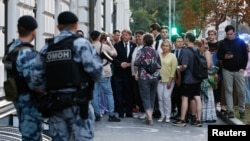
Yabloko said at least 35 people who came to the Supreme Court in hopes of attending the hearing were detained by law enforcement authorities before it began. Among those was actor Viktor Balabanov, one of the party's candidates for a Duma seat, the party said.
Videos shared on social media showed several young people being escorted by police at the court. Only the parties involved in the case and journalists were allowed inside even though the Supreme Court hearing was supposed to be open to the public.
Yabloko said it has the right to appeal to the Supreme Court's presidium and will do so soon. A reversal would be a massive surprise, and an election official suggested the August 17 decision was enough to ensure Yabloko is off the ballot.
Not long before the three-judge Supreme Court panel issued its ruling, the Pskov City Court convicted Shlosberg of discrediting and distributing false information about Russia's armed forces and sentenced him to 11 years and one month in prison.
In his final remarks in the courtroom, Shlosberg maintained his innocence, accusing the authorities of political motivation in prosecuting him, and repeated his ardent criticism of the war.
"The lives of countless thousands of people have been cut short" by the war, he said, according to a transcript published by the news outlet Mediazona. "Sooner or later, the precise and complete death toll -- with names included -- will be made public, and the entire nation will shudder at this list of martyrs."
"Today, cemeteries in our country, including military ones, are growing far more rapidly than maternity wards, kindergartens, and schools," said Shlosberg, who is one of the most prominent Kremlin opponents remaining in Russia.
Polls show a majority of Russians want negotiations to end the war, which has killed hundreds of thousands of Russian soldiers, and recent Ukrainian attacks on oil-and-gas infrastructure and other targets have brought the war closer to many citizens. Putin's approval ratings have been falling in recent months.
Putin has repeatedly rejected calls by Ukraine, the United States, and others for a cease-fire that would leave the front lines in place during peace talks. He has vowed to achieve goals including the seizure of the portion of the Donbas region in eastern Ukraine that Russian forces have been unable to overrun.
Inside Russia, the court rulings against Yabloko and Shlosberg were the latest steps in a what Kremlin critics say is a long and ever-tightening clampdown on dissent and retreat from the right to political representation and other freedoms under Putin, who has been president or prime minister since 1999.
Yabloko was a prominent political force for a decade following the Duma elections in 1993. It has not won any seats as a party in Duma elections held since 2003 that have been increasingly marred by evidence of fraud in favor of the Kremlin-controlled United Russia party.
Shlosberg's conviction comes as other party members face severe pressure from the Russian authorities. Dozens are facing prosecution and several are in custody, including another deputy chairman, Maksim Kruglov, who was sentenced to seven years in prison in June over social media posts about the war published in 2022.