Maybe it’s the widespread state-ordered mobile Internet outages that have disrupted the lives of millions of Russians, in Moscow above all.
Maybe it’s the Ukrainian drone attacks that have disrupted Russians’ flight plans and severely curtailed Russian oil exports in the Baltic Sea.
Maybe it’s the mass culling of infected livestock that has sparked howls of outrage from farmers in Siberia.

Maybe it’s the all-out war on Ukraine, which, despite Kremlin promises of swift victory, rages on in its fifth year, with Kyiv’s forces holding Russia to a near stalemate and Moscow’s war dead and wounded topping 1.2 million.
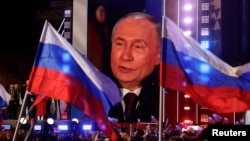
Regardless of the reason, the fact is: Russian President Vladimir Putin is not as popular as he used to be.
In recent weeks, a series of public opinion surveys -- including two conducted by state-linked pollsters -- have registered a decline in support for Putin. FOM, whose main customer is the Presidential Administration, a powerful policy-making body within the Kremlin, recorded the lowest level of public trust in Putin since September 2022.
The drop in approval ratings does not signal a political crisis for the Kremlin; Putin remains the unrivaled leader of the country. Kremlin officials -- the Presidential Administration above all -- have spent years cladding electoral processes in an attempt to create the perception that Russians have a genuine choice in their elected leaders, what’s called “managed democracy.”
But Kremlin officials are sensitive to shifts in public opinion, experts say, and the current change is being scrutinized internally by the administration officials charged with managing the political system.
“It is noteworthy and it’s also backed by various other 'events and incidents,’” said Gulnaz Sharafutdinova, director of the Russia Institute at King’s College London, pointing to the recent case involving a pro-Kremlin attack-dog lawyer who ended up in psychiatric hospital after ripping into Putin.

The shift in mood might be explained by several factors, she said: disruption from Ukrainian drones; disruption of messengers like Telegram, WhatsApp, and the Internet; unmet expectations and unfulfilled promises from US-backed peace negotiations for Ukraine; overall fatigue with a prolonged war that started to impact the economy more noticeably.
“This does not mean revolution is on the books, but rising tensions are not good for the Kremlin,” she said.

“We don't yet have enough data to link specific social processes in specific social groups to this downward trend,” said Konstantin Gaaze, a Tel Aviv-based sociologist and former Russian government adviser. “Who exactly is tired, disappointed, or angry?”
“We have seen major interventions in everyday life -- Internet blackouts and restrictions -- but we are also seeing a more prolonged tendency,” he said: “The war penetrating deeper and deeper into the heartland of European Russia. Drones, strikes on oil refineries, and so on. These things accumulate over time.”
Cows, Cukes, and Tech
For years, tech regulators -- and security agencies -- have tightened controls over the Internet inside Russia, installing surveillance hardware, passing restrictive laws, coercing tech companies to sell out to Kremlin-linked owners, and slowing down websites and apps that fail to comply with regulations.

Over the past year, however, officials have resorted to turning off mobile Internet service in a growing number of regions.
The Kremlin has justified the outages as a way to prevent Ukrainian drones from using Russian networks to navigate. But the slowdowns, along with the throttling of popular apps like Telegram and WhatsApp, have disrupted the lives of millions, particularly in Moscow.
A survey released last month by the Levada Center, one of Russia’s last remaining independent pollsters, showed a notable uptick in Russians encountering Internet problems -- and a growing number saying they were unhappy with authorities’ moves to squeeze Telegram and WhatsApp.
In early February, meanwhile, veterinary authorities in several Siberian regions ordered quarantines and the killing of tens of thousands of cows and other livestock, citing rabies and another highly infectious bacterial disease. Farmers and ranchers have complained, saying the move is overkill and is destroying livelihoods in poorer towns and villages. Some complained that compensation being paid for destroyed livestock was inadequate.
Several even took their protest all the way to Moscow’s Red Square, a political act that is a rarity these days.
Russia’s economy is also slowing down markedly, after years of torrid growth fueled by government war spending. Inflation has pushed up prices, prompting a sharp hike in interest rates. Wages are stagnating.
Don’t Mention The War
And then there’s the Ukraine war, which hit the four-year mark on February 24.
US President Donald Trump made ending the war a priority upon taking office in January 2025. His special envoys have met repeatedly with Putin, and his negotiators have organized multiple rounds of bilateral and trilateral talks.
But talks have ground to a halt.

A month of US and Israeli attacks on Iran is partly to blame. Russia’s hardline demands on territory and security guarantees, demands Ukraine says are unacceptable and potentially dangerous, are also responsible.
Plus, Ukraine’s military -- despite being smaller and mostly unequipped in terms of artillery, ammunition, and heavy weaponry -- has kept Russian troops from quickly advancing to achieve the Kremlin’s war goals. It has inflicted astronomical losses on Russian forces.
According to FOM’s tracking, the last time Putin’s approval ratings slipped noticeably substantially was in September 2022, seven months in.
That was when the Kremlin realized the war wasn’t going to be over quickly -- some had predicted Russia would subjugate Ukraine in a few days or weeks. Putin ordered a large-scale mobilization, jolting Russian society and prompting an exodus of hundreds of thousands of people from the country.
Inside Russia, dissent has been almost entirely crushed. Yevgeny Prigozhin, the St. Petersburg restaurateur who built a formidable private mercenary force, then staged an abortive mutiny in 2023, was one of the loudest dissenters of the war’s conduct. He died two months later in a plane crash widely believed to be an assassination.

Last month, Ilya Remeslo, a bombastic Kremlin booster, touched a public nerve when he penned a scathing broadside about the war and the overall state of the country. He also went after Putin himself, calling him a war criminal and complaining he was destroying Russia.
Less than two days after publishing the article, Remeslo was admitted to a psychiatric hospital, though it was unclear if it was voluntary or not. His current whereabouts are unclear.

“What’s happened now? A perfect storm has begun,” Yelena Koneva, a sociologist and public opinion marketer, said in a commentary published by Ekho, the renowned former Moscow radio station.
“Right now, this giant pile of snow called ‘support for Putin,' is starting to melt. It won’t collapse all at once; it melts and melts and melts,” she wrote. “It's a gradual, truly significant change. This is the first sign, and it can't be shut down by further repression -- there are too many reasons.”