



News
- By RFE/RL
As Xi Ends Russia Visit, Blinken Says China's Diplomatic Support For Moscow Is Counter To U.S. Interests
U.S. Secretary of State Antony Blinken has told U.S. lawmakers that China's diplomatic and political support for Russia goes against Washington's interests.
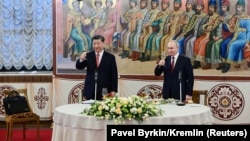
Blinken testified on March 22 before the Senate Foreign Relations Committee just as Chinese President Xi Jinping left Russia, wrapping up a three-day visit during which he and Russian President Vladimir Putin signed a series of documents on "strategic cooperation."
"I think their diplomatic support, their political support, and to some extent material support for Russia certainly goes against our interest in bringing this war to an end," Blinken said.
Xi's visit was his first to Russia in four years and came amid Moscow's deepening international isolation over its invasion of Ukraine.
Putin described as "successful and constructive" talks at the Kremlin, while Xi said one of the agreements signed by the two authoritarian leaders brings ties into a "new era" of cooperation.
"We signed a statement on deepening the strategic partnership and bilateral ties which are entering a new era," Xi said following talks with Putin on March 21 intended to cement the "no limits" partnership the two leaders announced just weeks before Russia invaded Ukraine in February 2022.
On the war in Ukraine, Xi said Beijing backed a diplomatic resolution to the conflict.
"We are guided by the principles of the United Nations...and promote a peaceful settlement" of fighting in Ukraine, Xi said. "We are always for peace and dialogue," he added, reiterating China's "neutral position" on Ukraine.
Western countries have dismissed a Chinese peace proposal -- a 12-point paper calling for a de-escalation and eventual cease-fire in Ukraine -- because it echoes Russian talking points.
Blinken has said that China would cross a red line if it provided substantial military support to Russia. He told lawmakers on March 22 that China thus far has not provided military assistance to Moscow despite ramping up diplomatic support.
"As we speak today, we have not seen them cross that line," Blinken said in response to a question at a Senate committee on whether China was providing "lethal aid" to Russia.
Blinken said China has been warned that it would face serious problems not just from the United States but also other allies of Ukraine if it provided substantial military aid.
White House National Security Council spokesman John Kirby on March 21 dismissed Xi's mediation efforts, saying China does not have an impartial position on the war.
Kirby also told reporters at the White House that nothing that came out of the Xi-Putin meeting indicated the war would end soon.
Kirby said it was clear to see during the meeting that Putin hopes to obtain lethal weapons from China.
"You can see in what Mr. Putin is doing...that he's having resource difficulties" and is trying to overcome them, Kirby said.
Kirby added that one reason the United States opposes a cease-fire at this time is because it would give Putin time to make up for the resource shortfall.
During the visit, Xi paid tribute to the "constructive talks" he held with Putin, referring to an expansion of trade and economic cooperation with Russia, including the export of more Chinese electronic goods.
Putin said that additional gas deliveries to China had been agreed, and that the two countries planned to expand their transport links by building roads and bridges.
A joint statement said the burgeoning partnership between the two countries had reached its highest level ever, but the statement said it was not directed against any other country and did not constitute a "military-political alliance."
Relations between Russia and China "do not constitute a bloc, do not have a confrontational nature and are not directed against third countries," the joint statement said.

With reporting by Reuters and AP
More News
- By Reuters
U.S. Officials Say Russian Hackers Targeting JetBrains Servers For Potential SolarWinds-Style Operations
U.S. officials say that Russian hackers are targeting servers hosting vulnerable software made by the Czech tech company JetBrains. U.S. law enforcement and cybersecurity agencies in a statement on December 13 accused Russian Foreign Intelligence Service (SVR) cyber-actors of trying to hijack the servers in a bid to access source code, something that could potentially allow them to tamper with its compilation or deployment. A similar technique was used to doctor software made by the U.S. firm SolarWinds, the statement noted. That cyberespionage campaign, discovered in 2021, led to a wave of serious breaches across the government.
Activist's Trial In Russia's Bashkortostan To Be Held Behind Closed Doors
A court in Russia's Bashkortostan region decided on December 13 that the trial of Fail Alsynov, the former leader of the banned Bashqort group that for years promoted the Bashkir language and culture, will be held behind closed doors "to avoid possible provocations." Alsynov's lawyer said the trial will start on December 20. Alsynov was charged with inciting hatred over his speech at a rally in April critical of the government's plans to start gold mining near a village in Bashkortostan and to bring in migrant laborers. Alsynov, who rejects the charge, faces up to five years in prison if convicted. To read the original story by RFE/RL's Idel.Realities, click here.
Soviet-Era Dissident Maria Rozanova Dies At 93
Prominent Soviet-era dissident journalist Maria Rozanova has died in France at the age of 93, Russian writer Dmitry Bykov said on December 13. Rozanova was the widow of Soviet dissident writer Andrei Sinyavsky, who in 1965 was sentenced to seven years in prison in Moscow on a charge of anti-Soviet propaganda. Shortly after Sinyavsky's release in 1971, the couple left for France, where they founded Syntaxis, a Russian-language newspaper that became a major outlet for many prominent Russian emigrants. The newspaper closed after Sinyavsky died in 1997 at the age of 71. To read the original story by RFE/RL's Russian Service, click here.
Russian Opposition Politician Yashin's Prison Sentence Upheld On Appeal
A court of appeals in Moscow on December 13 rejected an appeal filed by opposition politician Ilya Yashin, who is serving an 8 1/2-year prison term for his criticism of Moscow's invasion of Ukraine. Yashin, who took part in the hearing via a video link from prison, reiterated his anti-war stance. Last week, Yashin's Telegram channel said he spent five days in solitary confinement and was then placed in a stricter-regime unit in his prison. To read the original story by RFE/RL's Russian Service, click here.
- By Current Time
Moscow Court Refuses To Jail Activist Who Was Forcibly Brought From Kyrgyzstan
A Moscow court on December 13 refused to imprison activist Lev Skoryakin, who in October went missing in Kyrgyzstan after applying for asylum there and was later located in a Moscow detention center. Although prosecutors sought five years in prison for Skoryakin for staging a public action against the Federal Security Service in 2021, the court fined him 500,000 rubles ($5,520) but waived the fine, taking into account the time he spent in pretrial detention. Rights defenders have said Skoryakin was kidnapped in Kyrgyzstan and forcibly taken to Russia, where he was tortured while in detention. To read the original story by Current Time, click here.
Iran Says Powerful Cleric's Killer Executed
The Iranian judiciary has confirmed the execution of the person responsible for the April killing of Ayatollah Abbas Ali Soleimani, a powerful cleric and member of the Assembly of Experts.
The Mizan news agency, which is linked to the judiciary, said the execution was carried out at Babol prison on December 13 with Soleimani's family in attendance after the Supreme Court validated the "Qesas" sentence, a form of Islamic retributive justice, underscoring the gravity with which the authorities treated the case.
The decision came against a backdrop of heightened tensions and widespread social-media speculation regarding the motive behind the shooting.
Initial reports in Iranian media said Soleimani was killed in Babolsar city by a bank guard, leading to various narratives about the motive. A report by the Hamshahri newspaper, affiliated with Tehran's municipality, suggested a work-related dispute as the cause, with the assailant mistaking Soleimani for someone else.
Another narrative emerged on social media, according to which Soleimani had visited the Bank Melli of Babolsar to withdraw a large amount of cash, only to find out the bank didn't have that much money on hand. In the ensuing argument, a retired law enforcement officer working in the bank's security department shot Soleimani because he was poor and angry over his lack of money.
Footage of the incident from inside the bank showed the bank guard calmly approaching Soleimani, who was sitting in a chair, from behind and shooting him. People in the bank immediately apprehended the assailant, who did not resist. His name has not been revealed.
Some analysts said Soleimani's death, occurring amid the widespread "Women, life, freedom" protests, reflects the broader tensions and challenges facing a deeply divided society.
Iran's Misery Index, calculated by the Iranian Statistics Center and released in September, rose to its highest point ever and more than double what it was six years ago. The higher the rating in the index, the worse off people feel.
The index is also seen as a barometer for societal issues, with a direct link to crime rates and even instances of suicide. The publication highlighted that in the past year, 22 of Iran's 31 provinces have reported a Misery Index surpassing the national average.
The death in September 2022 of 22-year-old Mahsa Amini while in police custody for allegedly wearing a head scarf improperly has added fuel to the unrest, as Iranians demonstrate against a lack of freedoms and women's rights.
Written by Ardeshir Tayebi based on an original story in Persian by RFE/RL's Radio Farda
- By RFE/RL
U.S. Sanctions Target Russian Firm That Received Dual-Use Tech From Kazakhstan
The United States has imposed sanctions on a Russian firm that RFE/RL found had received hundreds of shipments from Kazakhstan of dual-use technology that Western governments say Russia is using in weapons it is deploying in its war against Ukraine.
The St. Petersburg-based electronics dealer Streloi E-Kommerts is among the raft of companies and individuals hit by U.S. sanctions on December 12 in what the U.S. Treasury Department called its latest move to target Russia's military procurement networks.
"The Kremlin has steadily turned Russia into a wartime economy, but Putin's war machine cannot survive on domestic production alone," U.S. Treasury Secretary Janet Yellen said in a statement.
"Our sanctions today continue to tighten the vise on willing third-country suppliers and networks providing Russia the inputs it desperately needs to ramp up and sustain its military-industrial base."
An RFE/RL investigation in June found that following Russia's full-scale invasion of Ukraine in February 2022, Streloi E-Kommerts received hundreds of shipments of dual-use goods from Elem Group, an affiliated company based in Kazakhstan's financial capital, Almaty.
Of these shipments, 273 listed types of sanctioned dual-use goods that have been deemed by Washington and its European partners as "high-priority" for export controls to Russia because of their use in "Russian weapons system components recovered on the battlefield in Ukraine."
Elem Group, which said it did not believe it was helping Russia circumvent sanctions, was incorporated in Kazakhstan less than three weeks after Russia's invasion of Ukraine. One of the founders, Russian businessman Kirill Tulyakov, was a founder of Streloi E-Kommerts.
Western officials have pressured Kazakhstan and other Central Asian governments not party to international sanctions on Russia to halt the flow of Western dual-use technology, such as microchips and telecommunications equipment, to Russia's military-industrial complex.
Azerbaijan, Armenia Exchange Prisoners Of War In Goodwill Step
Azerbaijan and Armenia exchanged prisoners of war on December 13, with Baku releasing 32 Armenian soldiers captured in 2020-2023, while Yerevan released two Azerbaijani soldiers captured in April 2023 as part of an earlier announced agreement on several goodwill steps. The swap was carried out within the framework of a deal reached last week and hailed by the United States, the European Union, and Russia. To read the original story by RFE/RL's Azerbaijani Service, click here. To read the original story by RFE/RL's Armenian Service, click here.
Iranian Professor Resigns After Being Questioned Over Support Of Protesters
Akbar Jafari, a professor at Tehran's Sharif University, has resigned after being summoned and interrogated by security agents over his support for protests last year sparked by the September 2022 death of Mahsa Amini while in police custody.
Ali Sharifi Zarchi, a faculty member at Sharif University who was previously dismissed for backing student demonstrators, confirmed the expulsion, noting that Jafari had been the youngest full professor of physics at Sharif University, an expert in quantum materials, and a board member of the Iranian Physics Society.
Iran has been clamping down on any sign of dissent with arrests, intrusive and high-tech surveillance, and the dismantling of student organizations and purging of professors.
Universities and students have long been at the forefront of the struggle for greater social and political freedoms in Iran.
In 1999, students protested the closure of a reformist daily, prompting a brutal raid on the dorms of Tehran University that left one student dead. Amini's death while being detained for an alleged head-scarf violation in September 2022 has once again made campuses a hotbed of dissent.
Over the years, the authorities have arrested student activists and leaders, sentencing them to prison and banning them from studying.
Zarchi, a faculty member at the computer-engineering department of Tehran's Sharif University, was dismissed from the university in August.
During the recent nationwide protests, he repeatedly supported the students and at one point declared that he would suspend his classes until all detained students from Sharif University were released.
The activist HRANA news agency says at least 700 university students have been arrested during the recent unrest.
Many have faced sentences such as imprisonment, flogging, and dozens of students have been expelled from universities or suspended from their studies, as security forces try to stifle widespread dissent.
Written by Ardeshir Tayebi based on an original story in Persian by RFE/RL's Radio Farda
Kazakh Activist Fined For Supporting Imprisoned Opposition Figure
A court in the East Kazakhstan region on December 12 fined Serik Ydyryshev, a member of the unregistered opposition Algha Kazakhstan (Forward Kazakhstan) party, 172,500 tenges ($377) for an online video supporting the imprisoned leader of the party, Marat Zhylanbaev. Ydyryshev told RFE/RL on December 13 that he will appeal the court decision, adding that placing a video on the Internet where you express your thoughts is not a crime but a basic right. Zhylanbaev was sentenced last month to seven years in prison on extremism charges that he rejects as politically motivated. To read the original story by RFE/RL's Kazakh Service, click here.
- By Current Time
Teacher Imprisoned For Condemning Russia's Aggression Against Ukraine Placed In Solitary Confinement
Supporters of Russian history teacher Nikita Tushkanov, who was imprisoned for criticizing Moscow's war in Ukraine online, said on December 12 that the activist was sent to solitary confinement for seven days for lying on a bed before it was officially sleeping time. The supporters said the prison administration's goal was to justify a possible transfer to a unit with harsher conditions. Tushkanov was sentenced to 5 1/2 years in May on a charge of "repeatedly discrediting Russia's armed forces and the justification of terrorism." He pleaded not guilty, calling Russia's actions in Ukraine "criminal." To read the original story by Current Time, click here.
Media Watchdogs Criticize Taliban Over Arrests Of Afghan Journalists
Afghan and international media watchdogs have condemned Afghanistan's hard-line Islamist Taliban rulers for handing down a one-year sentence to journalist Sultan Ali Jawadi on unspecified charges and called for his immediate release, along with the freeing of another recently detained media member.
In a December 12 statement, the Afghanistan Journalists Center (AFJC) expressed "deep concern" over the sentencing of Jawadi, the manager of local broadcaster Nasim Radio, saying that while Taliban officials had refrained from commenting on the sentence, reliable sources said Jawadi was found guilty of "propaganda against the Islamic Emirate of Afghanistan" and "espionage for foreign countries."
The AFJC denounced the sentence as "unfair and unacceptable due to the absence of a defense lawyer during the trial" and called for a "thorough review of the case, immediate and unconditional release of the journalist," and reopening of Nasim Radio.
Meanwhile, the international Committee to Protect Journalists also called on the Taliban, which seized power in the country in August 2021 as international troops withdrew, to release journalist Abdul Rahim Mohammadi.
Mohammadi, who works for independent Afghan broadcaster Tamadon TV, was detained by the Taliban in the southern city of Kandahar on unknown charges on December 4.
"The Taliban must immediately release Afghan journalist Abdul Rahim Mohammadi and end the intimidation and detention of journalists in Afghanistan," said Beh Lih Yi, CPJ's Asia program coordinator.
"After more than two years in power, the Taliban and its intelligence agency continue to crack down on Afghan journalists on a daily basis, hampering reporting and the free flow of information," she added.
On the second anniversary of the Taliban's return to power, the New York-based CPJ in August called on the Taliban to end its relentless campaign of intimidation against Afghan journalists and protect them.
Immediately after returning to power, the Taliban promised to allow freedom of the press.
However, its government has shut down independent radio stations, television studios, and newspapers. Hundreds of media outlets have also closed after losing funding.
The Taliban's hard-line government has banned some international broadcasters while some foreign correspondents were denied visas.
The ultraconservative Islamist group has also driven hundreds of Afghan journalists into exile.
Associate Says No Sign Of Navalny In Moscow Detention Centers
The former head of Aleksei Navalny's Anti-Corruption Foundation, Ivan Zhdanov, said on December 13 that associates of the Russian opposition leader were unable to find him in Moscow pretrial detention centers and his whereabouts remain unknown.
The claim made by government-linked Baza news outlet earlier that Navalny had been taken from his prison in the Vladimir region to Moscow for questioning could not be confirmed, Zhdanov said.
Lawyers checked most of the pretrial detention centers in Moscow used for cases such as Navalny's and didn't find him, Zhdanov said.
Zhdanov pointed out that the type of pretrial investigative activities that Baza referred to are carried out only with lawyers present, and that there would be no need to bring him to Moscow because all previous investigative activities had been conducted in Vladimir.
He also cast doubt on rumors that Navalny has been hospitalized, saying that was unlikely in a prison system that hadn't provided Navalny "normal" medical attention since he was first incarcerated in January 2021.
No one had heard from Navalny in eight days, Zhdanov, who currently resides abroad, said on X, formerly Twitter.
An aide to Navalny said earlier on December 13 that fears were rising that he could be in a dangerous situation given the secrecy surrounding it.
"At this point, we do not know where he is; he is face-to-face with people who once tried to kill him. We need to find him as soon as possible," Navalny spokeswoman Kyra Yarmysh said on X, urging anyone who knows Navalny's current location to let his associates know.
A day earlier, amid concerns voiced by Navalny’s lawyers and colleagues about his whereabouts, Baza reported that Navalny, who missed several court hearings since he went missing, was transported to Moscow as part of an investigation into his actions in a case of vandalism being brought against him.
There was no official confirmation of the report.
On December 11, Navalny's lawyer was told that his client had been transferred from the prison to an unspecified institution amid rising concerns that Navalny hadn't been heard from while his health may be in jeopardy.
Navalny is serving a total of 19 years in prison on extremism and other charges that he rejects as politically motivated.
He was expected to be transferred to a harsher "special regime" facility after his sentence was increased to 19 years in August on a charge of creating an extremist organization, which Navalny and his supporters also have rejected as politically motivated.
Navalny's current isolation from the outside world coincided with a campaign his team launched on December 7 against President Vladimir Putin. That day, the Russian parliament's upper chamber, the Federation Council, set March 17, 2024, as the date for a presidential election.
The European Union on December 12 reiterated its call for Navalny's release, with the bloc's top foreign policy official, Josep Borrell, saying it was "highly worrying" that the Russian activist was missing.
Kremlin spokesman Dmitry Peskov, however, said the presidential administration "has no opportunity" to follow the fate of any inmate, including Navalny.
Peskov added that "interference" into the situation around Navalny was "unacceptable."
Navalny's previous sentence was handed down in 2021 after he arrived in Moscow from Germany, where he had been recovering from a poisoning attack he blamed on the Kremlin, which it denied.
He was Russia's loudest opposition voice and galvanized huge anti-government rallies before he was jailed.
With reporting by Baza and Interfax
Extradition To Kosovo Of Monastery Attack Suspect 'Impossible,' Serbian FM Says
Serbian Foreign Minister Ivica Dacic on December 13 ruled out the extradition to Kosovo of Milan Radoicic, a Kosovar Serb politician who has claimed he is the sole mastermind of an armed attack on a monastery in Kosovo in September that left several people dead.
Dacic said it was "impossible" to extradite Radoicic, for whom Interpol has issued an arrest warrant after he claimed that he was the sole organizer of the September 24 raid and did not share his plan with anyone else.
"All court processes will be conducted before domestic courts," Dacic said in a statement to the Beta news agency.
Four people -- a Kosovar police sergeant and three attackers -- were killed in the attack at a 14th-century Orthodox monastery in northern Kosovo when some 30 gunmen stormed the monastery, sparking a gun battle with Kosovar police.
The incident prompted international concern over the stability of Kosovo, a former province of Serbia with a predominantly ethnic Albanian population that declared independence in 2008.
Radoicic, the former vice president of the Belgrade-backed Serbian List, the largest ethnic Serb party in Kosovo, was briefly detained by Serbia after the attack and later released pending further proceedings.
Kosovo has accused Serbia of being behind the attack, an accusation that Belgrade has denied.
The Interpol arrest warrant was issued at the request of Kosovo's Interior Ministry through the United Nations Interim Administration Mission in Kosovo (UNMIK), Kosovar government minister Nenad Rasic told RFE/RL on December 7.
Just days after the September attack in Banjska, amid rising tensions between Kosovo and Serbia, NATO announced an increase in its Kosovo Force (KFOR) peacekeeping mission.
KFOR, which normally has a troop strength of 4,500, was beefed up by an additional 200 troops from Britain and more than 100 from Romania.
NATO chief Jens Stoltenberg last month said the perpetrators of the Banjska attack must be brought to justice.
Serbian President Aleksandar Vucic has said Serbia welcomes KFOR's stepped-up presence in Kosovo, claiming that only ethnic Serbs there have been attacked since 2001.
Kyrgyz, Tajik Security Officials Say 90 Percent Of Border Agreed Upon
The security chiefs of Kyrgyzstan and Tajikistan say the two Central Asian nations have preliminarily agreed on more than 90 percent of the border between the two former Soviet republics during negotiations held in Kyrgyzstan's southern region of Batken.
The chief of Kyrgyzstan's State Committee for National Security, Kamchybek Tashiev, and his Tajik counterpart, Saimumin Yatimov, said on December 12 that talks on the remaining disputed segments of the border will continue.
On December 11, Kyrgyz President Sadyr Japarov expressed hope that talks on border issues will be completed by the spring of 2024.
Last week, officials of the two nations said they agreed on another 24 kilometers of the border after talks were held in Tajikistan’s northern town of Buston, near the Kyrgyz border.
The delimitation and demarcation of the Kyrgyz-Tajik border has been an issue for decades but turned into an extremely urgent problem in recent years after several deadly clashes took place along disputed segments of the frontier.
In spring 2021, an armed conflict along one segment of the border left 36 Kyrgyz nationals, including two children, dead and 154 injured on the Kyrgyz side.
Tajik authorities officially said that 19 Tajik citizens were killed and 87 were injured during the clashes. However, local residents told RFE/RL’s Tajik Service at the time that the number of people killed during the clashes was much higher.
In all, the border between Kyrgyzstan and Tajikistan is 972 kilometers, the most of which have now been agreed upon.
Many border areas in Central Asian former Soviet republics have been disputed since the collapse of the Soviet Union in 1991.
The situation is particularly complicated near the numerous exclaves in the volatile Ferghana Valley, where the borders of Tajikistan, Uzbekistan, and Kyrgyzstan meet.
Tensions in those areas have led to clashes between local residents and border guards of the three countries.
Kyivstar Gradually Restoring Service After Russian Cyberattack
Subscribers of Ukraine's largest mobile phone operator report that service is gradually being restored after a cyberattack that was claimed by a Russian hacking group.
Kyivstar said on December 13 that its specialists were working on restoring services, saying this may occur gradually but it is doing everything it can to complete the work as soon as possible.
"Friends, the enemy's strategy is to sow panic. Let's not let him succeed!" Kyivstar said on Facebook. "As we reported before, the subscriber information and personal data are safe. The systems in which this data is stored have not been affected by a hacking attack."
Ukraine's Security Service (SBU) said earlier that its cyber-specialists were working to repair the network in cooperation with other government agencies. The SBU also said it opened a criminal proceeding into the hack.
"One of the versions currently being investigated by the SBU investigators is that the special services of the Russian Federation may be behind this hacker attack," RFE/RL was told by the SBU.
The SBU said Internet for households should be completely restored sometime on December 13, followed by the partial relaunch of mobile phone and Internet services. The SBU said the slow pace of the repair work was due to the extensive damage suffered by Kyivstar's digital infrastructure.
The attack on Kyivstar, which has around 24 million mobile subscribers and more than 1.1 million home Internet users, knocked out services, damaged IT infrastructure, and silenced air-raid-alert systems in some parts of Ukraine.
A group of activist hackers called Solntsepyok said on Telegram that it carried out the cyberattack.
Ukraine's State Service of Special Communications and Information Protectorate (SSSCIP) said in a statement that responsibility for the attack has been claimed by a Russian group whose activities are associated with Russia's GRU military intelligence agency.
"This once again confirms Russia's use of cyberspace as one of the domains of the war against Ukraine," it said, without naming the group that has claimed responsibility.
Earlier this year, the SSSCIP identified Solntsepyok as a front for a Russian hacking group dubbed Sandworm, which has been previously linked to the GRU.
Sandworm has been tracked by cybersecurity researchers as having been responsible for cyberattacks on Ukraine's energy sector.
With reporting by Reuters and AFP
Influential Uzbek Crime Boss Faces Up To 10 Years In Prison
The deputy chief of the Tashkent city police, Doniyor Tashxojaev, said on December 13 that influential crime boss Salim Abduvaliev (aka Salimboi), who was arrested recently during a series of raids against organized crime, faces up to 10 years in prison if found guilty of illegal possession and transportation of arms and explosives. The 73-year-old Abduvaliev is believed to have ties with top Uzbek officials and leaders of the so-called Brothers' Circle, a Eurasian drug-trafficking network that included late Kyrgyz kingpin Kamchybek Kolbaev (aka Kamchybek Asanbek), who was killed during a police operation in Bishkek in October. To read the original story by RFE/RL's Kyrgyz Service, click here.
Russian-Installed Police In Crimea Detain Crimean Tatar Religious Leader
Russian-imposed police in Ukraine's Moscow-annexed Crimea detained a Crimean Tatar religious leader, Ismail Yurdamov, after searching his home on December 13, the Crimean Solidarity human right groups says. The reasons for the search and detention remain unclear. Russian-installed police also searched the home of another Crimean Tatar activist, Rustem Mustafayev, saying they were looking for banned literature. Mustafayev was not detained. Since illegally annexing Crimea in 2014, Russia has imposed pressure on Crimean Tatars, the peninsula's indigenous ethnic group, many of whom openly protested the annexation. To read the original stories by RFE/RL's Crimea.Realities, click here and here.
Russian Government Suspends Taxes For Imported Eggs Amid Abrupt Price Hikes
Russia's government on December 13 suspended taxes on imported eggs from January 1 to June 30, 2024, amid a sharp increase in prices last month. Egg prices jumped 15.1 percent in November alone, while since January the price of eggs has jumped 40.3 percent. Currently, the tax for imported eggs is 15 percent. Russia's Rosselkhoznadzor agricultural products watchdog said earlier this week that it had approved the importing of eggs from Turkey to help lower prices on the Russian market. To read the original story by RFE/RL's Russian Service, click here.
Convicted Murderer Of Russian Reformist Starovoitova Withdraws Transfer Request
Days after filing a request to be transferred to an open prison, Vitaly Akishin, who is serving a 23 1/2-year prison term for murdering reformist lawmaker Galina Starovoitova in 1998, withdrew the request without explanation, the Unified Press Service for courts in Russia's second city, St. Petersburg, said on December 13. Open prison is a dormitory-like facility where convicts can be transferred to after serving two-thirds of their sentences without violating internal order regulations in prisons. Starovoitova's murder stunned Russia at the time and sent shock waves abroad during Boris Yeltsin's presidency. To read the original story by RFE/RL's Russian Service, click here.
Fresh Russian Missile Attack On Kyiv Wounds Dozens, Including Nine Children
At least 53 people, including nine children, were wounded in the latest Russian missile attack on Kyiv early on December 13, officials said, despite all incoming missiles being shot down.
Injuries were caused by debris from the downed missiles, emergency services said, adding that 18 of the victims, including several children, were hospitalized.
Live Briefing: Russia's Invasion Of Ukraine
RFE/RL's Live Briefing gives you all of the latest developments on Russia's full-scale invasion, Kyiv's counteroffensive, Western military aid, global reaction, and the plight of civilians. For all of RFE/RL's coverage of the war in Ukraine, click here.
Ukraine's air defense earlier said it had shot down all 10 ballistic missiles launched by Russia at Kyiv, and authorities said debris fell in four districts of the capital.
In the capital's Dnipro district, water supply was interrupted temporarily because of damage caused by missile debris, Kyiv Mayor Vitali Klitschko said on Telegram.
As President Volodymyr Zelenskiy is touring Western countries to ramp up more military aid, his chief of staff, Andriy Yermak, hailed the work of Ukraine's air defense and highlighted the need for more Western-made air-defense systems.
"The effectiveness of Western weapons in the hands of Ukrainian soldiers cannot be doubted," Yermak said on the Telegram messaging app.
Separately, 10 Iranian-made drones were shot down over the southern region of Odesa, the air defense said.
Falling debris from one drone fell on an auto repair shop in Odesa, causing a fire and injuring two people, it said, adding that several vehicles and the shop were destroyed.
Debris from another downed drone damaged one of the buildings of the Odesa port infrastructure, without causing injuries, regional authorities said.
On the battlefield, Russian forces continued their relentless pounding of Ukrainian positions in the Donetsk city of Avdiyivka, which Moscow's forces have unsuccessfully been attempting to encircle for months.
The General Staff of Ukraine's military said that out of a total of 73 close-quarter battles fought by the Ukrainian forces over the past 24 hours, 37 took place in the Avdiyivka area.
- By AFP
EU Must Give Ukraine What It Needs To Be 'Strong': Von Der Leyen
EU chief Ursula von der Leyen on December 13 urged the bloc's 27 leaders to back massive financial aid for Ukraine and Kyiv's ambitions for membership talks, ahead of a crunch summit. "We must give Ukraine what it needs to be strong today. So it can be stronger tomorrow at the table when it is negotiating a long-lasting and just peace," she told MEPs. EU leaders will meet in Brussels on December 14. They face a major challenge overcoming opposition from Hungary -- Russia's closest ally in the bloc -- to fresh support for Kyiv almost two years after Russia's all-out invasion.
- By RFE/RL
Zelenskiy Says Stop In Norway Was Motivating To All Fighting For Ukrainian Freedom
Ukrainian President Volodymyr Zelenskiy said after a surprise visit to Norway on December 13 that it was an honor to address the Norwegian parliament and people for the second time.
Zelenskiy said his address -- this time in person -- was "not just about sending the right signal to Moscow" that Ukraine won’t be abandoned but was about "sending the right signal to our people, our soldiers, and everyone in Ukraine who is fighting and working for freedom."
Live Briefing: Russia's Invasion Of Ukraine
RFE/RL's Live Briefing gives you all of the latest developments on Russia's full-scale invasion, Kyiv's counteroffensive, Western military aid, global reaction, and the plight of civilians. For all of RFE/RL's coverage of the war in Ukraine, click here.
He noted in a post on X, formerly Twitter, that Norway was the first country to approve a long-term support program for Ukraine, setting an example for other nations.
He also said a Ukraine-Northern European summit on December 13 affirmed that support for Ukraine is becoming long-term, calling it "a huge step" and "vital" to motivate people, not only in Ukraine.
"The 21st century should not be a period in which dictators triumph. And it won’t be," he said.
Zelenskiy made the unscheduled stop in Norway on his way home from the United States, warning that Ukraine can't successfully repel Russia's invasion without the West's help.
"You can't win without help. But you can't lose, because all you have is your country," Zelenskiy said at a joint news conference with Norwegian Prime Minister Jonas Gahr Stoere in Oslo.
"Today we talked and will talk about such specific things that can save thousands and thousands of Ukrainian lives, as well as increasing pressure on the aggressor," Zelenskiy told reporters.
Stoere announced a 3-billion-crown ($273 million) disbursement for Kyiv, which is part of a larger, 75-billion-crown aid package over five years.
"Norway will continue to support Ukraine's fight to defend itself. We are providing targeted, long-term support to assist Ukraine in its battle for freedom and democracy," Stoere said in a statement.
"Ukraine's efforts are important to safeguarding freedom and security here in Norway as well."
Zelenskiy, whose trip came as Russia launched another missile attack on Kyiv early on December 13, wounding dozens of people, including children, arrived in Norway straight after meetings with U.S. President Joe Biden and American lawmakers in Washington to make the case for continued U.S. military support for his embattled country.
While Biden continued to stand behind Ukraine and said he would keep pushing for congressional support, many Republican lawmakers who met with the Ukrainian leader appeared unmoved by his pleas for aid. While Republicans say they support Ukraine, they have tied any funding bill to increased security at the U.S. southern border with Mexico.
WATCH: Ukrainian President Volodymyr Zelenskiy met with U.S. President Joe Biden at the White House on December 12 in a last-ditch effort to press for more military aid that experts say is crucial for the nation's survival.
Amid the stalemate between the White House and Congress, Zelenskiy left the United States with little sign of a bipartisan deal anytime soon that will keep money flowing from Washington to Kyiv.
From Oslo, Zelenskiy wrote on Telegram that he and Biden would work to step up the number of air-defense systems for Ukraine to repel attacks such as the one on Kyiv.
"Ten ballistic missiles. All shot down!" Zelenskiy wrote, referring to the number of missiles destroyed by Ukraine's air defense, adding, "Just yesterday President Biden and I agreed to work on increasing the number of air defense systems in Ukraine, the terrorist country (Russia) demonstrated how important this decision is."
"We will continue to work on building up our defense capabilities. And we already have new powerful agreements," he wrote.
Later on December 13, Zelenskiy joined Stoere, Finnish President Sauli Niinisto, Icelandic Prime Minister Katrin Jakobsdottir, Danish Prime Minister Mette Frederiksen, and Swedish Prime Minister Ulf Kristersson for the Nordic summit.
Zelenskiy's trip to Norway came ahead of a crucial EU summit on December 14-15 where the bloc is to discuss opening membership negotiations with Kyiv as well as a massive financial aid package amid strong opposition to both measures from EU member Hungary, whose right-wing Prime Minister Viktor Orban is Russian President Vladimir Putin's closest European friend.
The European Union executive on December 13 unlocked Budapest's access to 10 billion euros ($10.7 billion) of funding previously frozen over concerns Orban had damaged democratic checks and balances. Around 21 billion euros in further EU subsidies and COVID-19 recovery aid remain blocked as other reforms are still unaddressed, the European Commission said.
European Commission President Ursula von der Leyen earlier on December 13 told the European Parliament that the EU "must give Ukraine what it needs to be strong today so it can be stronger tomorrow at the table when it is negotiating a long-lasting and just peace."
She told MEPs that Ukraine is "not only fighting against the invader, but for Europe, and joining our family will be Ukraine's ultimate victory. And for this, we have a decisive role to play."
On December 12, Biden and Zelenskiy displayed their close relationship even as the American president struggled to convince opposition Republicans of the need to further aid Kyiv.
Biden has urged the U.S. Congress to pass a supplemental budget bill containing billions of dollars in additional aid for Ukraine, saying it was the best way to assure Kyiv’s eventual triumph in the war.
Zelenskiy also met with U.S. senators and had private talks with House Speaker Mike Johnson, whose Republican colleagues have blocked a bill that includes tens of billions of dollars in military aid for Ukraine.
Following that meeting, Johnson maintained his opposition to further aid for Ukraine, telling reporters that "what the Biden administration seems to be asking for is billions of additional dollars with no appropriate oversight, no clear strategy to win, and none of the answers that I think the American people are owed."
With reporting by Reuters, AP, and AFP
- By RFE/RL
Bulgaria Tells Austria It Wants Full Schengen Membership
Bulgarian Interior Minister Kalin Stoyanov has told Austria that Bulgaria insists on becoming a full member of the open-travel Schengen area, after Vienna agreed only on partial membership for Bulgaria and Romania. Austria on December 10 said it would allow the two Eastern European countries to join Schengen for air travel only and in exchange for tighter security at the EU's external border. "Bulgaria and Romania have fulfilled all the criteria for full Schengen membership," Stoyanov said at a meeting with Austrian and Romanian counterparts Gerhard Karner and Catalin Predoiu on December 12 in Slovenia.
Hungarian Parliament Approves 'Sovereignty' Law Assailed By Critics, West
The Hungarian parliament passed legislation on "protecting national sovereignty" on December 12 -- a move nationalist Prime Minister Viktor Orban says will prevent political interference by foreign persons but which domestic critics and Western officials say will restrict dissent much the way Russia's "foreign agent" law does. The Hungarian law provides for harsh penalties for parties accepting foreign money for election campaigns and creates a Sovereignty Protection Office with broad investigative powers. It is to take place February 1. To read the original story by RFE/RL’s Hungarian Service, click here.
Editors' Picks
Top Trending
Russia To Expel Families Of Uzbek Boys Who Put Out Eternal Flame In St. Petersburg
2With Aid In Doubt And Advances Slow, Ukraine Struggles In The War's 'New Phase'
3Russian Diplomat Expelled Amid EU Spy Purge Is Now An OSCE Election Observer In Serbia
4Ukrainian Forces Hold Ground Near Bakhmut Amid Russian Offensive
5Kyiv Expects Delivery Of F-16s 'Soon' As Further U.S. Aid Remains Stalled In Congress
6On The Hunt: Ukrainian Mortar Unit Targets Russian Forces Near Bakhmut
7Russian Opposition Leader Navalny Missing For Three Days, Life 'At Risk,' Supporters Say
8Russian Military Police In Armenia Detain Deserter Who Refused To Fight In Ukraine
9Why Should You Pay Attention To Putin's Q&A? Here Are Six Reasons.
10Live Briefing: Russia Invades Ukraine
Subscribe