




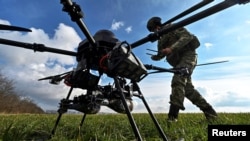
Two high-profile criminal cases against leading figures in Russia’s drone industry have highlighted claims by pro-war bloggers that corruption is undermining the country’s full-scale invasion of Ukraine.
The most recent case came with the arrest of two directors of a company called Drone Solutions on August 8. This followed the arrest of billionaire drone tycoon Valery Kustov in June.
Both cases relate to fraud charges, and in both instances drones developed by the companies had previously been demonstrated to Russian President Vladimir Putin as examples of homegrown innovation.
Drone Solutions presented its product, named Aist (Stork), to Putin in April. The company said the unmanned aerial vehicle (UAV) was designed for delivering medical and other supplies.
Now, company directors Irakli Khazalia and Vyacheslav Barbarov could face 10 years in prison on fraud charges. The details of the case are murky, but following the arrests, the head of a rival drone company was quick to crow.
“The unmanned aviation sector in our country is full of people who have no experience in aviation,” wrote Dmitry Tretyakov, whose company claims to be behind Russia’s first UAV with on-board AI.
“The main problem is the utter lack of professionalism, the lies, and the posturing of those in charge of this industry,” he added.

The other case involves Kustov, otherwise best known for manufacturing mayonnaise. He launched a new company, Transport of the Future, in 2023 in the car-production hub of Tolyatti (Togliatti), 800 kilometers east of Moscow.
The company’s website still has a big splash showing Putin visiting the plant in January 2025, presenting it as part of a national program he launched for drone innovation.
“By 2030, Russia should become one of the world’s leading technological innovators in the field of unmanned aerial systems,” Putin told industry leaders during the visit, according to a transcript on the Kremlin website.
Kustov’s company was allegedly buying Chinese drones and passing them off as its own. He’s been charged with embezzling government funds allocated for research and development. Other senior figures in the company have also been charged. Prosecutors allege the losses to the state budget were worth $105 million.
Pro-War Bloggers Speak Out
Russian pro-war bloggers have claimed that he earned $83,000 on each drone he bought in China and then sold to the Defense Ministry.
“The biggest anti-corruption crusaders in Russia today are the [pro-war] bloggers. They believe that Russia is losing the war because of corruption,” Ivan Filippov, an exiled Russian journalist and critic who analyses pro-Kremlin Telegram channels, told Current Time.
This belief has sometimes come at a price, with so-called Z bloggers getting detained for after reporting on corruption within the armed forces or criticizing the conduct of the war.
“Whenever there’s a story about corruption, especially in the army, especially related to state procurement, linked with defense issues and armaments, it makes them absolutely furious,” Filippov said.
As drone technology transformed the war, Russia at first lagged behind Ukraine in UAV capabilities. In response, it acquired thousands of units and technology from Iran and then developed its own homegrown production.
Russian drones now regularly pummel Ukrainian cities and Russia's Rubicon unit, which develops and buys new technology, has wreaked havoc on Ukrainian forces. But Ukraine still appears to have a technological edge that has not gone unnoticed among pro-war commentators in Russia.
Filippov pointed to Aleksei Chadayev, who referred to this in his Telegram channel in reference to the Kustov case.
Chadayev noted that Kustov’s company had tried, and failed, to develop a Russian equivalent of Ukraine’s Vampire drones -- nicknamed Baba Yaga, a mythical Slavic witch, by Russian soldiers.
Vampires carry a 15-kilogram payload over a range of up to 20 kilometers, with “high-resistance to electronic warfare” and “a bi-spectral camera for day and night missions,” according to the Ukrainian Defense Ministry.
“If [the drone] had flown well, the Russian Army would have had its own, mass produced, Baba Yaga,” wrote Chadayev. “But it didn’t fly.”
Russian Defense Minister Andrei Belousov took a similarly dim view of the drone, telling Putin at a meeting in June that it was “not a very high-quality product.”


