




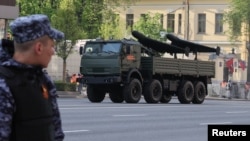
Iran has been a major supplier of military equipment to Russia in recent years, especially since the Kremlin launched its full-scale invasion of Ukraine in 2022, but experts have told RFE/RL that this support no longer plays a key role in Moscow's war effort.
Iranian missile sales to Russia, including air defense missiles and ballistic missiles, have totaled $2.7 billion since October 2021, according to a January 12 Bloomberg report citing an unnamed Western security official.
The volume of trade is not publicly disclosed by Moscow, and Iran denies supplying anything to Russia.
"So long as conflict persists between the parties, Iran will abstain from rendering any form of military assistance to either side," Iran's permanent mission to the United Nations said in a statement in May.

There is evidence to the contrary, particularly Russia's widespread use of Iranian Shahed attack drones in the early stages of the full-scale war. But the value of this support now seems much diminished.
Drones
"Even though there's still some transfers of Iranian drones, at least as late as last year, some newer drone designs that were still being transferred from Iran, I think we've long passed the peak of Iranian defense transfers to Russia," Hanna Notte, Eurasia program chief at the James Martin Center for Nonproliferation Studies, told RFE/RL on January 14.
Ruslan Suleymanov, an analyst at the New Eurasian Strategies Center, took a similar view.
"Russia is no longer as dependent on Iranian weapons as it was four years ago. The same Shahed drones are produced on Russian territory under the name Geran and…about 90 percent of the entire production cycle of those drones is already fully located in Russia, without Iran's assistance," he told Current Time on January 13.

Iran provided Russia with technology and training, and a plant at Alabuga in Russia's Tatarstan region is churning out Gerans.
According to Ukraine, Russia produces some 5,000 long-range drones of various types each month. This includes the Geran strike drone and the Gerbera, a drone without a warhead used as decoy to saturate Ukraine's air defenses.
Missiles
In April, General Christopher Cavoli, head of US Central Command at the time, told the US Senate Armed Services committee that "Iran also continued its material support for Russia, donating over 400 short-range ballistic missiles and hundreds of thousands of artillery shells."
In May, Reuters reported Iran would also send Fath-360 missile launchers, although Tehran denied this. Previously, in September 2024, Pentagon spokesman Pat Ryder said Fath 360 missiles had been delivered.
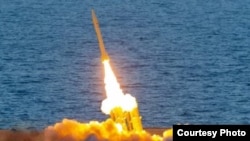
That was followed in October 2024 by US sanctions on two Russian shipping companies for delivering drone equipment and munitions across the Caspian Sea for use in Ukraine.
"The Department of State is taking action today to constrain further Iran's destabilizing activities, including its transfer of ballistic missiles to Russia," a statement said.
The European Union followed suit days later with sanctions on three Iranian airlines and two procurement firms "following Iran's missile and drone transfers to Russia."
But there have been no reports of Fath 360 being used in Ukraine. Notte said this may be because the Fath 360 launchers were never delivered or Russia didn't need to use them as it ramped up domestic production and took deliveries from North Korea.
A report in February last year by RUSI, a London-based think tank, noted Russia's Defense Ministry planned to produce some 750 ballistic and 560 cruise missiles in 2025. Since then, Ukrainian military intelligence has made higher estimates of output.
"The Russians may just simply not have needed to use these Iranian missiles," Notte said.
Munitions
Iran is estimated to have sent extensive supplies of ammunition and shells to Russia since 2022. A Wall Street Journal investigation in 2023 put the numbers at 300,000 artillery shells and around 1 million rounds of ammunition.
Ukrainian drone strikes in 2025 suggested military supplies were continuing. In April, Russian media reported the first attacks on the Caspian port of Olya, followed by reports of further strikes in August.
Olya has been identified a major hub for shipments of Iranian military supplies.
A report by the Kyiv School of Economics last year detailed volumes of explosives being transported by ship and rail from both Iran and North Korea. It said North Korean supplies now made up 58 percent of Russia's explosives imports.
Notte said that, likewise, North Korean shells and bullets had eclipsed Iranian supplies in scale.
"The Ukrainians estimated last year that 50 percent of all the ammunition that Russia used in Ukraine was DPRK (North Korea). So, my sense here is that once the DPRK came in as a major defense supply to Russia, there was just probably not a need to get Iranian ammunition," Notte said.

