




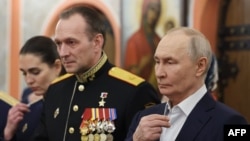
It was the first public work meeting for Russian President Vladimir Putin after the New Year.
No, the US raid on Venezuela, a close ally of Moscow, and the seizure of its president the previous week was not on the agenda -- at least not publicly.
Nor were the snowballing public protests roiling Iran, another vital ally for Moscow. Not even Cuba, whose government is under stress due to the Venezuela turmoil, was discussed.
The agenda for Putin's January 12 public meeting with a technocratic deputy prime minister was Russian manufacturing, along with the country's threadbare space program.
One may think a cascade of allies being destabilized or imploding would prompt a more robust response from Moscow. The Kremlin has nurtured those relationships for years, if not decades, partly for economic and military reasons, partly to outmaneuver the United States.
It has also for years railed against "color revolutions" -- anti-government demonstrations that it asserts are merely US-engineered efforts to undermine Moscow-friendly governments.
But the less-than-thundering public statements from Russian officials, not to mention crickets from Putin, on the events in Venezuela and Iran have raised eyebrows among Russia watchers.
"The Russians must say something on these issues, and so the [Foreign Ministry] will come with expected language and expected criticism, but overall the Russian system does not want to criticize the United States too brazenly, so that's why you have total silence from the Kremlin and the Putin," said Hanna Notte, director of the Eurasia Nonproliferation Program at the James Martin Center for Nonproliferation Studies.
"This US administration acting with impunity quite effectively, pursuing its interests, including with military means, and getting away with it; it also makes Russia look weak," Notte said. "I think Russia cannot really do anything to change the US course of action, or to sort of restrain it. And so in that kind of situation: what is Vladimir Putin going to say? And so he says nothing."
"I wouldn't say that they're being silent," said Nicole Grajewski, an expert on the Middle East and assistant professor at Sciences Po, the Paris university. "I would say that maybe we just aren't seeing what they're doing behind the scenes, especially in Iran."
Ruslan Suleymanov, a former journalist and expert on the Middle East, said the lack of angry denunciations regarding Iran, Venezuela, or even ousted Syria dictator Bashar al-Assad also reflects Moscow's overriding priority these days: Ukraine.
"The Kremlin is obviously preoccupied with completely different problems right now," Suleymanov, who is based in Germany with the New Eurasian Strategies Center, told Current Time.
"For Putin the capture of yet another village in Ukraine is far more important than saving Assad's regime, as we have seen, or Maduro in Venezuela, or even more so, Ayatollah Ali Khamenei in Iran."
'Categorically Unacceptable'
In the past, when a major geopolitical event such as a military attack, destabilizing anti-government protests, or a disputed election occurred and Washington was involved directly or indirectly, Russian officials would be quick to respond, calling for restraint or calling on outside countries -- read: the United States -- to butt out.
Putin's now-famous speech in Munich in 2007 ripping into US foreign policy was characteristic: "One state, the United States, has overstepped its national boundaries in every sphere."
Since US President Donald Trump's return to the White House last January, the Kremlin has tempered its harshest criticism of Washington while also turning its sights on Europe and NATO, particularly regarding the Ukraine war.
After US special forces swooped into Caracas on January 3, killing scores of guards seizing Nicolas Maduro and his wife, whisking them to a waiting US warship, Moscow's Foreign Ministry called it "an act of armed aggression…which gives rise to deep concern & warrants condemnation."
When US forces boarded and seized an oil tanker on January 7 that had departed waters off Venezuela a few weeks earlier, claiming it was sailing under a Russian flag, Moscow's first reaction came from the Transport Ministry in a legalistic post to Telegram that was then recirculated by the Foreign Ministry.

When two Russian citizens who were detained on the ship were released by US authorities, the ministry's sharp-tongued spokeswoman Maria Zakharova was effusive in thanking Trump by name.
In Iran, where anti-government protests have accelerated since demonstrations erupted on December 28, Russian public statements have been limited.
On January 12, the same day Trump warned that Washington was considering "several very tough options" against Iran, Sergei Shoigu, the head of Russia's Security Council, spoke by phone with his Iranian counterpart, Ali Larijani.
Shoigu, a longtime Putin confidant, condemned "yet another attempt by external forces to interfere in Iran's internal affairs."
A day later, the Foreign Ministry lashed out in more characteristic fashion, saying the White House threats toward Tehran were "categorically unacceptable."
Zakharova also characterized the Iranian protests as a "color revolution," a dog-whistle signaling that Moscow believes the demonstrations have been instigated by unspecified external forces.
'Iran Is Far More Important To Russia Than Venezuela Was'
Where the Kremlin is concerned, however, there's been nothing but crickets on the events of late.
Putin's January 12 meeting with Deputy Prime Minister Denis Manturov was largely technical and economic. No mention of any of the foreign upheaval.
At another public meeting, held on January 14, Putin discussed road safety with another deputy prime minister, and congratulated him for "achievements in the construction industry in 2025."
At least some of the explanation for the lack of bluster falls on Russian holidays. The first two weeks of January are typically a quiet period in Russia, due to New Year's and Orthodox Christmas.
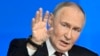
At a Kremlin welcoming ceremony for new foreign ambassadors on January 15, Putin gave a roughly 15-minute speech -- his longest public remarks since the holidays -- but made no mention of the recent upheaval, only an oblique reference to current US policies.
“Instead of dialogue between countries, we hear a monologue from states that, by the right of might, consider it legitimate to dictate their will, lecture others, and issue orders," he said.
The Ukraine invasion, which is nearing its fourth anniversary, is also an all-consuming priority for the Kremlin. The conflict has also limited Moscow's ability in other ways, sucking up men and weaponry, and distorting the Russian economy.
"There is no point for the Russians to focus too much attention on these matters," said Sergey Radchenko, a historian and professor at the Johns Hopkins School of Advanced International Studies. "If things go south, they can't do much about them. That's why they merely offered thoughts and prayers on the account of US/Israeli strikes on Iran, and remained quiet on Venezuela."
Like Notte, Radchenko argued that the Kremlin is trying to stay in the Trump administration's good graces.
"There is no longer a revolutionary world, and the Kremlin is very far from claiming any leadership role therein," Radchenko said. "So they can pragmatically play it down, understanding that raising havoc won't do them any good and possibly undermine Russia's diplomacy vis-a-vis the US in the Ukraine conflict."
The absence of angry rhetoric also fits a pattern, dating back to December 2024, when another stalwart ally -- Syria's Assad -- suddenly collapsed, depriving Moscow of a big Middle East partner that it had intervened to prop up a decade earlier.
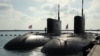
With Venezuela half a world away, Moscow's ability to affect events is even more limited.
If US actions in Venezuela lead to the collapse of Cuba's communist government, whose ties with Moscow date back to the 1960s, that will also be problematic. But Russia will likely be hamstrung in its response, experts said.
With Iran, however, which Russia shares a maritime border with, it's potentially more urgent, Grajewski said.
"If Iran falls, for Russia, this isn't just a humiliation, it's probably the last holdout of authoritarian countries that align with them…that isn't North Korea," she said.
"Iran is far more important to Russia than Venezuela was," Grajewski said. "So the Russians have a vested interest here in ensuring that the regime survives."