




It is said that politics makes strange bedfellows. Apparently international sanctions do too.
Russia and Iran, the world's two most-sanctioned nations, are deepening trade and financial ties to reduce their reliance on Western-dominated economic systems, a marriage of convenience through national currencies, direct banking links, and alternative transport routes.
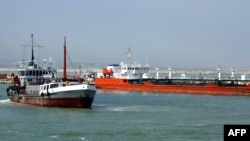
This deepening economic cooperation is perhaps most visible in the Caspian Sea, where shipping activity between Russia and Iran has increased as Moscow's war in Ukraine and Middle East tensions disrupt established trade routes.
According to data from Castellum, a global risk adviser, Russia is now the most-sanctioned nation in the world with more than 5,000 international actions against it, followed by Iran with some 3,600 designations.
"Russia's invasion of Ukraine and Iran's destabilization have simultaneously spotlighted Eurasia's strategic importance while testing the limits of the region's historic alignments," Tina Dolbaia and Leah Kieff of the Center for Strategic and International Studies (CSIS), said recently.
Officially recorded bilateral trade between the two nations relies heavily on agricultural commodities: Russia exports grain and vegetable oils to Iran, while Tehran supplies fruits and vegetables in return.
Moscow's exports also encompass heavy industrial goods, including metals, timber, and machinery.
But beyond this transparent commercial exchange, the economic relationship contains a strategic military component.

According to the independent London-based maritime intelligence provider Lloyd's List Intelligence, the number of active Russian- and Iranian-flagged vessels operating in the Caspian rose 21 percent year on year in August.
The increase began in March, following US and Israeli strikes on Iran that started on February 28 and disrupted traffic through the Strait of Hormuz. A US maritime blockade imposed in April further complicated Iranian shipping routes.
"The cargoes being transported are often difficult to identify," Lloyd's List reported, noting that trade data points to an increasing role for agricultural commodities.
Regional analyst Nitya Labh, who has written about the growth of Russia's and Iran's shadow fleets, points out that what began as an ad hoc practice involving a small handful of isolated nations has evolved into a massive, highly sophisticated global network.
"Today, estimates suggest the shadow fleet is over 1,300 vessels, accounting for at least one in every five oil tankers worldwide," Labh told RFE/RL.
Trade Has Grown Substantially
Russia's ambassador to Iran said in June that bilateral trade reached about $5.8 billion in 2025, up 21 percent from the previous year.
ProZerno, a Russian grain consultancy, reported that Iran imported 1.7 million tons of Russian wheat from July 2025 to January 2026, compared with 565,000 tons in the previous agricultural year.
Dolbaia, an associate fellow at CSIS, said agricultural products and foodstuffs dominate officially recorded trade. But the relationship also has a less transparent dimension involving military-related goods and efforts to limit exposure to Western sanctions.

Iran supplied Russia with attack drones early in Moscow's full-scale invasion of Ukraine, but Russia has since localized and improved production, the expert said.
She added that there have been reports of Russia sending drone components to Iran via the Caspian Sea.
Alternative Payments
The two countries are also trying to make payments without relying on Western financial channels.
They have expanded settlement in rubles and rials and connected their respective interbank financial messaging systems, allowing banks to communicate allowing banks to communicate without using SWIFT, the international network banks use to exchange payment instructions.
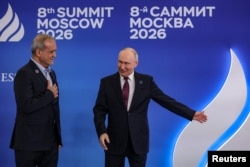
A CSIS report co-authored by Dolbaia in April identified the International North-South Transport Corridor as a central element of that strategy.
The planned road, rail, and maritime network would connect Russia with Iran and extend toward the Persian Gulf and India through the South Caucasus and Central Asia, although major infrastructure and geopolitical obstacles remain.
More Trade, Harder To Track
Lloyd's List Intelligence found that the number of active general cargo ships on the Caspian route rose from 105 in February to 215 in August. The segment recorded a 36 percent year-on-year increase in carrying capacity, according to the report.
But the corridor cannot easily absorb the volume of trade handled by major maritime routes.
Ships are constrained by the Volga-Don river system, shallow water, declining water levels, limited port capacity, and rail bottlenecks.
Tanker activity has increased from a very low base. Three Russian-flagged crude-oil tankers were recorded on the route in August.
Lloyd's List said all three switched off their Automatic Identification System (AIS) signals as they approached Russian and Iranian ports, then reappeared during transit, obscuring the visibility of their cargo movements.
Ships are not required to keep AIS switched on in all circumstances, making activity in the Caspian difficult to track.
The CSIS researchers argue that sanctions evasion is one of the drivers behind the countries' efforts to develop alternative trade infrastructure. But the existence of a new route, or a vessel going dark on its tracking system, does not by itself prove that a specific shipment is illicit.
Allegations of military transfers through the Caspian have added to scrutiny.
Kyiv has accused Moscow of using the route to funnel military equipment.
The Institute for the Study of War (ISW) reported that Ukraine targeted several sanctioned cargo vessels in the sea following assessments that they were transporting military cargo.
ISW analysis also notes that the covert route has been utilized to shift sensitive defense assets, drone components, and ammunition.
Lloyd's List said the allegations remain unconfirmed, and neither government has publicly acknowledged such transfers.
While the European Union expanded its enforcement in 2026 by passing its 20th sanctions package to target shadow fleet owners, managers, and service providers, physical interdictions carry severe military risks, regional expert Labh warns.
Labh cited the risks of maritime enforcement, pointing to a May 2025 incident in which a Russian Su-35 briefly entered Estonian airspace as Estonia attempted to stop a suspected Russian shadow-fleet tanker.
In August 2026, Russia President Vladimir Putin separately threatened retaliation for Western seizures of Russian commercial vessels, calling them "piracy."
But despite the growing bilateral trade, Dolbaia cautioned against overstating what Iran can do for Russia.
"For Russia, cooperation with China is far more important to withstand Western sanctions effects than cooperation with Iran," she told RFE/RL, noting that China buys Russian energy and supplies components used in Russia's defense sector.
Russia's trade with China surpasses $200 billion annually, dwarfing the single-digit billions traded with Iran.