




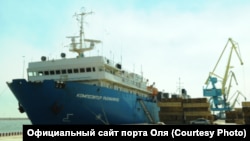
WASHINGTON -- The Caspian Sea is emerging as a potentially important logistics corridor in the expanding military relationship between Russia and Iran as they look to move goods beyond the reach of Western naval power.
The corridor opens a route that could allow Moscow and Tehran to exchange large quantities of cargo through an inland sea that Western navies cannot directly enter.
NBC News reported this week that it had obtained a document, which it confirmed with a Western official, that shows Moscow is already using the Caspian Sea to send military-related supplies to Iran.
Barry Pavel, a former senior director for defense policy and strategy at the US National Security Council, says the corridor deserves greater attention as the two countries -- both in the throes of war and international sanctions -- deepen their cooperation.

"As these two countries get closer together, one should expect increased traffic and use of this corridor for moving things back and forth -- whatever Iran's helping Russia with and vice versa," Pavel told RFE/RL.
Glen Howard, president of the Saratoga Foundation, added that the Caspian is a "natural kind of secure lifeline supply line that goes both ways for the Russians and for the Iranians."
That lifeline is shielded, which is exactly why Russia and Iran chose it.
Iran became a major supplier to Russia in its full-scale war against Ukraine, now in its fifth year, providing drones, military technology, and other equipment. Iran also helped Russia develop its Shahed drone production capabilities, including at the Alabuga Special Economic Zone.
Russia now appears to be returning that support as Iran seeks to restore capabilities depleted in fighting through almost six months of conflict with the United States and Israel.
Mystery Cargoes
The contents of individual shipments through the Caspian Sea are largely unknown, and therefore it's difficult to determine how much of the traffic is commercial, military-related, or raw materials. The route is also an economic artery, with grain and other goods moving between the two countries.
"We just don't know what's in the cargoes of those ships," Howard said. "But we know it's there. We know it's vibrant."
Senior US administration officials, speaking on condition of anonymity because of the sensitivity of the issue, told RFE/RL that Washington is closely watching the broader Russia-Iran military and logistics relationship and monitoring signs that wartime supply arrangements could develop into more durable infrastructure.
The officials declined to discuss intelligence or specific cargoes and would not confirm speculation about outside assistance to Ukraine's Caspian operations. They cautioned that the closed nature of the Caspian and limited public transparency make it difficult to determine the contents or purpose of individual shipments.
But they said the wider issue is increasingly relevant to US policymakers assessing how Russia, Iran, and other partners are building supply networks less vulnerable to sanctions, maritime pressure, and other forms of Western coercion.
The geography is crucial. Unlike the former so-called Syrian Express, which supplied Bashar al-Assad's government through Mediterranean Sea lanes and the Bosporus, the Caspian is landlocked.
Russian equipment can be loaded at ports such as Olya or Astrakhan and transported across the Caspian, making the route potentially useful for large shipments. Sea transport can also provide a relatively discreet way to move cargo.
"You can send more quantity, and you can also send it in a much quieter way," Howard said, adding, "It's very stealthy and secure."
"The US Navy cannot plow through the Caspian," he said, describing it as a protected Russian "bastion" that Western naval forces cannot directly enter.
On the flip side, the Caspian is not entirely beyond Ukraine's reach.
Ukraine's expanding long-range campaign against Russian military and economic targets has increasingly affected infrastructure around the northern Caspian, including in Dagestan. Last month Kyiv struck an Iranian commercial vessel, killing an Iranian sailor and prompting Tehran to demand compensation and threaten retaliation.

