



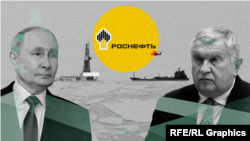
For the Kremlin, the giant Vostok Oil project in the frigid Far North is crucial to two goals: bolstering Russia’s presence in the Arctic and keeping production of the key export commodity going as reserves in more accessible parts of the country are depleted.
It’s also a case study of how a huge, state-run corporation like Rosneft -- headed by Igor Sechin, a longtime ally of President Vladimir Putin -- goes about putting such an enterprise in place amid increasingly tight Western sanctions over Russia’s war on Ukraine, an RFE/RL investigation indicates.
A web of contractors, suppliers, and others with links to the 10-trillion-ruble ($118 billion) project includes a billionaire Sechin associate, several companies connected to Rosneft, and the father of Putin’s purported partner, Alina Kabayeva, Systema, RFE/RL’s Russian investigative unit, discovered in conjunction with Arctida, an NGO focusing on the Russian Arctic.
The investigation by Systema and Arctida also shows how Rosneft and other companies working on the project have sought to adapt as increasingly tight sanctions imposed since Moscow launched its full-scale invasion of Ukraine in February 2022 led to the departure from Russia of some of the Western oil-services firms that had played important roles in oil exploration and drilling in the Russian Arctic.
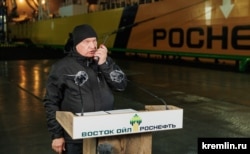
Speaking to a “freezing” Sechin by video-link at a September 5 opening ceremony for the first stage of the much-delayed project, for which Rosneft has built a 790-kilometer pipeline and a port on a frigid bay on the Taimyr Peninsula, Putin called it a “momentous event” for the Arctic region and for Russia.
Security And Sports Ties
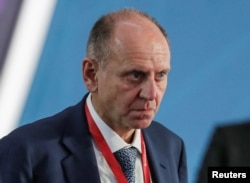
One key figure in the project is billionaire oil-pipe magnate Dmitry Pumyansky, who controlled a company called Sinarastroikomplekt in 2021, when it became the general contractor for Vostok Oil and the sole supplier of metal products -- mainly steel pipes -- for the venture.
Connections between Pumpyansky and Sechin date back at least to 2009, when Pumpyansky joined a government metals-industry commission headed by Sechin, who at the time was a deputy prime minister in the cabinet of Putin during his four-year stint as Russia’s prime minister.
Pumpyansky also met several times with socialist Venezuelan strongman Hugo Chavez, who died in 2013. Sechin, who became the Rosneft CEO in 2012, after Putin returned to the presidency -- cultivated ties and concluded oil deals with Caracas.

Pumpyansky was hit with Western sanctions in March 2022, shortly after Putin launched its all-out war against Ukraine, and soon withdrew as beneficiary of Sinarastroikomplekt and his main company, TMK -- at the time the world’s biggest steel-pipe producer -- and resigned from their boards. Later that year, his multimillion-dollar superyacht was seized by Gibraltar authorities and sold at auction.
Pumpyansky continued to take part in meetings with Putin, however, and in 2024 joined the supervisory board of the All- Russian Volleyball Federation, long headed by one of Putin’s closest confidants, Nikolai Patrushev, a former Federal Security Service (FSB) head and Russian Security Council chairman who is now a presidential aide. Sechin has been on the federation’s board since 2009.
Patrushev, Sechin, and Pumpyansky may also have had shared interests elsewhere -- in a company that is a contractor for Vostok Oil and is partially owned by the father of Kabayeva, the 2004 Olympic rhythmic gymnastics gold medalist who is widely reported to be Putin’s longtime partner and the mother of two of his children. Neither Putin nor Kabayeva has confirmed that they are a couple or that they have children together, and the Kremlin works hard to keep Putin’s private life under wraps.

Kabayeva's father, Marat Kabayev, is an Uzbekistan-born businessman and longtime soccer player and coach. In early 2026, he acquired a 25 percent stake in Taimyr Invest, a logistics company that works at Rosneft facilities.
When it interviewed Kabayev in March, Russian state news agency TASS said in a background note that Taimyr Invest delivers cargoes to Vostok Oil.
Financial documents from Vostok Oil, obtained by Systema and Arctida, confirm that the company has received payments from Vostok Oil, though the amount -- less than 200 million rubles ($2.4 million) from 2024-26 -- is a small fraction of its annual revenue of tens of billions of rubles.
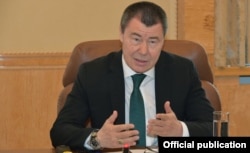
That, however, is only the payments directly from Vostok Oil. Arbitration court documents seen by Systema indicate that Sinarastroikomplekt is a key client of Taimyr Invest.
The same court documents show that as a result of tax audits in 2024-25, Taimyr Invest was asked to pay an additional 3 billion rubles ($35.5 million) in taxes and an 800-million- ruble ($9.5 million) penalty. Taimyr Invest challenged the tax claims in court, and the proceedings are ongoing. Taimyr Invest did not respond to a request for comment from Systema.
In recent years, Taimyr Invest has grown into a group of companies including the operator of a cargo fleet, a logistics firm, and a pipeline factory formerly controlled by Pumpyansky. The Taimyr Group website says its activities include support for Russia’s war on Ukraine and sponsorship of a soccer club in Ukraine’s Russian-occupied Luhansk region.
Oil Services, Oil Sanctions
Until 2022, four international oil-services companies -- Baker Hughes, Halliburton, Schlumberger, and Weatherford -- provided support including equipment and expertise for projects in the Russian Arctic, where everything from building infrastructure to drilling from oil can be more difficult than in warmer climes.
Sanctions imposed after Russia seized Ukraine’s Crimean Peninsula in 2014 had little effect on the project because while they barred the supply of drilling technology for operations on the Arctic Shelf and in deep water, Vostok Oil is on dry land.
The US and others stepped up sanctions after Putin launched the full-scale invasion of Ukraine in 2022, and Western oil-services companies began to pull out of Russia. In January 2025, the US Treasury Department slapped sanctions on the Rosneft-affiliated operator of Vostok Oil. A few weeks later, it also imposed a ban prohibiting US companies from providing oil services in Russia.
US-based Baker Hughes announced in the summer of 2022 that it was selling its Russian business to local management, and its assets in Russia were turned over to a Russian company, OFS Technologies.
In 2023-24, according to documents obtained by Systema and Arctida, OFS Technologies continued to import European and American equipment, but journalists found no evidence of imports of equipment linked to Baker Hughes after sanctions were tightened early in 2025.
A representative of Baker Hughes said the company does not control the activity of OFS Technologies, receives no economic benefit from OFS Technologies' contracts with Rosneft or Vostok Oil, and provides no equipment, technology, or services to Vostok Oil in violation of existing sanctions or export controls. OFS Technologies did not respond to questions.
US-based Halliburton left Russia around the same time, also handing its business there to the local management. The successor company, Burservis, received contracts with Vostok Oil worth over 8 billion rubles ($95 million) from late 2023 to spring 2026, according to Vostok Oil financial documents obtained by Systema and Arctida.
Halliburton and Burservis did not reply to requests for comment.
US-based Weatherford and SLB, formerly known as Schlumberger, halted shipments and suspended new investments and the deployment of new technology in Russia after the February 2022 invasion triggered a new wave of Western sanctions.
But their affiliates continued to operate in Russia, and Systema and Arctida found that they continued to collaborate with Vostok Oil.
Financial records from the project show that Weatherford’s Russian subsidiary received three payments totaling 58 million rubles ($688,000) for work on a well between May 2022 and February 2023. The records also show that, in 2026, the subsidiary transferred 8 million rubles ($54,000) to Vostok Oil as prepayment under a contract concluded in March of this year.
Weatherford did not reply to a request for comment.
The Financial Times reported in August 2025 that Weatherford was expanding its operations in Russia. A year earlier, the FT published a similar report about SLB, saying it had “signed new contracts and recruited hundreds of staff” in Russia.
Analyzing customs declarations, Systema and Arctida found evidence that SLB affiliates in Russia imported high-tech equipment worth more than 5.7 billion rubles from January 2024 to 2025, most of it made in China or India.
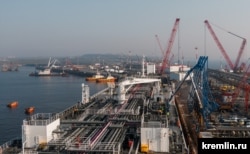
Financial records obtained by Systema and Arctida also indicate that Vostok Oil concluded a contract with the Moscow office of Panama-based Schlumberger Logelco for technical support for drilling in one of the sectors of the Arctic project, and that work and payments under the contract continued into 2026.
Financial and court records show that Netherlands-based Schlumberger Investment Services B.V., which is affiliated with SLB, owns more than 20 percent of Bashneftegeofizika, a Russian oil services company that conducts exploration at the Vostok Oil site.
A Russian court stated in one of its rulings that Schlumberger Investment Services B.V. was part of Schlumberger, but SLB itself did not list it among its subsidiaries.
From 2021 to 2025, before the US imposed sanctions on the operator of Vostok Oil that January, Bahneftegeofizika received nearly 13 billion rubles ($154 million) from Vostok Oil, financial records indicate.
Bashneftegeofizika has supported Russia’s war against Ukraine by supplying Russian forces with equipment. Putin awarded its former director, Rustem Adiyev, an Order for Services to the Fatherland medal in August 2022, six months into the full-scale invasion.
SLB and Bashneftegeofizika did not reply to requests for comment.