




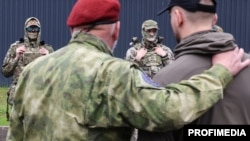
On July 23, men in civilian clothes showed up at security company employee Sergei Teplyakov's home and ordered him to produce his "internal passport," the main identification document in Russia.
"One of them introduced himself as the new district police officer and demanded his passport," said Oksana, one of several fellow residents of Bashmakovo, a town in the Penza region, who told RFE/RL about the incident.
When Teplyakov called the actual local police, she said, the men got angry, grabbed him, and tried to bundle him into their vehicle. But they released Teplyakov after his son arrived and began filming the incident.
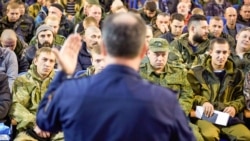

The following day, two men grabbed Aleksei Denisenko, another resident of the town of some 9,000 people, while he was cutting grass as part of court-ordered community service for drunk driving.
They told him it would be "worse" if he refused to go to the district administration, according to Artyom, a resident, who said a district administration employee was sitting in the vehicle and they drove away.
Denisenko's sister eventually intercepted the vehicle on the road toward the regional capital, forced it to a stop, and got him out, Artyom said. Artyom's real name and those of others who spoke to RFE/RL have been withheld for safety reasons.

Teplyakov and Denisenko are among a growing number of targets of what residents say is a push to round men up and pressure them -- often using deception, threats, and force -- into signing contracts to fight in Russia's war on Ukraine.
In response, residents have taken an unusual step against what they fear is a creeping military mobilization campaign: They have formed volunteer patrols to prevent neighbors from being swept up and sent to the front.
Volunteers coordinate through a group on VK, Russia's largest social media network, and take shifts to watch the streets around the clock.
"I joined the patrol almost immediately. Everything happened spontaneously," Bashmakovo resident Galina told RFE/RL earlier this month, adding that about 250 people had joined.
Mobilization Fears
Residents maintain it is more effective to intervene early, before a man is taken to a police station or recruitment office. Once he is there, Galina said, it may be too late.
The patrols in Bashmakovo are a local response to what observers, media reports, and anecdotal evidence suggest is an increasingly coercive campaign to get men to fight in Ukraine, where Russian forces are gaining ground very slowly and sometimes losing more ground than they gain, at a massive cost in terms of casualties.
Russia has sustained 1.4 million casualties, including as many as 450,000 soldiers killed, since the start of the full-scale invasion in February 2022, the Washington-based Center for Strategic and International Studies estimated in early summer. Some estimates are higher.

Ordering a mandatory call-up presents a political risk for Putin, particularly ahead of parliamentary elections on September 18-20, and the Kremlin has sought to tamp down fears that such a mobilization is in the works. Despite being labeled "partial," a mobilization that Putin decreed in September 2022 prompted hundreds of thousands of people to leave the country.
Since then, the Russian government has turned to an array of tactics, from financial incentives to the use of force, to replenish its forces in Ukraine. And it has turned to groups such as convicts and the homeless in search of manpower.
Several Russian regions reportedly increased signing bonuses sharply this year after reductions in 2025. In May, Putin signed a law forgiving up to 10 million rubles ($120,000) in unpaid debt for new military recruits and their spouses.
Meanwhile, media reports and on-the-ground accounts from regions across the country -- from Penza to the Far East, and elsewhere -- suggest the authorities are increasingly using pressure, deception, and raids to fill the ranks.
Force And Deception
Shortly after the close calls with Teplyakov and Denisenko, at least two other men from Bashmakovo were taken to a recruitment center in Penza and pressured into signing contracts.
Artyom said one of them was threatened with criminal prosecution over debts, even though his debts did not qualify for criminal liability.
"They simply deceived him," he said.
The allegations could not be independently verified. The head of the Bashmakovo district administration, Tamara Pavlutkina, did not respond to a request for comment from RFE/RL.
In Bashmakovo, the residents say they have managed to prevent at least five or six people from being taken away since the patrols started in July. They say the vehicles used in some of the incidents belonged to local government agencies, strongly suggesting that officials were involved.
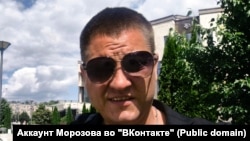
Similar pushback has emerged online.
In early August, Penza blogger Stanislav Morozov created a chat to help men detained and pressured into signing military contracts. More than 300 people joined on its first day and more than 1,200 within a week.
"We are doing this out of desperation," Morozov wrote. "Because we simply have no other way out. People are standing up for our basic rights and freedoms."
The Federal Security Service opened a criminal case against Morozov in July over a video, accusing him of inciting public attacks and calls to beat up enlistment office employees.

