The gnarly old poplar tree that survived the Battle of Stalingrad (Courtesy of visitvolgograd.info)
It survived one of World War II's bloodiest battles, in which some 2 million people are thought to have perished.
Although it was often pummeled by machine-gun fire and shrapnel, it stood firm as fierce fighting in Stalingrad raged around it for 200 days.
It's little wonder, therefore,that the gnarled,100-year-old poplar, which still stands in Volgograd (as Stalingrad is now known), has a special place in the hearts of the city's denizens.
The tree has been protected by the local council since 1993 and a special plaque at its base reminds passersby that the hoary old poplar "lived through the great battle."
Now, however, despite withstanding everything that Nazi Germany could throw at it, the tree seems set to finally succumb to the vicissitudes of old age.
As poplars usually only survive an average of 80 years, this centenarian is living on borrowed time.
Consequently, moves are afoot to clone the tree so that its legacy can be kept alive.
"In order to preserve the idea of continuity between generations, we have decided to use this tree’s genetic material to reproduce it," a spokesperson for Volgograd's environmental authority told the RIA Novosti news agency on June 18.
Scientists have already taken 10 samples from the tree and they hope to plant the first cloned saplings in downtown Volgograd by 2014.
In this way, it is hoped that this living reminder of the city's resilience and fortitude can be preserved for decades to come.
PHOTO GALLERY: The Battle of Stalingrad in pictures
75th Anniversary Of Victory In The Battle Of Stalingrad
1/15Stalingrad's main railway station in late 1942
The Battle of Stalingrad (August 23, 1942-February 2, 1943) was one of the most brutal and bloody battles of World War II. Germany's disastrously ill-fated attack on the Russian city is widely considered to have been a major turning point in the conflict, as its army suffered massive military losses and a huge psychological blow from which it never recovered.
Show moreShow less
2/15Street combat, October 1942
The Battle of Stalingrad (August 23, 1942-February 2, 1943) was one of the most brutal and bloody battles of World War II. Germany's disastrously ill-fated attack on the Russian city is widely considered to have been a major turning point in the conflict, as its army suffered massive military losses and a huge psychological blow from which it never recovered.
Show moreShow less
3/15A downed German fighter lies amid the ruins of Stalingrad. Huge air battles were waged over the city during the course of the siege.
The Battle of Stalingrad (August 23, 1942-February 2, 1943) was one of the most brutal and bloody battles of World War II. Germany's disastrously ill-fated attack on the Russian city is widely considered to have been a major turning point in the conflict, as its army suffered massive military losses and a huge psychological blow from which it never recovered.
Show moreShow less
4/15The brutal battle conditions were exacerbated by the harsh Russian winter.
The Battle of Stalingrad (August 23, 1942-February 2, 1943) was one of the most brutal and bloody battles of World War II. Germany's disastrously ill-fated attack on the Russian city is widely considered to have been a major turning point in the conflict, as its army suffered massive military losses and a huge psychological blow from which it never recovered.
Show moreShow less
5/15With supplies running out, most Germans were in an exhausted and emaciated condition by the time the fighting ended.
The Battle of Stalingrad (August 23, 1942-February 2, 1943) was one of the most brutal and bloody battles of World War II. Germany's disastrously ill-fated attack on the Russian city is widely considered to have been a major turning point in the conflict, as its army suffered massive military losses and a huge psychological blow from which it never recovered.
Show moreShow less
6/15Street fighting in the Battle of Stalingrad (TASS)
The Battle of Stalingrad (August 23, 1942-February 2, 1943) was one of the most brutal and bloody battles of World War II. Germany's disastrously ill-fated attack on the Russian city is widely considered to have been a major turning point in the conflict, as its army suffered massive military losses and a huge psychological blow from which it never recovered.
Show moreShow less
7/15Columns of Nazi German Wehrmacht soldiers pass through the streets of Stalingrad on February 1, 1943.
The Battle of Stalingrad (August 23, 1942-February 2, 1943) was one of the most brutal and bloody battles of World War II. Germany's disastrously ill-fated attack on the Russian city is widely considered to have been a major turning point in the conflict, as its army suffered massive military losses and a huge psychological blow from which it never recovered.
Show moreShow less
8/15Clouds of smoke rise from besieged Stalingrad in this aerial picture that reached London and the United States via "neutral sources." Despite repeated German bombings like this, the Russian city was still holding out. (White markings on the photo are not explained.) (AP)
The Battle of Stalingrad (August 23, 1942-February 2, 1943) was one of the most brutal and bloody battles of World War II. Germany's disastrously ill-fated attack on the Russian city is widely considered to have been a major turning point in the conflict, as its army suffered massive military losses and a huge psychological blow from which it never recovered.
Show moreShow less
9/15German troops passing through a wrecked generating station in the factory district of Stalingrad on December 28, 1942, where fierce fighting had been raging for months. (AP)
The Battle of Stalingrad (August 23, 1942-February 2, 1943) was one of the most brutal and bloody battles of World War II. Germany's disastrously ill-fated attack on the Russian city is widely considered to have been a major turning point in the conflict, as its army suffered massive military losses and a huge psychological blow from which it never recovered.
Show moreShow less
10/15Heavy fighting on the grounds of the Red October Factory during the Battle of Stalingrad. (TASS)
The Battle of Stalingrad (August 23, 1942-February 2, 1943) was one of the most brutal and bloody battles of World War II. Germany's disastrously ill-fated attack on the Russian city is widely considered to have been a major turning point in the conflict, as its army suffered massive military losses and a huge psychological blow from which it never recovered.
Show moreShow less
11/15German troops in Stalingrad on September 10, 1942. (TASS)
The Battle of Stalingrad (August 23, 1942-February 2, 1943) was one of the most brutal and bloody battles of World War II. Germany's disastrously ill-fated attack on the Russian city is widely considered to have been a major turning point in the conflict, as its army suffered massive military losses and a huge psychological blow from which it never recovered.
Show moreShow less
12/15Smoke billows from an industrial area of Stalingrad following an attack by German Stuka dive bombers on November 24, 1942, according to a caption passed through German government censors. (Buro Laux/F. Marquis de Costa via AP)
The Battle of Stalingrad (August 23, 1942-February 2, 1943) was one of the most brutal and bloody battles of World War II. Germany's disastrously ill-fated attack on the Russian city is widely considered to have been a major turning point in the conflict, as its army suffered massive military losses and a huge psychological blow from which it never recovered.
Show moreShow less
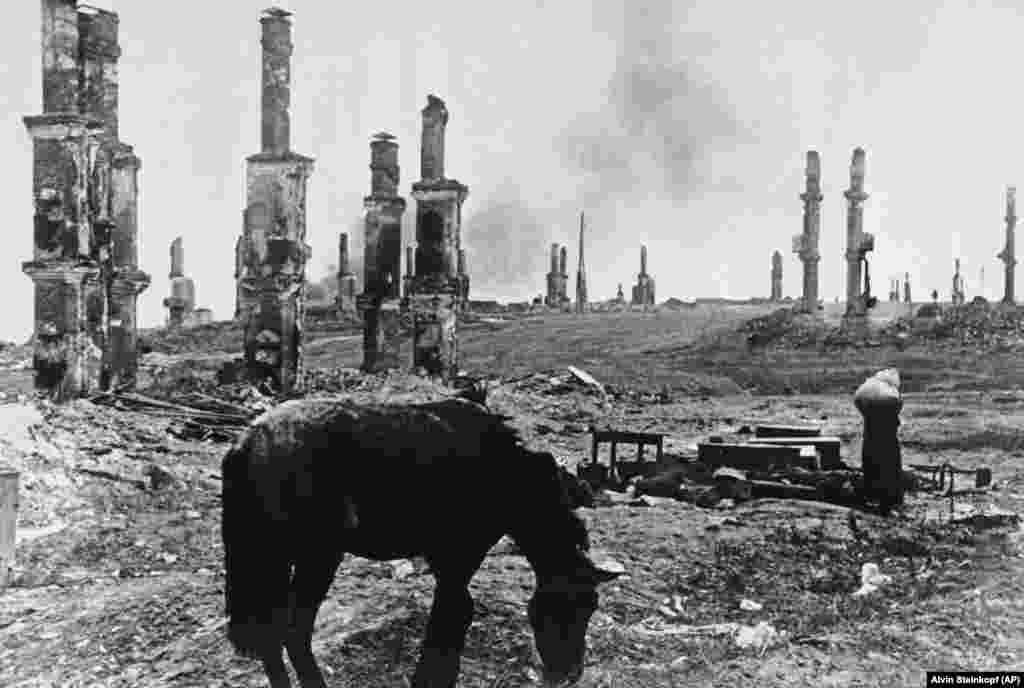
13/15An abandoned horse grazes among the ruins of Stalingrad on December 18, 1942. In the background, at right, Russian women leaving their battered homesteads make their way through the ruins. (AP/Alvin Steinkopf)
The Battle of Stalingrad (August 23, 1942-February 2, 1943) was one of the most brutal and bloody battles of World War II. Germany's disastrously ill-fated attack on the Russian city is widely considered to have been a major turning point in the conflict, as its army suffered massive military losses and a huge psychological blow from which it never recovered.
Show moreShow less
14/15German Field Marshal Friedrich Paulus is pictured after his capture at Stalingrad in early 1943. (TASS/A. Tarantsev)
The Battle of Stalingrad (August 23, 1942-February 2, 1943) was one of the most brutal and bloody battles of World War II. Germany's disastrously ill-fated attack on the Russian city is widely considered to have been a major turning point in the conflict, as its army suffered massive military losses and a huge psychological blow from which it never recovered.
Show moreShow less
15/15"Stalingrad Has Fallen" blares a newspaper the Germans printed in advance in Belgium in 1942. But as underground agents who confiscated the newspapers wrote in the lower left corner: "Mais Stalingrad Tient Toujours (But Stalingrad Stands Eternally)."
The Battle of Stalingrad (August 23, 1942-February 2, 1943) was one of the most brutal and bloody battles of World War II. Germany's disastrously ill-fated attack on the Russian city is widely considered to have been a major turning point in the conflict, as its army suffered massive military losses and a huge psychological blow from which it never recovered.