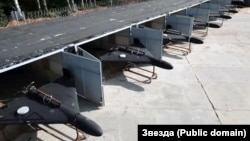
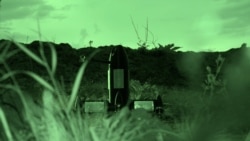
A jet-engine roar passes over a Ukrainian train stuck on the tracks during an air-raid alert as dozens of passengers shelter in a wooded area nearby. Moments later, a black drone strikes the locomotive, engulfing the train in an orange flash of fire and forcing passengers to flee.
The scene was captured in a video posted online by Ukrainian President Volodymyr Zelenskyy's adviser on defense technology, who said it might have been evidence of one of Russia's latest military inventions: the Shahed Seeker.
Also known by its Russian name, Geran-4, the drone is yet another modification of the Iranian-origin Shahed, which was provided to Moscow by Tehran in the early stages of Russia's full-scale invasion of Ukraine in 2022.
Back then, Shahed drones changed warfare, forcing the Ukrainian military to develop and adapt its air defenses in response to regular, large-scale, and often deadly air attacks.
Now they are being domestically produced by Russia in large numbers. And in the past year some of them, like the Geran-4, are now jet-powered and equipped with remote-control technology, leaving Kyiv with yet another technological challenge to address.

'Major Problem'
Well into the fifth year of its all-out war on Ukraine, Russia has not pulled back on its relentless bombing campaign aimed at forcing Kyiv to comply with President Vladimir Putin's demands.
However, over the past two months, there has been a notable change in approach: The number of Shahed drones largely launched in Russian air attacks on Ukraine has fallen by at least half. Yet the threat they pose has increased significantly.
While the majority of the drones used by Russia are still powered by internal combustion engines and have already become a common target for Ukrainian air defenses, the country's military reported the number of jet-powered drones had increased fivefold in July.
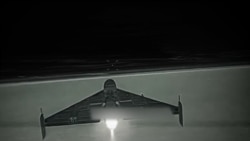

"It is a major problem," Danylo Shenhelskiy, a military liaison manager on a leading charity organization's project to counter Russian drones, told RFE/RL's Ukrainian Service. "In some areas, jet-powered Shaheds literally make up the majority of the Shaheds being used."
"We knew that these jet-powered Shaheds existed," Shenhelskiy said, but "there was a belief in military circles that the Russians wouldn't be able to scale up production because they would need a more expensive turbojet engine and so on."
As of now, three versions of Russia's jet-powered drones are known to the public: the Geran-3, Geran-4, and Geran-5. According to the Ukrainian military news site Militarniy, Russia produces nearly 3,000 of the latest two models every month.
While the Geran-3 is largely the same drone as previous versions of Russia's Shahed prototypes, modified only with a jet engine -- it has already been intercepted multiple times by the Ukrainian military -- the later versions have more significant upgrades, providing them with a considerable speed advantage.
According to an official from Ukraine's military intelligence agency, HUR, who spoke to RFE/RL's Ukrainian Service, the Geran-4 can reach speeds of around 350 kilometers per hour, while the Geran-5 can reach speeds of up to 600 kph and has a range of as far as 950 kilometers.
Unlike previous Geran versions, which were launched toward pre-programmed coordinates, the latest versions of these drones equipped with additional technology can be controlled online, the official said: "They have the capability to directly carry out a strike targeted by an operator."
The Russian military uses MESH modems for that purpose, the official said. At around $3,500 per unit, these modems are significantly more expensive than the Starlink terminals used by Ukraine, but they allow the drones to be operated from control stations located in Russia and in Russian-occupied parts of Ukraine.
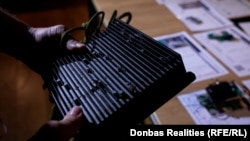
Receiving a signal from one of the stations, a MESH-equipped drone can then relay it to the next drone, which can pass it on to another, creating a chain. But the strength of the signal decreases with each hop, limiting the ability to control the drones over longer distances.
According to HUR, the Russian military is constantly searching for the most effective ways to use its new technology. For example, the drones cross the border at maximum speeds and at certain altitudes but approach their targets at extremely low altitudes.
"With stable communications and video guidance, they can strike higher-value targets because they can see the situation and prioritize which targets to hit. This is an even bigger problem for Ukrainian air defenses, as they can begin to adapt and respond more effectively," Shenhelskiy said.
"Unfortunately, there is no effective means that can intercept them on a large scale and with certainty," he said, adding that areas within 100 kilometers of the front line are the most at risk.
At the same time, the newest jet-powered Geran drones have already been spotted over Kyiv, nearly 200 kilometers from Russia's Bryansk region.
What Are The Targets?
One of the most frequent targets for Russia's jet-powered drones this summer has been Ukrainian energy infrastructure sites, French OSINT analyst Clement Molin told RFE/RL, warning that Russia's latest air strike campaign might be only the beginning.
"The aim is to disrupt the operation of Ukrainian industry," he said, adding that more attacks on energy sites could be expected in the autumn, as colder weather sets in.
"Jet-powered Geran 4/5s are a big emerging problem that will worsen through the winter as Russia produces more. Their increased speeds, payloads, and operator control at long distances complicates interception, but there are counters [in the works]," Dara Massicot, an expert on Russia's armed forces and senior fellow at the Carnegie Endowment for International Peace, wrote on X.
For the past four winters, the Russian military has sought to paralyze Ukraine's energy system, leaving thousands of people across the country with no heating and electricity amid freezing temperatures.
Molin, who has been following Russia's invasion of Ukraine on a daily basis, also said Russia has recently found another priority target for its jet-powered drones: logistics.
"Russia has indeed been using its drones against logistics facilities, which is quite a new phenomenon," he said.
"Russia struck around 60 warehouses across Ukraine [in July], including a supermarket, as well as numerous warehouses used for drone production and by the military and civilian industries across the country."
Molin also noted that Russia has carried out strikes on numerous transport facilities across Ukraine, including trains throughout the country -- particularly in the Dnipropetrovsk region -- as well as seaports in the southern cities of Odesa and Mykolayiv.
Russian strikes have caused significant delays to train schedules in recent months, disrupting some of the key routes in Ukraine from Kyiv and the eastern regions. These routes carry civilians out of frontline areas and across the country on a daily basis.
One Threat After Another
As the Russian military continues to advance its jet-powered drone technology, which largely outpaces Ukraine's drone interceptors, Kyiv is now racing to find a practical, cost-effective response amid a shortage of air-defense missiles capable of engaging targets traveling at such speeds.
"The entire military community working specifically on interception is currently focused on finding a solution to this problem," said Shenhelskiy.
He added that "many" Ukrainian manufacturers are experimenting with ways to intercept or shoot down the latest Geran drones alongside the military but said he did not "see any large-scale solution that works reliably and consistently."
While Ukraine's Defense Ministry announced on August 21 that the country had produced its first jet-powered drone interceptor, Alexa Spatium, Andriy Lebedenko, deputy commander-in-chief of the Armed Forces of Ukraine, said at a briefing in July that several parallel air-defense projects were under way in Ukraine.
Along with new interceptors, he said Kyiv was working to produce remote-controlled turrets, munitions with programmable fuses, upgrades to surface-to-air missile systems, and missile weaponry.
"We are developing aircraft-type platforms that will also carry weapons on board, allowing them to maneuver at speeds ranging from 300 to 800 kilometers per hour and at altitudes where jet-powered Shahed drones operate," Lebedenko said.
"In our view, this is the most scalable option. We can scale it up for mass production, and it is economically viable," he added.
Shenhelskiy, meanwhile, is already forecasting the next, even bigger threat from Russia: a hybrid drone-cruise missile. He says he believes it will replace jet-powered drones once Ukraine develops a sufficient response to them.
In fact, Russia is already using such a weapon, called the Banderol, mostly against the Kharkiv and Odesa regions, with HUR saying it "can be launched from a ground-based launch system," allowing the Russian military to have a limited number of its carriers.
"The more jet-powered Shaheds we intercept, the more Banderols there will be, and they are even harder to intercept," Shenhelskiy said. "They fly at 550-600 kilometers per hour, making them physically impossible to intercept with interceptor drones."
"Unfortunately, our air force and other air defense units still face a shortage of air defense missiles, and that is a problem.... Everyone wants it cheap and fast. But intercepting fast-moving targets will be expensive and take time," he added.
Experts agree that an additional part of the effort to counter the increasing number of strikes by jet-powered drones would be to target their launch stations, remote-control bases, and the Alabuga factory in Russia's Tatarstan region where the drones are produced.

"It is much harder to change the launch site if the launchers are hit. This would force the Russians to suspend launches for several days or weeks until they set up new ones. This is a major challenge for Ukraine," said Molin.
This year, Ukrainian forces have stepped up long- and medium-range strikes inside Russia and Russian-occupied Ukrainian territory, targeting military sites as well as oil and gas facilities in an effort to curb Moscow's energy revenues and push the Kremlin toward negotiations.
Western Parts, Russian Drones
While searching for a technological solution to counter Russia's jet-powered drones, Kyiv may also need to make a political push toward its Western partners: A significant share of the components used to produce Russia's Geran drones are of Western origin.
Russia seeks to produce some of the components for the drones domestically. But products from the United States, Japan, Germany, Switzerland, and other technologically advanced countries still make up the majority. Chinese components account for roughly one-third.
For example, a HUR official told RFE/RL that Russia has been using German-made Infineon components in the power distribution units of its first Geran drones and continues to use them in later models.
The original markings on Western-made components have been removed with lasers, he added: "By removing the markings, they conceal the batch number, which could be used to trace the particular supply chain, who the components reached, and through whom they ended up in Russia."

He said Kyiv sees some components disappear from Russia's drones only to reappear in later models, while others are eventually replaced with Chinese equivalents as Moscow builds complex supply chains involving third countries to procure the components it needs in the face of sanctions.
Despite this, the HUR official said the sanctions are "helpful," adding: "If sanctions were not working -- in terms of making it more difficult for them to access the components they need -- then both the number of systems and possibly some degree of further development would continue to grow."