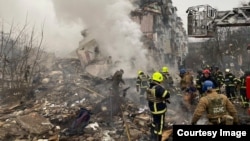
Ukrainian rescuers work at the site of a Russian missile strike on Poltava on February 1.
The Ukrainian military and President Volodymyr Zelenskyy said Russian forces had struck a boarding school in the Ukrainian-occupied Russian region of Kursk, killing at least four of “their own citizens” and injuring dozens as the civilian death toll continues to mount in the war.
The attack late on February 1 came hours after Kyiv reported that at least 10 people had been killed in a Russian attack on a residential area in the central Ukrainian city of Poltava.
"Russian aviation struck a boarding school in the town of Sudzha, Kursk region, with a guided aerial bomb. The strike was carried out on purpose," the Ukrainian General Staff said.
Unconfirmed reports indicated many of the victims were elderly people being temporarily housed in the building.
"At the time of the attack, dozens of local residents were inside the building preparing to evacuate. Everything possible is being done to rescue the survivors," the General Staff said, adding that at least 84 civilians “were rescued and provided with medical aid."
Zelenskyy wrote on X that "this is how Russia wages war -- Sudzha, Kursk region, Russian territory, a boarding school with civilians preparing to evacuate."
"A Russian aerial bomb. They destroyed the building even though dozens of civilians were there...Russian bombs destroy Ukrainian homes the same way. And even against their own civilians, the Russian army uses similar tactics.”
Russia's Defense Ministry later claimed that Ukrainian forces had carried out the attack.
"On February 1, the Ukrainian Armed Forces committed another war crime by launching a targeted missile strike on a boarding school in the city of Sudzha," a ministry statement said.
The claims could not independently be verified.
Ukraine in August seized a chunk of Russian territory in Kursk region as part of a successful surprise attack. After giving up nearly half those gains since then, Ukraine has recently launched a small-scale offensive in the region to take back territory.
Russian forces have utilized many of the estimated 11,000 North Korean troops deployed by Pyongyang to fight alongside the Kremlin’s forces in the Kursk region, although they have sufferied heavy losses, according to Western and Ukrainian officials.
Earlier, Ukrainian authorities said at least 10 people had been killed on a Russian attack on a residential building in the central Ukrainian city of Poltava
Images from AFP showed firefighters searching through the ruins of a building at the site.
"God saved us," Olena Svyryd, a resident of a neighboring building, told AFP.
"Opposite us on the fifth floor, a woman, my friend, was taken out. No, she's not alive. She was crushed by the wall. There were a lot of casualties," she said.
The United Nations on February 1 condemned a Russian air strike on the historic center of the southern Ukrainian city of Odesa. Buildings on the UNESCO World Heritage list were damaged and at least seven people were injured.
Deadly Russian air strikes were also reported in the large Ukrainian cities of Kharkiv and Sumy.
Fear And Hope As Battle For Ukraine’s Pokrovsk Looms
1/17A woman walks through a suburb of Pokrovsk in early December.
In the early days of the full-scale Russian invasion my colleagues and I had based ourselves in Pokrovsk, where cafes, restaurants, and shopping centers offered a respite from the front lines. Now we are watching it die. Since 2022, I’ve seen many cities overtaken by war. Some fall quickly and disappear from the headlines, others hold on to the bitter end: Syevyerodonetsk, Lysychansk, Soledar, and others familiar only to the military and journalists. Now Pokrovsk is on that list.
Russian forces have neared the outskirts of Pokrovsk, a strategically important transportation and logistics hub in Ukraine’s eastern Donetsk region. Once home to more than 60,000 people before Russia's full-scale invasion of Ukraine in February 2022, only a fraction of this population now remains in the embattled city. Photojournalist Serhiy Nuzhnenko recently visited Pokrovsk with a colleague from RFE/RL's Donbas.Realities and talked to some residents who are still living there.
Show moreShow less
2/17A woman rides past a cinema with a banner declaring “Pokrovsk -- the strength of the Cossack clan.”
A curfew is in place in Pokrovsk from three in the afternoon until 11 a.m. the next day. As soon as the curfew is lifted we park our car and walk through the city streets. Only a handful of people are out and about. In the background, artillery can be heard working to the south and east, where Russian forces are advancing from both directions.
Russian forces have neared the outskirts of Pokrovsk, a strategically important transportation and logistics hub in Ukraine’s eastern Donetsk region. Once home to more than 60,000 people before Russia's full-scale invasion of Ukraine in February 2022, only a fraction of this population now remains in the embattled city. Photojournalist Serhiy Nuzhnenko recently visited Pokrovsk with a colleague from RFE/RL's Donbas.Realities and talked to some residents who are still living there.
Show moreShow less
3/17Many shops here are closed and apparently abandoned. Svitlana Yaroslavovna (pictured) operates one that is still open, selling sweets, milk and sausage. “When it’s quiet, I get nervous. It feels like maybe the military are surrendering us. I hope they don’t,” she confides after making us coffee. “Because [the nearby settlements of] Novohrodivka and Selydove were both surrendered very quickly even though there were fortifications there. I’m not a soldier, but I wish they hadn’t allowed them to fall."
Russian forces have neared the outskirts of Pokrovsk, a strategically important transportation and logistics hub in Ukraine’s eastern Donetsk region. Once home to more than 60,000 people before Russia's full-scale invasion of Ukraine in February 2022, only a fraction of this population now remains in the embattled city. Photojournalist Serhiy Nuzhnenko recently visited Pokrovsk with a colleague from RFE/RL's Donbas.Realities and talked to some residents who are still living there.
Show moreShow less
4/17"Dragon's teeth" anti-tank obstacles in Pokrovsk.
Suppliers for Yaroslavovna's grocery shop still come every weekday, she tells us, but some drivers are afraid to come into the city center. “We meet them behind the bridge and transfer the products, then drive them in ourselves.”
If Russian troops keep pushing closer, Yaroslavovna says, “I’ll close the shop and flee with the dogs and cats that I’m looking after here. I definitely won’t live here under the Russians, if the front gets any closer. But for now, I’ll be here for as long as I can."
Russian forces have neared the outskirts of Pokrovsk, a strategically important transportation and logistics hub in Ukraine’s eastern Donetsk region. Once home to more than 60,000 people before Russia's full-scale invasion of Ukraine in February 2022, only a fraction of this population now remains in the embattled city. Photojournalist Serhiy Nuzhnenko recently visited Pokrovsk with a colleague from RFE/RL's Donbas.Realities and talked to some residents who are still living there.
Show moreShow less
5/17The city slowly comes to life as we continue walking, people are appearing, carrying water and food. A makeshift market is operating nearby. It feels almost like any normal winter morning in a provincial eastern town, only the booming of nearby explosions offers a constant reminder of the situation in Pokrovsk.
Russian forces have neared the outskirts of Pokrovsk, a strategically important transportation and logistics hub in Ukraine’s eastern Donetsk region. Once home to more than 60,000 people before Russia's full-scale invasion of Ukraine in February 2022, only a fraction of this population now remains in the embattled city. Photojournalist Serhiy Nuzhnenko recently visited Pokrovsk with a colleague from RFE/RL's Donbas.Realities and talked to some residents who are still living there.
Show moreShow less
6/17In some suburbs there is still electricity and gas, but central heating no longer operates in Pokrovsk. People warm their apartments with electric heaters or gas burners.
Russian forces have neared the outskirts of Pokrovsk, a strategically important transportation and logistics hub in Ukraine’s eastern Donetsk region. Once home to more than 60,000 people before Russia's full-scale invasion of Ukraine in February 2022, only a fraction of this population now remains in the embattled city. Photojournalist Serhiy Nuzhnenko recently visited Pokrovsk with a colleague from RFE/RL's Donbas.Realities and talked to some residents who are still living there.
Show moreShow less
7/17The still smoldering remains of a building in Pokrovsk that was wiped out by a Russian glide bomb.
Donetskoblhaz JSC, the company that supplies gas and electricity to Pokrovsk says it is becoming increasingly difficult for their repair crews to work amid frequent shelling. The company announced that, as of December 12, it would suspend gas supplies due to “the consequences of hostilities on the gas distribution system.”
Russian forces have neared the outskirts of Pokrovsk, a strategically important transportation and logistics hub in Ukraine’s eastern Donetsk region. Once home to more than 60,000 people before Russia's full-scale invasion of Ukraine in February 2022, only a fraction of this population now remains in the embattled city. Photojournalist Serhiy Nuzhnenko recently visited Pokrovsk with a colleague from RFE/RL's Donbas.Realities and talked to some residents who are still living there.
Show moreShow less
8/17A Pokrovsk resident collects water from one of a handful of supply points in the city.
One of the biggest challenges for Pokrovsk's residents is sourcing water. Locals say that Russian forces destroyed water pumping stations outside the city in August 2022, and since then most water has been sourced from tankers organized by local government and aid organizations.
Russian forces have neared the outskirts of Pokrovsk, a strategically important transportation and logistics hub in Ukraine’s eastern Donetsk region. Once home to more than 60,000 people before Russia's full-scale invasion of Ukraine in February 2022, only a fraction of this population now remains in the embattled city. Photojournalist Serhiy Nuzhnenko recently visited Pokrovsk with a colleague from RFE/RL's Donbas.Realities and talked to some residents who are still living there.
Show moreShow less
9/17Anton, who came to collect water on his day off.
The local man evacuated his family but has remained to work at a mine in Pokrovsk that was still in operation in early December. “I think everyone is considering leaving. Only those who are waiting [for a Russian takeover] are not," he says. "I hope [Ukraine's military] will drive them away, and we can continue to live here."
Russian forces have neared the outskirts of Pokrovsk, a strategically important transportation and logistics hub in Ukraine’s eastern Donetsk region. Once home to more than 60,000 people before Russia's full-scale invasion of Ukraine in February 2022, only a fraction of this population now remains in the embattled city. Photojournalist Serhiy Nuzhnenko recently visited Pokrovsk with a colleague from RFE/RL's Donbas.Realities and talked to some residents who are still living there.
Show moreShow less
10/17Vasyl, an elderly local crossing an empty street in Pokrovsk.
“My friends have gone to the Dnipropetrovsk region,” he tells us. “The poor are suffering everywhere. No one needs people. This is a fight for territory, not people. I am 81 years old. I think if [the Russians] restore order there will be heat, gas, and so on. I am being very frank, but, people will have one hell of a time surviving [until then].”
Russian forces have neared the outskirts of Pokrovsk, a strategically important transportation and logistics hub in Ukraine’s eastern Donetsk region. Once home to more than 60,000 people before Russia's full-scale invasion of Ukraine in February 2022, only a fraction of this population now remains in the embattled city. Photojournalist Serhiy Nuzhnenko recently visited Pokrovsk with a colleague from RFE/RL's Donbas.Realities and talked to some residents who are still living there.
Show moreShow less
11/17A printed sign announces “pharmacy working” in Pokrovsk.
Along with pharmacies, cafes, and a bookstore, the biggest surprise was an Apple Store that was still operating in early December. Though perhaps as I’m writing this it has already closed down.
Russian forces have neared the outskirts of Pokrovsk, a strategically important transportation and logistics hub in Ukraine’s eastern Donetsk region. Once home to more than 60,000 people before Russia's full-scale invasion of Ukraine in February 2022, only a fraction of this population now remains in the embattled city. Photojournalist Serhiy Nuzhnenko recently visited Pokrovsk with a colleague from RFE/RL's Donbas.Realities and talked to some residents who are still living there.
Show moreShow less
12/17Bells in the cathedral begin to ring, calling the faithful to prayer and momentarily drowning out the sounds of war. The bells frighten a flock of pigeons which flap into the air then settle on the Soviet-era apartment block whose windows are boarded up with chipboard.
Russian forces have neared the outskirts of Pokrovsk, a strategically important transportation and logistics hub in Ukraine’s eastern Donetsk region. Once home to more than 60,000 people before Russia's full-scale invasion of Ukraine in February 2022, only a fraction of this population now remains in the embattled city. Photojournalist Serhiy Nuzhnenko recently visited Pokrovsk with a colleague from RFE/RL's Donbas.Realities and talked to some residents who are still living there.
Show moreShow less
13/17A local woman walking her dog.
Even after covering the war for years, moments like this, showing hope for life amid destruction and death are always surprising. The animals seem to be accustomed to the backdrop of explosions and show no signs of fear.
Russian forces have neared the outskirts of Pokrovsk, a strategically important transportation and logistics hub in Ukraine’s eastern Donetsk region. Once home to more than 60,000 people before Russia's full-scale invasion of Ukraine in February 2022, only a fraction of this population now remains in the embattled city. Photojournalist Serhiy Nuzhnenko recently visited Pokrovsk with a colleague from RFE/RL's Donbas.Realities and talked to some residents who are still living there.
Show moreShow less
14/17"We live, we keep hoping,” Valentyna Vasylivna (pictured) tells us as she walks through her war-damaged city. “I have a pension of 2,700 hryvnias ($65) per month. Where would I go? My apartment walls keep me warm, this is my home.”
Russian forces have neared the outskirts of Pokrovsk, a strategically important transportation and logistics hub in Ukraine’s eastern Donetsk region. Once home to more than 60,000 people before Russia's full-scale invasion of Ukraine in February 2022, only a fraction of this population now remains in the embattled city. Photojournalist Serhiy Nuzhnenko recently visited Pokrovsk with a colleague from RFE/RL's Donbas.Realities and talked to some residents who are still living there.
Show moreShow less
15/17At Pokrovsk Railway Station the platforms are empty. This homeless man was trying to stay warm in a sleeping bag, and to get some sleep.
Russian forces have neared the outskirts of Pokrovsk, a strategically important transportation and logistics hub in Ukraine’s eastern Donetsk region. Once home to more than 60,000 people before Russia's full-scale invasion of Ukraine in February 2022, only a fraction of this population now remains in the embattled city. Photojournalist Serhiy Nuzhnenko recently visited Pokrovsk with a colleague from RFE/RL's Donbas.Realities and talked to some residents who are still living there.
Show moreShow less
16/17A man pushes a load of firewood. Behind him is the road towards Shevchenko, where Russian forces are currently advancing from the south.
Some civilians we spoke to told us of friends and neighbours who are returning to Pokrovsk despite the city's precarious situation. Some couldn't find work elsewhere and ran out of money; others couldn't get used to living away from their hometown. Many say the only state help that registered refugees receive is a payment of 11,000 hryvna, ($265) and those people who leave by their own means cannot even count on this.
Russian forces have neared the outskirts of Pokrovsk, a strategically important transportation and logistics hub in Ukraine’s eastern Donetsk region. Once home to more than 60,000 people before Russia's full-scale invasion of Ukraine in February 2022, only a fraction of this population now remains in the embattled city. Photojournalist Serhiy Nuzhnenko recently visited Pokrovsk with a colleague from RFE/RL's Donbas.Realities and talked to some residents who are still living there.
Show moreShow less
17/17A road sign for Pokrovsk on the outskirts of the city.
We leave Pokrovsk with heavy hearts. It seems likely we could return soon to the city to film street battles. We remember the words of shopkeeper Svitlana Yaroslavovna: "I hold on to my faith in God, and the armed forces of Ukraine, this is where I place my hope."
Russian forces have neared the outskirts of Pokrovsk, a strategically important transportation and logistics hub in Ukraine’s eastern Donetsk region. Once home to more than 60,000 people before Russia's full-scale invasion of Ukraine in February 2022, only a fraction of this population now remains in the embattled city. Photojournalist Serhiy Nuzhnenko recently visited Pokrovsk with a colleague from RFE/RL's Donbas.Realities and talked to some residents who are still living there.
Show moreShow less
Previous slide
Next slide
Also on February 1, the General Staff of Ukraine's armed forces reported 134 combat encounters over the previous 24 hours.
According to Ukraine's Energy Ministry, Russia has launched more than 1,000 strikes on Ukrainian energy infrastructure facilities since October 2022. In 2024 alone, nine gigawatts of generating capacity were reportedly lost due to the strikes, amounting to roughly half of Ukraine's peak winter demand.
RFE/RL's Ukrainian Service has seen its audience grow significantly since Russia's full-scale invasion in February 2022 and is among the most cited media outlets in the country. Its bold, in-depth reporting from the front lines has won many accolades and awards. Its comprehensive coverage also includes award-winning reporting by the Donbas.Realities and Crimea.Realities projects and the Schemes investigative unit.







![Many shops here are closed and apparently abandoned. Svitlana Yaroslavovna (pictured) operates one that is still open, selling sweets, milk and sausage. “When it’s quiet, I get nervous. It feels like maybe the military are surrendering us. I hope they don’t,” she confides after making us coffee. “Because [the nearby settlements of] Novohrodivka and Selydove were both surrendered very quickly even though there were fortifications there. I’m not a soldier, but I wish they hadn’t allowed them to fall." ](https://gdb.rferl.org/07682f19-0cca-4699-bb49-de631d02fd62_w1024_q10_s.jpg)


![Anton, who came to collect water on his day off.<br />
<br />
The local man evacuated his family but has remained to work at a mine in Pokrovsk that was still in operation in early December. “I think everyone is considering leaving. Only those who are waiting [for a Russian takeover] are not," he says. "I hope [Ukraine's military] will drive them away, and we can continue to live here."](https://gdb.rferl.org/55cfa829-1dc1-446b-ad5b-7f77dc02716d_w1024_q10_s.jpg)
![Vasyl, an elderly local crossing an empty street in Pokrovsk.<br />
<br />
“My friends have gone to the Dnipropetrovsk region,” he tells us. “The poor are suffering everywhere. No one needs people. This is a fight for territory, not people. I am 81 years old. I think if [the Russians] restore order there will be heat, gas, and so on. I am being very frank, but, people will have one hell of a time surviving [until then].” ](https://gdb.rferl.org/8610c9a8-c9a7-426e-9426-334a2bc9176d_w1024_q10_s.jpg)



