




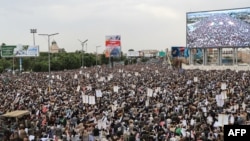
Islamabad has condemned attacks by Iran-backed Houthi rebels on Saudi-flagged vessels in the Red Sea. It also warned that any aggressive actions toward Pakistan-flagged vessels or the country's maritime interests would be regarded as a “grave threat” that may result in “lawful use of force.”
The Yemen-based Houthi militia said last week that it would impose a blockade on ships from Saudi Arabia -- the world's biggest oil exporter -- if they tried to pass through the Red Sea. In the early hours of July 23, it claimed to have hit two Saudi vessels in transit.
“Pakistan unequivocally condemns the continued threats by the Houthis against the Kingdom of Saudi Arabia and commercial shipping in the Red Sea, which we have stated endanger regional security, freedom of navigation, and global trade,” Pakistan’s foreign office spokesman, Tahir Andrabi, told journalists in Islamabad on July 23.

Pakistan, a key mediator in the US-Iran conflict, is also an ally of Saudi Arabia. A Strategic Mutual Defense Agreement (SMDA) signed between Saudi Arabia and Pakistan in September last year states that “any aggression against either country shall be considered aggression against both countries.”
The Kingdom has been redirecting its oil exports from the Persian Gulf to the Red Sea following Iran’s blockade of the Strait of Hormuz, a narrow waterway that normally accounts for one-fifth of the world's oil supplies.
“Pakistan remains deeply concerned by attempts to draw the Kingdom of Saudi Arabia into the Middle East conflict and reiterates its unwavering support for the Kingdom's security, sovereignty, and territorial integrity,” Andrabi told journalists during his weekly briefing.
'A Red Line'
Pakistan’s stern warning came less than 24 hours after Iranian Interior Minister Eskandar Momeni concluded a two-day official visit to Islamabad where he held meetings with top officials, including Prime Minister Shehbaz Sharif and the country’s powerful army chief, Asim Munir.
Asked about the “thin line” between Pakistan’s role as a mediator in the ongoing Middle East conflict and its partnership with Saudi Arabia, Andrabi said he did not think there was a thin line when it comes to defending “our national security and our assets.”
“This is not a thin line; this is a red line,” he said, adding that “this red line is strictly within the context of our own national security.”
Asked about the presence or deployment of Pakistani naval forces in the Red Sea, he said “this is a matter of operational details.”
Saudi-Pakistan defense cooperation dates back to the 1960s and Pakistani military trainers and advisers have been training Saudi armed forces since the 1980s.
In April, amid the escalating conflict in the Middle East, Saudi Arabia announced the arrival of Pakistani armed forces, including jet fighters and support aircraft, at Saudi Arabia’s King Abdulaziz Air Base.
Recent reports suggest that approximately 8,000 Pakistani troops have been deployed in Saudi Arabia with a squadron of the JF-17 fighter jets, drones and an air-defense system.
Saudi Arabia has also repeatedly provided financial support to Pakistan's cash-strapped economy. In April, Riyadh pledged an additional $3 billion in deposits and extended a separate $5 billion deposit facility for three years, while continuing to supply petroleum to Pakistan on deferred payment terms to ease pressure on the country's foreign exchange reserves.
On July 23, Pakistani Prime Minister Sharif called Saudi Crown Prince Muhammad bin Salman to reaffirm his country’s solidarity with the Kingdom.
In a social media post the same day, Sharif called the Houthi attacks on Saudi ships “unacceptable,” saying they “violate international law, threaten freedom of navigation and undermine regional peace and security.”
Saudi state media later provided details of one of the Houthi attacks, confirming on July 23 that a vessel owned by a Saudi company had been struck in the Red Sea. Quoting official sources, they said the ship ENCELIA was hit by the rebels, resulting in a fire at the bow of the vessel.
The Houthis, also known as the Zaydi Shia Islamist armed group, emerged in northern Yemen in the 1990s. They seized the Yemeni capital, Sanaa, in 2014 and currently control most of Yemen’s northwest, including the Hodeibah Red Sea Port.
Analysts believe the recent escalation by the Houthis is an attempt by the Iranian regime to drag Saudi Arabia into the conflict.
“That is a dangerous gamble because Riyadh has spent nearly a decade avoiding the wider regional war that Tehran increasingly appears determined to provoke,” says Nawaf Obaid, Senior Fellow at the London King’s College.
“By threatening shipping in both the Strait of Hormuz and Bab al-Mandeb [Strait], Tehran seeks to pressure Saudi Arabia from its eastern and western maritime gateways while raising the cost of regional stability,” Obaid wrote on July 21. “That strategy carries consequences far beyond the region.”

