




WASHINGTON -- This wasn't the first time during Russia's full-scale invasion that Ukrainian officials came to Washington seeking weapons, ammunition, and financial support. But the message was markedly different.
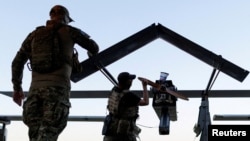
According to lawmakers, organizers, and participants interviewed by RFE/RL, two frontline Ukrainian drone commanders visited Capitol Hill on July 29 not to ask for more aid but to explain what the United States can learn from nearly five years of fighting the world's first large-scale drone war.
The closed-door Senate Republican Steering Committee luncheon, chaired by Senator Rick Scott of Florida, brought together almost every Republican senator for an unusually candid briefing on the changing nature of warfare seen in the more than four years of combat in Ukraine.

The meeting coincided with President Volodymyr Zelenskyy's visit to Washington and came as Kyiv and Washington negotiate a broader drone cooperation agreement after signing an initial framework earlier this summer.
RFE/RL has learned that the roughly 30-minute presentation focused less on specific weapons than on the operational lessons Ukraine has learned through constant battlefield adaptation.
The commanders described how unmanned systems have transformed combat, explained how drones have isolated Crimea without major ground offensives, outlined the role played by Iran, North Korea, China, and other actors supporting Russia, and argued that Ukraine's experience has implications far beyond the current war -- including for US homeland security and future conflicts involving Iran or Taiwan.
Several participants told RFE/RL the most important takeaway from the meeting was not Ukraine's drone technology itself, but the military thinking behind it.
"I invited two Ukrainian commanders here to explain what they've done with their drone technology and their warfighting, and you really have to admire them," Scott told RFE/RL, adding that the quality of their operators was impressive.
Scott recalled one commander describing how a force of roughly 2,000 personnel had destroyed nearly $15 billion worth of Russian military equipment.
Another commander, leading a unit accounting for only a small share of Ukraine's defense budget, said his force had inflicted roughly 30 percent of Russia's battlefield losses through autonomous systems, highly trained operators and relentless adaptation.
"The people operating the drones are talking directly to the people building the technology," Scott said. "There's incremental improvement day after day after day."


The observation that Ukraine's greatest comparative advantage is not manufacturing but human capital reflects a broader shift taking place in Washington.
For years, debate centered on how quickly the United States could arm Ukraine. Increasingly, some lawmakers believe the United States must also absorb lessons from Ukraine's battlefield experience.
Scott drew a stark comparison between the two countries' drone production capacities. "Ukraine is going to build over 5 million drones this year. We'll build less than 100,000."
The challenge, he argued, is as much institutional as it is technological.
"We've got to make decisions faster in our military-industrial complex.... We've got to focus on what's important now, not five years from now."
That shift was intentional, according to Alik Kasman, chief strategy officer at the Peace Through Strength Institute, which helped organize the Senate meeting.
"This trip wasn't about putting out a request," Kasman told RFE/RL. "It was more about what Ukraine can contribute."
Kasman acknowledged the meetings produced no formal commitments. "Getting a commitment from any politician is like a moonshot," he joked.
Instead, he said, the delegation's objective was to convince policymakers that Ukraine should no longer be treated simply as a recipient of military aid.

"My personal vision is that, in the fifth year of the war, Ukraine should not be seen as a beggar asking for assistance," he said. "Ukraine should be seen as a partner."
Ukraine's drone revolution, Kasman said, accelerated after delays in US military assistance in late 2023 and early 2024 forced Kyiv to find cheaper alternatives to conventional weapons.
Russia's subsequent embrace of drones despite possessing large stocks of traditional munitions demonstrates, he argued, that autonomous systems have become central rather than complementary to modern warfare.
The implications extend beyond Ukraine. Kasman argued that recent US operations in the Middle East have highlighted weaknesses in America's own force structure.
Using multimillion-dollar Patriot interceptors against drones costing tens of thousands of dollars, he said, is economically unsustainable: "The math doesn't work."
Ukraine, Kasman argued, can offer something more valuable than individual technologies. "It's not only technology. It's the know-how, the ecosystem around it -- all of it."
Bill Cole, founder of the Peace Through Strength Institute and another organizer of the meeting, said the Senate briefing was framed around one concept: "Doctrine."
"Modern warfare is not about the drone," Cole told RFE/RL. "It's about shifting your doctrine."

According to Cole, Ukrainian commanders emphasized that today's battlefield is saturated by roughly 10,000 drone sorties every day, forcing militaries to abandon procurement cycles measured in years and adopt operational models that evolve in weeks.
The commanders described an almost continuous feedback loop linking frontline operators with software developers and manufacturers, allowing systems to be modified in real time as Russian tactics evolve.
That model, rather than any individual platform, was presented as Ukraine's most valuable export.
Cole argued that many Western militaries remain focused on buying new equipment when they should be redesigning how their forces fight.
"You may have to buy something knowing it'll be obsolete in three months," he said.
The discussions unfolded as Russia intensifies pressure beyond Ukraine's borders.
On August 6, Senate Armed Services Committee Chairman Roger Wicker warned that Russian missile and drone incidents involving Poland and Romania reflected deliberate efforts to intimidate NATO, arguing that Moscow "only understands strength and cost imposition."
Other Republicans echoed the argument that cooperation with Kyiv has indeed become reciprocal.
"Ukraine's been very impressive...particularly in drone technology," Senator John Curtis of Utah told RFE/RL. "The fact that we have an opportunity to share that with them and learn shows how valuable allies can work together and be mutually beneficial."
Kasman warned that delays in implementing a broader US-Ukraine drone partnership would have consequences well beyond Eastern Europe.
"Any delay is very damaging," Kasman said.

