




BELGRADE -- Human rights groups say dozens of Bangladeshi workers employed at a Chinese-owned tire factory in northeastern Serbia were subjected to labor abuses that may amount to human trafficking, renewing scrutiny of a flagship Chinese investment that has faced years of controversy over its treatment of foreign workers.
Watchdog groups warned on January 30 that the Chinese tire factory Linglong has "tightened control and retaliation" against workers from Bangladesh, following reports earlier this week about the violations of their rights, including allegations of human trafficking and labor violations at the facility near the city of Zrenjanin.
"Workers report that their phones are sealed with red stickers, that photographing, recording, or taking notes is prohibited, and that factory entry passes are now being strictly enforced as a means of control," the Zrenjanin Social Forum, a local NGO focused on workers rights, said in a statement to RFE/RL.
The NGO, together with activists from the organization ASTRA, a Serbian watchdog group that supports victims of human trafficking, first reported suspicions of human trafficking and exploitation of several dozen workers from Bangladesh to Serbian state institutions.
“A number of workers, with legal assistance, managed to receive their outstanding wages, and all workers had their passports returned,” Marija Andelkovic, the director of Astra, told RFE/RL. She added that several workers were transferred to Serbia’s state-run Center for the Protection of Victims of Human Trafficking.
According to Astra, who first came forward with the allegations in a statement to RFE/RL, more than 40 Bangladeshi workers arrived in Serbia in June 2025 after being recruited by labor agencies in Bangladesh.
The case is now under review, Serbian authorities said, but no formal charges have been announced.
Many workers took on debts of up to $10,000 to secure the jobs, a practice rights groups say left them vulnerable to exploitation before they even arrived. Many workers also had their passports confiscated upon arriving in Serbia to work at the factory.
The allegations are the latest in a series of claims of forced labor linked to the Linglong factory, a cornerstone of Serbia’s economic partnership with China. Similar accusations previously involved Vietnamese and Indian workers, which prompted warnings from international bodies, including the European Parliament and the United Nations Human Rights Committee.

The Bangladeshi workers declined to speak to RFE/RL, citing fear for their safety. Linglong did not respond to requests for comment.
Linglong officially opened its Serbian plant in September 2024 after five years of construction. Valued at roughly $950 million, the project was declared one of national importance by the Serbian government and is considered a pillar of Belgrade’s deepening economic and political ties with Beijing.
Recruitment, Debt, And Confiscated Passports
Since reaching Serbia, the workers were employed at Linglong’s production facilities, though the company does not appear as their employer in contracts reviewed by NGOs.
Instead, the documents list a Serbian intermediary company, Mega Green Plus, based in the village of Basaid, about 30 kilometers from Zrenjanin.
Mega Green Plus, founded in late 2024 and owned by a Chinese national, did not respond to RFE/RL’s questions. Public records show it reported a small financial loss in 2024 and list no other information about staffing levels or licenses to recruit foreign labor.

Workers told human rights groups that they were paid below Serbia’s legal minimum wage of about $660 per month and were not compensated for overtime, which is illegal under Serbian law. NGOs involved in the case also said workers’ passports were held by their employer for months.
“When some workers demanded unpaid wages or the return of their documents, they were subjected to intimidation and threats,” Tara Rukeci Milivojevic of the Zrenjanin Social Forum, a local NGO that has documented labor abuses at the factory for years, told RFE/RL.
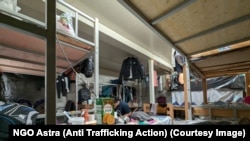
Photographs shared with RFE/RL by NGOs show cramped container housing near the factory, with multiple bunk beds crowded into single rooms. Activists said six to seven workers often shared a room, sleeping on beds without mattresses and using electric heaters near bedding during winter.
“They sleep, cook, and wash clothes in the same space,” Rukeci Milivojevic said, adding that workers complained of poor food, unhygienic toilets, and leaking pipes.
A Factory Under Global Scrutiny
The Higher Public Prosecutor’s Office in Zrenjanin said police, labor inspectors, and the anti-trafficking center are involved in reviewing the case but offered no timeline for findings. Other state institutions did not respond to RFE/RL’s request for comment.
Rights groups criticized what they described as a pattern of delayed or incomplete investigations in previous cases at Linglong.

“The fact that some workers received partial payments does not mean the case is resolved,” Rukeci Milivojevic said. “There are still serious indications that criminal offenses may have been committed.”
Due to past controversy, US Customs and Border Protection (CBP) issued a withhold release order in December 2025 on the import of car tires produced by Linglong in Serbia, citing allegations that they were made using forced labor.
Serbian President Aleksandar Vucic dismissed those allegations following the US restrictions.
Rights groups say the new allegations involving Bangladeshi workers suggest that abusive labor practices at the Linglong factory are not isolated incidents but part of a recurring pattern.
“Inhumane conditions keep repeating,” Rukeci Milivojevic said. “And the state’s response remains inadequate.”