




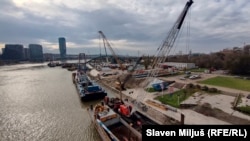
BELGRADE -- Construction has begun to replace Serbia's iconic Sava Bridge, but the government's refusal to fully disclose its agreements with the Chinese companies involved is fueling opposition to the project and raising transparency questions over how the contracts were awarded.
China State Construction Engineering (CSEC), one of the two Chinese state-owned firms participating in the undertaking, announced that the installation of the steel structures on the new 420-meter bridge in the heart of the capital, Belgrade, began on December 5.

PowerChina, a massive state-owned Chinese conglomerate and one of the world's largest engineering, procurement, and construction firms, is the main contractor. It was involved in tearing down the old Sava Bridge in July and is building the new 94.1 million euro ($109 million) bridge, which is scheduled to be completed by the end of 2026.
But the absence of any public bidding for the contracts, which could have implications for the project's overall cost and quality, has raised transparency questions.


That's a particularly controversial issue in Serbia since the canopy of a railway station in the city of Novi Sad collapsed in November 2024 and killed 16 people. The incident sparked massive protests and led to the resignation of Prime Minister Milos Vucevic in January. Demonstrators blamed corruption and poor construction for the collapse.
Several contractors, including Chinese companies, were involved in reconstructing the railway station. Serbian authorities insisted the Chinese consortium of China Railway International Company (CRIC) and China Communications Construction Company (CCCC), two Chinese contractors, were not to blame and both firms stated the station's concrete canopy was not part of the reconstruction work they carried out.

An investigation into the incident was eventually launched, with the prosecution accusing some Serbian officials of having "obtained material benefits" worth at least $18.7 million from the Chinese consortium, which is building a high-speed railway project.
Transparency International program director Nemanja Nenadic told RFE/RL that carveouts and loopholes in Serbia have effectively created a "shortcut for contracting jobs without competition."
"We can generally assume that the price is higher than it would be in a public tender because the company that wins the job has no motive to give better conditions when it knows that there is no competition," said Nenadic, a veteran anti-corruption lawyer.
'They Said They Were All Secret'
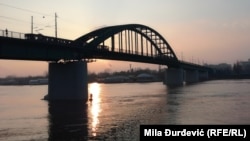
The old Sava Bridge was built in 1942 while Serbia was under Nazi occupation and managed to be saved after the retreating Germans mined it as they left the city. It's since become a key landmark and symbol of Belgrade.
In May, the city of Belgrade said the bridge needed replacing due to a "number of structural and safety risks" and because it did not "meet the existing and growing traffic needs of the city of Belgrade." The new, larger bridge would be able to handle increased traffic and offer a better link to other new projects, the city said.

But transparency and construction questions have followed the venture since the idea of knocking down the old bridge gained traction in 2017, and the contract was signed with PowerChina in 2020.
The Serbian government has since sidestepped the public procurement process on the new Sava Bridge by citing an intergovernmental agreement between China and Serbia signed in 2009 that allows for direct public contracting and increased cooperation in building infrastructure.
The Serbian Constitution says international agreements are also part of the legal system and the country's domestic laws cannot conflict with international contracts.
Adding to those procurement concerns is the fact that the full documentation for the project has never been made public.
Neither the Ministry of Construction, Transport, and Infrastructure nor the city of Belgrade responded to RFE/RL's questions about the construction of the bridge.

CSEC and PowerChina did not reply to RFE/RL's requests for comment about the procurement procedure or their involvement with the project.
Rastko Naumov of the Belgrade Remains advocacy group, which organized protests against the decision to demolish the old Sava Bridge, told RFE/RL he believes key details about the project have been hidden from the public.
He said he approached the city of Belgrade's Directorate for Building Land and Construction in January to file formal petitions for the release of contracts about the demolition of the old bridge and the construction of a new one but his request was denied.

"They refused to hand over the contracts. They said they were all secret," Naumov, a lawyer and activist, told RFE/RL.
Naumov shared his submitted requests to the directorate with RFE/RL, including the rejection letter from the authorities.
The letter said Naumov was denied access to the contracts because they are a "business secret" and PowerChina said the disclosure of this information would amount to revealing trade secrets.
The city of Belgrade's Directorate for Building Land and Construction did not respond to RFE/RL's request for comment.
A Pattern Of Hidden Contracts
Beijing enjoys a close relationship with Serbian President Aleksandar Vucic and has been steadily deepening its ties with Belgrade and across the Balkans over the past two decades.
Belgrade's ties with China have expanded across an array of sectors, from trade and defense to technology and education, with billions of dollars in Chinese cash flowing into the country under the Belt and Road Initiative (BRI), China's global infrastructure venture, and through bilateral deals.

The construction of the new bridge over the Sava River is just one of a series of large projects in Serbia that have raised transparency questions.
PowerChina is also a key contractor for building the massive complex in Belgrade for the 2027 World Expo as well as constructing exhibition halls, a national soccer stadium, and related infrastructure like metro lines, a new highway, and a ring road around the Serbian capital.
Those contracts have also been able to bypass Serbia's law on public procurement, which regulates which companies can obtain permission to work on state projects and procurements and ensures that these projects are competitive and transparent.
Concerns over transparency were also raised in the European Commission's report for Serbia this year as it evaluated the status of its candidacy to join the European Union.
The report warned that intergovernmental agreements like the one signed with China -- and which exist with other countries -- are eroding the checks and balances over large-scale projects in the Balkan country.
"This leads to the risk of corruption and noncompliance with European standards," the report states.

