




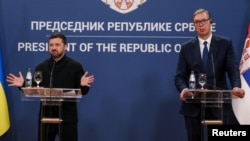
BELGRADE -- Ukrainian President Volodymyr Zelenskyy’s first visit to Belgrade since being elected in 2019 has produced few significant results while underlining Serbia’s ongoing efforts to maintain ties with both Moscow and the West.
Speaking at a news conference wrapping up the visit on August 8, Zelenskyy said he was grateful for all foreign support and thanked Serbia for a “new packet of humanitarian support from Serbia to Ukraine, including in the fields of medicine and energy. It’s very important for us.”
Both leaders also talked up the prospects for a free trade deal.
But more sensitive issues were not mentioned, at least in public, such as Serbia’s continued reliance on Russian energy supplies and its sales of ammunition stocks that have reportedly ended up with the Ukrainian armed forces.

Most importantly for both sides, despite a small pro-Russian demonstration in the city center, the visit went off without any embarrassing hitches.
Serbia’s Balancing Act
Although Serbia has repeatedly supported Ukraine's territorial integrity and sovereignty at the United Nations, condemning Russian aggression, it has not followed the European Union’s lead by imposing sanctions on Russia.
Serbia imports nearly all of its natural gas from Russia, and Serbian President Aleksandar Vucic has sought to maintain personal ties with his Russian counterpart, Vladimir Putin, also stressing historical bonds between the two nations. Putin remains a popular figure in Serbia, according to public opinion research.
Just a few weeks ago, Vucic was the only leader at a summit in Odesa who refused to sign a declaration calling for additional pressure on Russia to end the war.
Asked on August 8 about the prospects for peace in Ukraine, Vucic offered a neutral answer that avoided apportioning blame for Russia’s full-scale invasion in 2022.
“I just hope, without any real facts behind these hopes, that this will end tomorrow. But I don’t see the way how this might happen,” he said.

Vucic then went on to speak about plans for Serbia to “invest hugely” in “one small town in Ukraine that was harshly hit by the war,” without adding details. Again, he kept firmly to neutral language that did not mention Russia’s role.
Earlier, Vucic said that he and Zelenskyy had not discussed military cooperation. He has repeatedly denied media reports that Serbia has indirectly supplied Ukraine with ammunition, by selling it knowingly to third countries that then passed it on.
“Serbia produces ammunition of various calibers, including calibers compatible with Soviet-origin systems, of which there are still a large number on the Ukrainian battlefield," Nikola Lunic, a strategic affairs consultant, told RFE/RL’s Balkan Service ahead of the visit.
What’s In It For Zelenskyy?
For Zelenskyy, the visit to Belgrade could be seen as, at least, trolling the Kremlin by visiting one of the few countries in Europe that wants to maintain friendly relations with it.
A Zelenskyy aide reportedly described the visit as "a slap in the face for the Russians."
Speaking in Belgrade, Zelenskyy underlined work to deepen bilateral economic relations and also stressed that both Serbia and Ukraine were on the path to EU membership.

“We would be happy if Serbia's path to the European Union is accelerated. We all in Europe should cooperate with each other, as fruitfully as possible,” he said.
But while the optics of these two countries heading towards the EU may irritate Moscow, the reality is that for both of them the path is going to be long, difficult, and not assured of success.
Meanwhile, the pressing realities of the war remain.
Zelenskyy began his remarks by talking about the latest overnight Russian strikes on Ukraine and was asked about Ukraine’s shortage of interceptors to shoot down ballistic missiles.
“Anti-ballistic missiles and the manufacturer’s system come primarily from the United States of America. Can they help? We’re working on it,” he said. “Will they provide us with missiles every month? Yes. We have agreements in place. Are these missiles enough? No.”
Elsewhere, Russia said it struck port facilities and vessels in the Black Sea region that it said were supporting the Ukrainian military.
The Defense Ministry in Moscow claimed its forces used precision air-launched weapons and drones to hit military warehouses containing communications and electronic equipment in the port of Odesa. It added that it struck a cargo vessel carrying military supplies in the Black Sea.
Ukraine did not immediately comment and the Russian claim could not be verified.
Turkish Foreign Minister Hakan Fidan said he had conveyed to both Ukraine and Russia that they should stop attacks in the Black Sea after a series of ships there in recent days.
"The conflict has spread across the whole Black Sea," he said.



