




KYIV -- Anna fled to the Ukrainian capital with her 9-year-old son Misha to escape Russian bombardment in Kharkiv, where her home on the northern edge of the city sits some 20 kilometers from the front line.
But, she says, the intensity of recent Russian attacks on Kyiv is comparable to those she fled from. And there’s often nowhere to hide.
“The basements are usually overflowing. It's not just that there's nowhere to lie down. There's nowhere even to sit or stand,” she told Current Time this week. “People come and there’s no place for them. They send people away. There are not enough places anywhere in the whole neighborhood.”

Anna lives in Kyiv’s Desnyanskiy district, a sprawling area of Soviet-era housing blocks in the northeast of the city, which has the biggest shortfall of shelters. Most of the residential buildings have no basements --increasing demand on shelters beneath hospitals, schools, or kindergartens with capacity for less than half the local population.
Another local mother, Marina, told Current Time she usually spends Russian attacks hiding in the hall with her 18-month-old child.
“There is a shelter we could have gone to, for example, at a school. But it takes eight minutes to reach it on foot,” she said. “Walking there at night with a child under fire is a bit of a challenge.”
Russia Steps Up Attacks
With Russian forces making minimal advances on the front lines this year, Moscow has stepped up its air campaign against Ukrainian cities including Kyiv. This week, 17 people were killed in a single night of strikes on the Kyiv region.
Ukrainian air defenses did not manage to bring down a single Russian ballistic missile in this attack, drawing attention to its critical lack of interceptor missiles.
But the increasing civilian death toll -- the UN recorded 1,396 fatalities in the first six months of this year, a 37-percent jump on last year -- also underlines the shortage of shelters.
Official figures say there are just 4,000 shelters in a city where there are currently more than 3 million inhabitants. Some of these are inaccessible or derelict.

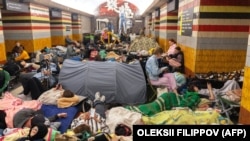
Increasing numbers are spending the night sleeping at subway stations, where the overcrowded platforms and stairwells recall the first weeks of Russia’s full-scale invasion in 2022.
During one recent night of Russian attacks, some 56,000 people came with tents, carry mats, and sleeping bags. But this is less than two percent of the city’s population.
The head of the Desnyanskiy district administration, Maksym Bakhmatov, told Current Time that the simplest and fastest solution to the problem comes in the form of prefabricated mobile shelters.
Made from reinforced concrete, they sit above ground and provide protection from shrapnel, falling masonry, or blast waves -- though not from a direct hit.
These have been installed at locations across the country and, in December last year, the Desnyanskiy district took delivery of the first one in Kyiv. It was financed by local businesses.
“It comes like a Lego kit, in separate pieces. They put it together, fasten it with bolts. It’s ready in 2-3 days,” said Bakhmatov.
Who Is To Blame?
Kyiv Mayor Vitali Klitschko has said district administrations are responsible for the lack of shelters. He said recently that in 2025 more than $11 million was made available for construction of shelters but most of it was not spent.
“If the district administrations don’t fulfil their responsibilities, [other] people who will fulfil these responsibilities need to be found. Unfortunately, we have an administrative structure where the [Kyiv] mayor cannot even issue a reprimand to the head of the district,” Klitschko said.

Bakhmatov rejected the criticism, arguing that Klitschko and the city administration had all the powers and budgetary resources needed.
“It’s not just about handing out money, but about having a plan, a strategy,” he said. “Nobody will tell you how many shelters there should be.”
While city representatives quarrel over the blame, residents of Kyiv and the surrounding areas continue to feel the heat.
Overnight on August 8, Russian forces killed three people in Pukhovka, in the Kyiv region: a grandfather, a grandmother, and their grandson, President Volodymyr Zelenskyy said.
"The boy was only three years old. Four more were hospitalized: the child's parents and his 15-year-old brother and a neighbor who came to help the family and was injured during the second strike,” he wrote on social media, adding that Russia fired six ballistic missiles at civilian infrastructure in Kyiv.
The strikes in the capital itself claimed one life, according to the city’s military administration.