




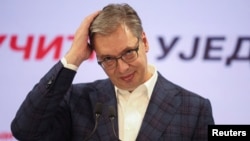
BELGRADE -- For two years, a student-led protest movement tried to push Aleksandar Vucic, who led Serbia as either president or prime minister since 2014, from power. Over the weekend, they achieved their goal. But with no identifiable leader and no sharp policy focus, analysts say their real battle is just beginning.
Students' List focused its election platform on fighting corruption, strengthening independent institutions, education, and improving living standards. Despite the uncertainties surrounding the new political movement’s future course, voters placed their trust in it, disappointed with what established political parties had achieved.
That culminated in a resounding win at the polls, with the movement taking 139 of parliament's 250 seats. Once parliament starts after the official announcement of the results, the Students' List candidates have 90 days to form a government.

This is where the uncertainty begins.
The student-led electoral list will enter parliament for the first time. It has no obvious leader and is made up largely of experts and academics from various fields. The movement may have enough seats to form a government on its own, but it has no clear candidate to become prime minister.
Cardiologist Ilija Srdanovic, a professor at the Faculty of Medicine at the University of Novi Sad, was at the top of the electoral list, which also included well-known figures such as former central bank Governor Dejan Soskic and former basketball star Dejan Bodiroga.
None, however, have been publicly presented as a candidate for prime minister. Nor have any names come to the forefront for ministerial candidates.
"They were born out of frustration with everything within the state that they are dissatisfied with," Balkan expert Nikola Xaviereff-Weckwerth told RFE/RL's Balkan Service.
"Their strategy was not to have a single figure leading the movement, so that the other side -- Vucic’s party -- would not have an individual to target," he added.
Train Station Collapse
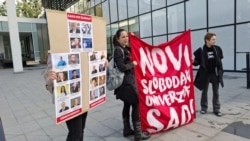
The protest movement was ignited by the collapse of a newly installed canopy at a train station in Novi Sad in November 2024.
A total of 16 people died in the tragedy, which the students alleged was caused by shoddy work that they claimed could be traced back to government corruption and the Chinese company that got the contract to build the canopy.
In its campaign program, the student movement listed full transparency in public procurement, audits of state-funded projects, and the public disclosure of all contracts and tenders among its goals.
Its proposals also include confiscating illegally acquired assets and introducing lustration measures for public officials.
"Serbia is experiencing the same energy we saw when [late Serbian President Slobodan] Milosevic was overthrown," Ivana Stradner, a research fellow at the Washington-based Foundation for Defense of Democracies, told RFE/RL.
"But history must not repeat itself: Removing Vucic is only the beginning. Serbia now must dismantle the system of corruption and authoritarian control that sustained his rule and not simply replace the people at the top.... This is Serbia’s chance to build lasting democratic institutions and put the country firmly on a path toward the West," she added.
Over the years, Vucic cultivated close ties with Moscow and Beijing, positioning Serbia as one of their closest partners in Europe.
The Students' List encompasses both sides of the political spectrum, which leaves some its members at odds given Serbia's internal battle over how close its relationship with Moscow should be at a time when it is also a European Union candidate.
The movement's policy of refraining from imposing sanctions on Russia is expected to remain unchanged, a move Students' List justified by arguing that sanctions, as an expression of a political stance, do not help resolve political and security challenges.
"The immediate challenge will be to translate protest momentum into institutional reform," said Bojana Zoric of the European Union Institute for Security Studies.
She said the window for reform may be "narrow," particularly given the likely resistance from within state institutions.

"A student-backed government of experts would need to confront entrenched political networks, restore trust in institutions, and create the conditions for genuinely competitive elections," she said.
"The student-backed list may embrace European democratic values, but this does not necessarily translate into a pro-EU foreign policy. Its program provides little clarity on foreign policy priorities."
Regional politics are another potential flashpoint -- as always in the Balkans.
Students' List opposes recognizing Kosovo, in line with Serbia’s official position since Kosovo declared independence in 2008.
During the election campaign, Students' List representatives referred to Serbia’s constitution, whose preamble was amended in 2006 to state that Kosovo is part of Serbia.
It also said it will "preserve the constitutional position and established competencies" of Republika Srpska, the Serb-majority entity within Bosnia-Herzegovina.