


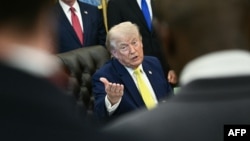
US President Donald Trump said the United States will win the conflict with Iran either "militarily or on paper,” referring to the fitful negotiations with Tehran, and he suggested he could meet with Iran's reclusive supreme leader "if it was to make a deal.”
"We're going to win one way or the other," Trump told reporters at the White House.
"It's going to be militarily or on paper."
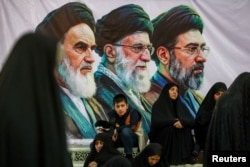
Trump also said he had no desire to meet with Iranian Supreme Leader Mojtaba Khamenei, who has not been seen since the outbreak of violence on February 28 and was reportedly seriously injured in US-Israeli air strikes.
However, Trump added if the two sides reached a deal, it was possible the two leaders would meet and added: "If it happened...I'd be respectful."
"I don't want to meet, but if I did meet, I'd be honored to meet him," Trump said.
"But if we make a deal, it's possible that I would meet him. I'd be OK with that."
Trump on June 3 had said Khamenei was "involved, absolutely" in negotiations, while Secretary of State Marco Rubio a day earlier said that "there are indications out there that he is increasingly engaging at some level."
Trump: US Could Resume Military Operations
Trump also said US forces would resume operations if American troops were killed in any Iranian strikes during the current cease-fire. Tehran and the US have exchanged occasional air strikes in recent days, the latest being Iran's attacks on Kuwait's international airport that killed one person and injured 63 on June 3.
Trump was speaking at the White House on June 4 to reporters on a wide variety of subjects, including the Ukraine war, Cuba, and global trade issues.
Amid the shaky cease-fire in the Middle East and on-and-off peace negotiations, Trump said the United States did not need a deal with Tehran to get Iran's supply of enriched uranium out of the country.
"We could get it right now. I don't think they could stop us if we wanted, but there's no reason to. It's entombed," he told reporters, referring to the material that could be used to build a nuclear weapon.
Trump claimed that the uranium was under surveillance. "We have cameras on it," he said, without elaborating.
Mohsen Rezaei, adviser to Iran's supreme leader, said the current draft of the memorandum of understanding being negotiated to end the war has ambiguities that need to be clarified.
He claimed that Trump seeks to pressure Tehran to accept his terms and keep Tehran's conditions in a vague state.
Progress In Lebanon Amid Violence?
Trump also said he believed progress was being made between Israel and Lebanon and that Lebanon deserved to have peace and that he "actually spoke to Hezbollah about it."
Iran-backed Hezbollah, a militant group and political party that controls much of southern Lebanon, is considered a terrorist organization by the US, while the European Union has blacklisted its armed wing but not its political branch.
Trump on June 1 also said he had spoken to Hezbollah, but the White House later clarified that it was through intermediaries.
Given that Hezbollah is a designated terror group, no US president has previously acknowledged having spoken to the group, directly or through intermediaries.
Hezbollah on June 4 rejected a new cease-fire in Lebanon, and Israel said it would not withdraw troops from the country, undermining US efforts to halt fighting there as part of a wider peace deal with Iran. Hezbollah has not been a direct participant in the talks involving the US, Israel, and the Lebanese government.

Trump told reporters he had also spoken to Israeli Prime Minister Benjamin Netanyahu and said that "I think progress is made. It's been going on for a long time, you know."
"It would be really nice if Lebanon could have some peace," he said. "Lebanon has been under attack for so many years and always like an underdog, and it would be really nice if it could end."
Tehran has made a Lebanon truce one of its conditions for a peace deal with Washington. It has suggested it could intervene directly if Israel forces maintain their ferocious attacks there.

