



Accessibility links

Breaking News

News

U.K.: Russia Sanctions Could 'Come Off With Full Cease-Fire And Withdrawal' From Ukraine

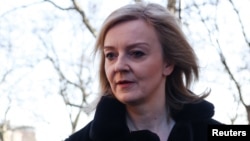
British Foreign Secretary Truss (file photo)

British Foreign Secretary Liz Truss says sanctions to punish wealthy Russian elite and businesses since the invasion of Ukraine could be lifted if Russia's president ended the attack and pledged "no further aggression."

Truss told the Sunday Telegraph in an interview published on March 27 that the Foreign Office had formed a "negotiations unit" to aid possible peace talks.

British Prime Minister Boris Johnson has warned that London and its allies will "steadily ratchet up" sanctions on Russian President Vladimir Putin and his backers.

"Those sanctions should only come off with a full cease-fire and withdrawal, but also commitments that there will be no further aggression," Truss said.

"And also, there's the opportunity to have snapback sanctions if there is further aggression in future," she said. "That is a real lever that I think can be used."

Ukrainian President Volodymyr Zelenskiy has repeatedly urged Putin to engage in serious talks to end the fighting since the Kremlin leader announced the full-scale invasion more than a month ago, with his latest overture coming on March 25.

Truss's comments will be regarded as a fresh invitation for Putin to cut Russian losses amid a war that critics say has exposed major problems in Russia's strategy, tactics, and preparations for the conflict.

It has also sparked massive cutoffs of Russian funds, assets, and operations in the international financial system, as well as more targeted sanctions and diplomatic isolation.

U.S. Secretary of State Antony Blinken has said various bans and asset freezes on the Putin circle are "not designed to be permanent."

Based on reporting by Reuters

More News

South Africa Says Inquiry Found No Evidence Of Arms Shipment To Russia

South African President Cyril Ramaphosa (left) and Russian President Vladimir Putin (file photo)

South African President Cyril Ramaphosa on September 3 said an inquiry into a U.S. allegation that a Russian ship had picked up weapons in South Africa late last year found no evidence the vessel had transported weapons to Russia. “None of the allegations made about the supply of weapons to Russia have been proven to be true," Ramaphosa said in an address to the nation. "No arms were exported," he said. The U.S. ambassador to South Africa had said in May that Russian cargo ship Lady R had uploaded weapons at a naval base near Cape Town in December. To read the original story by Reuters, click here.

Updated

'New Approaches Needed': Zelenskiy To Replace Ukraine's Defense Minister In Surprise Move

Ukrainian President Volodymyr Zelenskiy said he wants Rustem Umerov (above) to be the country's new defense minister.

KYIV -- Ukrainian President Volodymyr Zelenskiy said late on September 3 that he has decided to replace wartime Defense Minister Oleksiy Reznikov with Rustem Umerov, a Ukrainian politician of Crimean Tatar origin, in a surprising shake-up as Kyiv's forces press on with their counteroffensive against the Russian invasion.

Zelenskiy said in a Telegram post and video address that Reznikov “went through these more than 550 days of full-scale war. I believe the ministry now needs new approaches and other formats of interaction with both the military and society as a whole.”

“The ministry shall be headed by Rustem Umerov,” Zelenskiy said, adding that he will propose the change to parliament in the coming days and that he expects lawmakers to approve the appointment.

“The Verkhovna Rada of Ukraine knows this man well, and Mr. Umerov needs no further introduction," Zelenskiy said. "I expect the parliament to support this candidacy.”

The 41-year-old Umerov, a deputy of the Holos (Voice) party, was last year appointed to head the country's State Property Fund.

Reznikov was appointed to his post on November 4, 2021, a few months before Russia’s full-scale invasion in February 2022.

The 57-year-old Reznikov played a key role in persuading Ukraine's Western allies to provide billions of dollars in military aid and sophisticated weapons to assist Kyiv's fight against Russian forces.

Oleksiy Reznikov
Oleksiy Reznikov

In February 2023, the leader of Zelenskiy's faction in parliament said that Reznikov was about to be replaced by General Kyrylo Budanov.

However, a senior Ukrainian official the next day said no personnel changes would be announced at the ministry at that time.

It was not immediately clear what had sparked those reports of Reznikov’s departure.

But rumors of a possible Reznikov resignation or ouster had mounted after a series of accusations of corruption within the ministry.

Reznikov said after those initial reports that he was not planning to resign but added that any decision about his future would be made by the president.

“He nominates an appointee, and the [parliament] appoints. Therefore, only by the decision of the president of Ukraine will I make certain decisions, and I will do what the president of Ukraine tells me," he said.

In January, Ukrainian media reported that the Defense Ministry had allegedly purchased products for the military at inflated prices through a "gasket" company. Other charges of corruption were also alleged in the media.

Moldovan President Says Audit Disproves $800 Million Gazprom Debt Claim

Moldovan President Maia Sandu (file photo)

An audit carried out by an international firm has disproved Russian gas giant Gazprom's claim that the Moldovan government owes it $800 million, Moldovan President Maia Sandu was quoted as saying on September 3. The former Soviet republic, situated between Ukraine and EU member Romania, used to buy Russian natural gas. But in late 2021, Gazprom and its Moldovan subsidiary said it had accumulated hundreds of millions of dollars in debt that had to be repaid to ensure further stable supplies. Gazprom put the debt at $709 million a year ago, although the sum might have increased with the addition of interest. To read the original story by Reuters, click here.

Israeli-Iranian Movie Filmed Undercover To Avoid Suspicion

The film takes place over the course of the single day of competition as an Iranian judoka champion is ordered to fake an injury to avoid a possible matchup with an Israeli competitor.

The first production co-directed by Iranian and Israeli filmmakers had to be shot in secret to prevent possible interference by Tehran, directors Zar Amir Ebrahimi and Guy Nattiv told Reuters on September 3. Tatami, a tense thriller centered on a world judo championship, got its world premiere at the Venice Film Festival over the weekend, receiving a standing ovation. The film takes place over the course of the single day of competition as an Iranian judoka champion, played by Farsi-speaking U.S. actress Arienne Mandi, is ordered to fake an injury to avoid a possible matchup with an Israeli competitor. To read the original story by Reuters, click here.

French-Israeli Business Tycoon Steinmetz Detained In Cyprus On Romanian Warrant

Beny Steinmetz (file photo)

French-Israeli business magnate Beny Steinmetz, who faces a five-year prison term in Romania, has been arrested in Cyprus on a European warrant issued by Bucharest, his spokesman said on September 3. Steinmetz was sentenced in absentia in December 2020 on charges of forming an organized criminal group in a series of land deals in Romania in 2006-08. Italy and Greece had previously declined to enforce the same warrant. An extradition hearing is pending. A statement by his spokesman said, "Steinmetz welcomes the opportunity to be vindicated in…Romania, a country infamous for its disrespect to human rights." To read the original story by RFE/RL’s Romanian Service, click here.

Ukraine Says It's Received $100 Billion In Military Aid From Western Backers

Ukraine's Defense Minister Oleksiy Reznikov

Ukrainian Defense Minister Oleksiy Reznikov said in an interview published on September 3 that since the Russian invasion, Kyiv has received about $100 billion in military aid from Western backers, including more than $50 billion from the United States. He added in comments to Ukrinform that the focus of reform efforts within the Defense Ministry should be carried out with Europe and NATO in mind. “Ukraine's [potential] membership in NATO would be a very serious step toward building the architecture of our new security, in fact, a guarantee of security against a future offensive and attack by Russia,” he said. To read the original story by RFE/RL’s Ukrainian Service, click here.


Zelenskiy, Macron Discuss Grain, Odesa Security In Phone Call

Ukraine's President Volodymyr Zelenskiy (left) and French President Emmanuel Macron (file photo)

Ukrainian President Volodymyr Zelenskiy’s office said he discussed the transport of Ukrainian grain exports and the security of the Odesa region in a phone call with French leader Emmanuel Macron on September 3. “They discussed in detail the situation on the battlefield…. [Zelenskiy] conveyed current defense needs and thanked France for its strong support and constant help in expanding our soldiers’ capabilities,” a post on his Telegram channel said. The two discussed the specifics of the Black Sea “grain corridor” and “agreed to strengthen cooperation in the protection of sea routes,” it added. Zelenskiy said he had struck a "very important agreement on training our pilots in France" but didn't elaborate. To read the original story by RFE/RL's Ukrainian Service, click here.

Armenian PM Says Depending Solely On Russia For Security Was 'Strategic Mistake'

Armenian Prime Minister Nikol Pashinian (file photo)

Armenia's prime minister has said his country's policy of solely relying on Russia to guarantee its security was a strategic mistake because Moscow has been unable to deliver and is in the process of winding down its role in the wider region. In an interview with the Italian newspaper La Repubblica published on September 3, Nikol Pashinian accused Russia of failing to ensure Armenia's security in the face of what he said was aggression from neighboring Azerbaijan over the breakaway Nagorno-Karabakh region. To read the original story by Reuters, click here.

IOC: Participation Of Russian, Belarusian Athletes At Asian Games 'Not Feasible'

Russian and Belarusian athletes will not compete at the Asian Games in China starting on September 23 after the International Olympic Committee (IOC) concluded that the plan was "not feasible." "The concept of the participation of athletes with Russian and Belarusian passports at the Asian Games 2023 was explored as discussed at the Olympic Summit in December 2022, but was not feasible due to technical reasons," the insidethegames.biz news portal quoted the IOC as saying. A spokesman for the Olympic Council of Asia told insidethegames.biz that there would be "no Russian and Belarusian athletes [at the Asian Games], and it is IOC’s decision, not OCA."

Iran Sentences Two Women Journalists To Jail Time

Elnaz Mohammadi and Negin Bagheri (combo photo)

Two female Iranian journalists will spend around a month behind bars as part of a three-year partly suspended prison sentence for "conspiracy and "collusion,” local media reported on September 3. Under the sentence, Negin Bagheri and Elnaz Mohammadi will serve one-fortieth of the term, or less than a month, in prison, their lawyer Amir Raisian told the reformist Ham Mihan daily newspaper, where Mohammadi works. "The remaining period is suspended over five years," during which time they will be required to take "a professional ethics training" class and are "prohibited from leaving the country," the lawyer added.

Kyrgyz Opposition Lawmaker Detained Over Role In 2009 Border Deal

Adakhan Madumarov (left) is taken away from the Ministry of Internal Affairs for a court session in Bishkek on September 2.

Kyrgyz opposition lawmaker Adakhan Madumarov was detained on September 2 over his role in signing a Kyrgyz-Tajik border deal in 2009 when he led the country's Security Council, his defense lawyer said. In June, a parliamentary commission approved the launch of a probe into the border deal that President Sadyr Japarov has criticized for ignoring Kyrgyzstan's interests. Madumarov, the leader of the Butun Kyrgyzstan (United Kyrgyzstan) party, is expected to remain in custody until the probe is completed on October 24, court officials said. To read the original story by RFE/RL’s Kyrgyz Service, click here.

Japan's 'Militarization' Complicates Situation In Asia-Pacific, Russia's Medvedev Says

Kunashir, one of four islands known as the Kurile Islands in Russia and as the Northern Territories in Japan. (file photo)

Japan's "militarization" complicates the situation in the Asia-Pacific region, the deputy chair of the Russian Security Council and former President Dmitry Medvedev said on September 3. Russia and Japan have complex relations marked by decades of territorial dispute over a handful of small, Russian-held islands off Hokkaido that Moscow calls the southern Kuriles, but Japan claims as its Northern Territories. The dispute over the area has prevented Tokyo and Moscow from reaching a peace treaty formally ending World War II hostilities. To read the original story by Reuters, click here.

Updated

Ukraine Claims Landing Craft In Black Sea Destroyed, Six Russians Killed

A firefighter works at a site that was hit during Russia's drone attacks in the Odesa region on September 3.

The Ukrainian Navy late on September 3 claimed its forces had blasted a Russian landing craft in the Black Sea, killing six soldiers, hours after Kyiv said its air-defense systems had shot down 22 of the 25 Iranian-made Shahed drones that Moscowa launched on the southern Odesa region near the Romanian border.

Ukraine’s Navy said on its Telegram channel that its aviation forces had “destroyed an enemy KS-701 boat” attempting to land troops in the northwestern area of the Black Sea.

“The enemy suffered losses six killed and two wounded,” said the statement, which could not immediately be verified.

Earlier, Ukrainian authorities said at least two civilians were injured in the “several waves of attacks” that hit a Danube River port infrastructure near Odesa and the border with Romania, adding that the strikes lasted about 3 1/2 hours.

Live Briefing: Russia's Invasion Of Ukraine

RFE/RL's Live Briefing gives you all of the latest developments on Russia's full-scale invasion, Kyiv's counteroffensive, Western military aid, global reaction, and the plight of civilians. For all of RFE/RL's coverage of the war in Ukraine, click here.

The Danube has become Ukraine's main route for exporting grain since the collapse in July of a UN-brokered deal allowing safe shipments from the Black Sea.

The action came hours before Ukrainian President Volodymyr Zelenskiy announced he was replacing long-standing Defense Minister Oleksiy Reznikov with politician Rustem Umerov in a surprising announcement as Kyiv’s forces press ahead with their crucial counteroffensive in the south. Zelenskiy said "new approaches" were needed after Reznikov's 550 days in his position.

Russia has since increased attacks on Ukraine's southern Odesa and Mykolayiv regions, home to ports and infrastructure that are vital for the shipment of grain.

The Russian military said its latest drone strikes hit the Ukrainian port of Reni on the Danube River, on the border with Romania.

"Today at night, the Russian Army carried out a group drone strikes on fuel-storage facilities used to supply military equipment of the Armed Forces of Ukraine in the port of Reni, in the Odesa region," the military said on September 3.

"All designated targets were hit," it claimed.

At least one person was killed and six others were wounded by Russian shelling in Ukraine's northeastern Sumy region late on September 2, the regional military authorities said.

The artillery attack caused multiple explosions that also damaged private homes and vehicles, as well as the premises of a former utility company, according to local officials.

Late on September 3, Russian officials in Kurchatov in the Kursk region said a residential building had been hit by a Ukrainian drone, causing a fire, amid increased reports of Ukrainian drone attacks inside Russia.

Battlefield reports cannot immediately be independently verified.

Earlier, Zelenskiy and other Ukrainian leaders said Kyiv’s forces had broken through the first and strongest of Russian defense lines during the country’s renewed counteroffensive in the south.

Ukrainian forcers were approaching the weaker second line of defense, officials said, although details remained scarce.

In Russia, the deputy chairman of the Russian Security Council, Dmitry Medvedev, claimed that some 280,000 people have signed up so far this year for professional service with Russia's military.

The former Russian president made the comments in Russia's Far East, where he said he was meeting local officials to work on efforts to beef up the armed forces.

"According to the Ministry of Defense, since January 1, about 280,000 people have been accepted into the ranks of the armed forces on a contract basis," including reservists, state news agency TASS quoted Medvedev as saying.

Last year, Moscow announced a plan to expand its combat personnel more than 30 percent to 1.5 million, an ambitious task made harder by Russia’s heavy casualties in its ongoing war in Ukraine.

WATCH: Medical volunteers continue to travel to villages in eastern Ukraine's Donbas region to bring care to civilians near the front line. Current Time's Boris Sachalko reports.

Mobile Medical Unit Brings Care To Frontline Ukrainian Villages
please wait

No media source currently available

0:00 0:02:34 0:00

According to Britain’s Defense Ministry, Russia in recent months has been appealing to citizens of neighboring countries with recruitment adverts for individuals to fight in Ukraine.

“There have been recruitment efforts in Kazakhstan's northern Qostanai region, appealing to the ethnic Russian population,” the ministry said on its daily bulletin on September 3.

“Online adverts have been observed in Armenia and Kazakhstan offering $5,140 in initial payments and salaries from $1,973,” according to the bulletin.

Central Asian migrants in Russia have also been approached by military recruiters with promises of fast-track citizenship and salaries of up to $4,160, it said.

On the diplomatic front, Volodymyr Zelenskiy’s office said the Ukrainian president had discussed transport of Ukrainian grain exports and the security of the Odesa region in a phone call with French counterpart Emmanuel Macron on September 3.

“They discussed in detail the situation on the battlefield…. [Zelenskiy] conveyed current defense needs and thanked France for its strong support and constant help in expanding our soldiers’ capabilities,” a post on his Telegram channel said.

With reporting by Reuters and AFP

Tajikistan Resumes Border Relations With Afghanistan In A Sign Of Thawing Tensions

Tajik authorities say they reopened a market on the border with Afghanistan.

The administration of Tajikistan's Gorno-Badakhshan region on September 2 said border cooperation with Afghanistan has resumed in several districts on the orders of Tajik President Emomali Rahmon after three years of closures, a sign of a potential normalization of relations between two countries. Rahmon in the past has criticized the Taliban for ignoring the rights of Tajiks in Afghanistan and said he would only support the creation of an inclusive government in that country. Tajik officials have also complained of drug and refugee traffic along the border. Tajikistan shares more than 1,300 kilometers of border with Afghanistan. To read the original story by RFE/RL’s Tajik Service, click here.

Pakistani Business Leaders Strike Against Rising Energy Prices

Pakistani business leaders on September 2 went on strike to protest higher fuel and electricity prices and the general rise in the cost of living. The strike, called by the Jamaat-e Islami party in Khyber Pakhtunkhwa Province, has spread to other areas and also sparked public protests against the rising costs. Caretaker Prime Minister Anwaar-ul-Haq Kakar has said electricity has become more expensive due to rising oil prices and that cabinet officials are working on ways to meet existing challenges in a way that doesn't breach agreements with the IMF. To read the original story by RFE/RL’s Radio Mashaal, click here.

Updated

Ukrainian Court Orders Either $14 Million Bail For Kolomoyskiy Or Pretrial Detention

Ukrainian Oligarch Kolomoyskiy Arrested In Fraud, Money-Laundering Case
please wait

No media source currently available

0:00 0:01:06 0:00

KYIV – A court in the Ukrainian capital ordered bail of nearly $14 million for powerful businessman Ihor Kolomoyskiy, who was detained after he was named a suspect in a fraud and money-laundering case, as President Volodymyr Zelenskiy's government appeared to be stepping up efforts to meet Western demands to tackle alleged corruption.

If Kolomoyskiy is unable to meet the bail conditions, the Shevchenkivskiy District Court ruled that the oligarch be held in pretrial detention for at least two months.

Kolomoyskiy's lawyers said the businessman would appeal the court decision and would not be posting bail. Kolomoyskiy could not be reached for comment.

In television video, Kolomoyskiy was later seen being led away in a tracksuit jacket

The hearing was held behind closed doors, reportedly at Kolomoyskiy’s request.

"Under the procedural guidance of the Prosecutor-General's Office, the [SBU State Security Service] and the Economic Security Bureau of Ukraine notified the well-known oligarch of suspicion of legalizing fraudulently obtained property," the Prosecutor-General's Office said in a statement.

Without naming Kolomoyskiy, Zelenskiy on September 2 thanked law enforcement for bringing long-running cases to justice.

"I thank Ukrainian law enforcement officials for their resolve in bringing to a just outcome each and every one of the cases that have been hindered for decades," Zelenskiy said in his nightly video address.

Kolomoyskiy, a billionaire who made his wealth in the 1990s scooping up former state assets, has been accused by critics of using overly aggressive business practices, including sending armed men to take over companies.

He has owned banks, energy firms, and other companies, including one of Ukraine's most influential television channels, which backed Zelenskiy's election campaign in 2019. The channels had also broadcast a TV series that starred Zelenskiy, who was a comedian and actor before becoming president.

The United States filed a civil forfeiture cases against Kolomoyskiy in 2020, alleging he laundered hundreds of millions of dollars to purchase U.S. commercial real estate. Those cases have been stayed at the request of the U.S. government to avoid disclosing witnesses in a related criminal case it is pursuing against the tycoon.

In 2021, the State Department banned Kolomoyskiy and his family from traveling to the United States, accusing him of corruption while serving as governor of the Dnipro region in 2014-15. The U.S. actions were seen as a signal to Kyiv to go after Kolomoyskiy for money laundering and corruption.

In February, agents from the SBU and the Bureau of Economic Security carried out searches of the homes of Kolomoyskiy and former Interior Minister Arsen Avakov in a separate matter -- an alleged embezzlement case worth over $1 billion -- in what appeared to be part of efforts to root out corruption amid the battle to repel invading Russian forces.

The billionaire has denied any wrongdoing. Last year, he was reportedly deprived of Ukrainian citizenship by Zelenskiy, though there has been no confirmation by either side.

The loss of Ukrainian citizenship -- if true -- could open the door to Ukraine extraditing Kolomoyskiy to the United States should the Department of Justice eventually charge him with money laundering in a criminal case. Ukraine does not extradite its own citizens.

The nearly $14 million bail demand roughly matches the amount the SBU accused Kolomoyskiy of withdrawing from the country.

“It was established that during 2013-20, Ihor Kolomoyskiy legalized more than half-a-billion hryvnyas (about $14 million) by withdrawing them abroad and using the infrastructure of banks under [his] control," the SBU said in a statement.

Zelenskiy has vowed to crack down on corruption -- especially among the nation's wealthy oligarchs -- amid criticism from his Western backers in the war.

Kolomoysky’s supporters say the actions against the businessman are an effort by Zelenskiy to show the West he is meeting their demands on alleged corruption.

Russian Taxi Law Requiring Companies To Share Data With FSB Goes Into Effect

A law requiring taxi companies to provide the Federal Security Service (FSB) with data on riders' trips has come into force. The new law, enacted on September 1, also prohibits taxi companies from disclosing their cooperation with the FSB. Under the provisions of the law, the FSB will have constant access to databases that taxi companies are required to maintain. Passenger travel data is to be stored for six months. The law was adopted by the State Duma, Russia's lower house of parliament, in December. To read the original story by RFE/RL's Russian Service, click here.

Updated

Iranian Pilgrims Among 18 Dead In Iraqi Crash

Iranian Shi'ite pilgrims pray as they attend the holy ritual of Arbaeen in Karbala on August 31.

A road accident killed 18 people, mostly Iranian pilgrims, north of the Iraqi capital, Baghdad, overnight, the state news agency INA reported on September 2. The "horrible accident" between Dujail and Samarra also injured 15 people, INA said, citing the toll from Khaled Burhan, director of health services in Salaheddine Province. Among the dead were 14 Iranians, two Afghans, and two people yet to be identified, according to a hospital official. Millions of Shi'ite pilgrims, many of them from Iran, head each year to the holy shrine city of Karbala for Arbaeen, one of the world's biggest religious gatherings. To read the original story by AFP, click here.

Three Pakistani Soldiers, One Militant Killed In Shoot-Outs Along Afghan Border

A Pakistani Army soldier stands guard at a market in Miran Shah. (file photo)

Two soldiers and one militant were killed in a shoot-out during an overnight military operation against militant activity in the northwest along the border with Afghanistan. A military statement late on September 1 said security forces initiated an operation in Miran Shah, the main town of North Waziristan, “to eliminate remaining terrorists” after receiving concrete intelligence reports about the presence of militants. It said that as troops closed in on the location, a group of militants was spotted and intercepted, triggering a shootout that resulted in the death of the army major leading the operation and another soldier. One militant was killed. To read the original story by AP, click here.

White House Discusses Anti-Corruption Efforts With Ukrainian Delegation

U.S. national-security adviser Jake Sullivan (file photo)

U.S. national-security adviser Jake Sullivan met on September 1 with the heads of Ukrainian anti-corruption institutions and reiterated American support for anti-corruption reforms in Ukraine, the White House said in a statement. "Mr. Sullivan underscored the vital importance to any democratic society of independent, impartial law enforcement and judicial institutions capable of investigating, prosecuting, and adjudicating corruption cases no matter where they lead," the White House said. Ukraine has made a crackdown on graft a priority as it presses on with a counteroffensive 18 months into Russia's invasion. To read the original story by Reuters, click here.

Zelenskiy Insists Kyiv's Forces 'Are Moving Forward' As Push Toward Melitopol Continues

A Ukrainian self-propelled artillery system fires toward Russian positions at the front line near Bakhmut on September 1.

Ukrainian President Volodymyr Zelenskiy has rebuffed criticism over the slow pace of Kyiv's nearly three-month-long counteroffensive to retake territory occupied by Russia.

Live Briefing: Russia's Invasion Of Ukraine

RFE/RL's Live Briefing gives you all of the latest developments on Russia's full-scale invasion, Kyiv's counteroffensive, Western military aid, global reaction, and the plight of civilians. For all of RFE/RL's coverage of the war in Ukraine, click here.

"Ukrainian forces are moving forward. Despite everything, and no matter what anyone says, we are advancing, and that is the most important thing," Zelenskiy wrote on Telegram. "We are on the move."

The comments came after unidentified U.S. officials expressed frustration at the progress of Ukraine's counteroffensive, backed by Western military equipment and training.

Following the criticism, U.S. officials and British intelligence have noted gains by Ukrainian forces as they attempt to break through heavily fortified Russian defenses in Ukraine's southeast.

On September 1, the United States said that Ukrainian forces had made progress in the Zaporizhzhya region in recent days.

"They have achieved some success against that second line of Russian defenses," White House national security spokesman John Kirby said. He also acknowledged criticism of Ukraine's counteroffensive "by anonymous officials," saying this was "not helpful."

"Any objective observer of this counteroffensive, you can't deny...that they have made progress now," Kirby added.

In an intelligence assessment issued on September 2, the British Defense Ministry said that the Ukrainian military had reached Russia's main defensive line in parts of southern Ukraine and that Russian forces were fighting to halt the counteroffensive.

British intelligence said that the Russian military was continuing its own offensive in the north, near Kupyansk, in Ukraine's northeastern Kharkiv region.

While "Russian forces are likely trying to distract Ukraine from its counteroffensive" by forcing Kyiv to split its forces, the assessment continued, Russia risks dividing its own forces as it seeks to prevent a Ukrainian breakthrough.

On September 2, Russia said that its forces thwarted three sea drone attacks on the strategic Crimea Bridge linking Ukraine's occupied Crimean Peninsula to the Russian mainland, as Ukraine's military said it was continuing its push to cut off the land bridge to Crimea in Ukraine's southeast.

One attempt by Ukraine to strike the Crimea Bridge was made on the night of September 1, and two others on September 2, according to the Russian Defense Ministry.

Ukraine has not yet commented on the attacks, which reportedly blocked traffic on the bridge for three hours.

Kyiv has repeatedly stated that it considers the rail and vehicle bridge used to supply Russian forces fighting in Ukraine to be a legitimate military target.

Oleksiy Danilov, Ukraine’s secretary of the National Security and Defense Council, told national radio on September 2 that Kyiv’s forces are now capable of reaching targets in Russian territory that are up to 1,500 kilometers away using its own weapons as Ukraine continues to develop its missile and drone programs.

Russia has attempted to hinder Ukraine's ability to strike the bridge with barriers, including sunken ships, following a July attack that damaged the road section of the bridge.

The attacks came as the Ukrainian military said its forces were continuing their push in the direction of the southeastern city of Melitopol in an attempt to cut off a land bridge connecting occupied Ukrainian territory to the Crimean Peninsula, which Kyiv has said it intends to take back after it was illegally annexed by Russia in 2014.

Meanwhile, Ukraine's military intelligence said on September 1 that a recent drone attack on an airport in northwestern Russia that damaged several transport planes was carried out from within Russian territory.

The attack this week on Pskov airport, around 700 kilometers from Ukraine, marked the latest strike on Russian territory since Kyiv vowed in July to "return" the conflict to Moscow.

"Four Russian IL-76 military transport planes were hit as a result of the attack. Two were destroyed and two were seriously damaged," Ukrainian intelligence chief Kyrylo Budanov said.

With reporting by AFP

U.S. OKs Potential Sale Of Military Vehicles To Bulgaria

U.S. Army M1296 Stryker infantry carrier (file photo)

The U.S. State Department has approved the possible sale of Stryker military vehicles to Bulgaria for an estimated $1.5 billion, the Pentagon said on September 1. The sale to the NATO ally would consist of 183 Stryker vehicles, including infantry carriers, command vehicles, and medical evacuation vehicles, the Pentagon said. The Pentagon's Defense Security Cooperation Agency notified Congress of the possible sale. The notification does not indicate that a contract has been signed or that negotiations have concluded. U.S. defense contractor General Dynamics is the prime contractor for the vehicles, the Pentagon said.

Updated

Nobel Committee Says Russia Is 'Trying To Silence' Peace Laureate Dmitry Muratov

Nobel Peace Prize laureate and journalist Dmitry Muratov (file photo)

Russia is trying "to silence" the 2021 Nobel Peace Prize laureate Dmitry Muratov by branding the journalist a "foreign agent," the body in charge of the prestigious award said on September 2.

"Dmitry Muratov was awarded the Nobel Peace Prize...for his efforts to promote freedom of speech and freedom of information, and independent journalism," Berit Reiss-Andersen, chairwoman of the Norwegian Nobel Committee, said in a statement.

"It is sad that Russian authorities are now trying to silence him. The accusations against him are politically motivated," she added.

The Russian Justice Ministry said on September 1 that Muratov "used foreign platforms to disseminate opinions aimed at forming a negative attitude toward the foreign and domestic policy of the Russian Federation."

Muratov is editor in chief of Novaya gazeta and co-winner of the 2021 Nobel Peace Prize.

In addition to Muratov, opposition politician and former deputy of the St. Petersburg city council Maksim Reznik, stand-up comedian Ruslan Bely, and six other writers, journalists, and politicians were added to the foreign agent list.

Updated

Protesters Back Indicted Pro-Russian Bosnian Serb Leader

Bosnian Serb Protesters Wave Putin Portraits
please wait

No media source currently available

0:00 0:01:06 0:00

Protests in support of the pro-Russian leader of the mostly Serb-populated entity of Bosnia-Herzegovina, who has been indicted for disrespecting the decisions of the Office of the High Representative (OHR), took place on September 1 in several locations across Bosnia.

Milorad Dodik, president of the Republika Srpska, has been charged over two controversial laws he signed in July that allow the Bosnian Serb entity to bypass or ignore decisions made by the high representative, the top international envoy to Bosnia.

About 2,000 people from Republic of Srpska gathered near the administrative line that divides two entities in East Sarajevo and three other cities in the north and south of the country.

Under the slogan "The Border Exists," the protesters said their aim was to stop traffic for half an hour at these locations.

High Representative Christian Schmidt said in a statement that it was "irresponsible to stage divisive political events at the interentity boundary line," adding that this is not a border between Republika Srpska and the Bosniak-Croat federation but a "purely administrative line."

The protests were organized by the Committee for the Protection of Rights of Serbs in Bosnia. A request to protest in front of the building that houses the Bosnian Court and Prosecutor-General's Office was denied by the police.

Republika Srpska and the Bosniak-Croat federation, the two highly autonomous entities of Bosnia, were created by the Dayton accords, which ended the Bosnian War in 1995. Bosnia has been governed and administered along ethnic lines established by the agreement with a weak and often dysfunctional central government.

The accords also set up the position of OHR, an internationally appointed foreign diplomat who has the power to impose laws as the final interpreter of the state constitution, though his decisions can be reviewed and questioned by the Constitutional Court of Bosnia.

The controversial measures signed into law by Dodik on July 7 were approved earlier by the deputies in the National Assembly of Republika Srpska.

One of the laws blocks the publication of decisions made by the high representative in the Official Gazette of Republika Srpska, effectively meaning the entity can disregard them.

The protests on September 1 also showed support for Milos Lukic, acting director of the publication, who has also been indicted.

The other law concerns the nonimplementation of decisions by the Constitutional Court in the territory of the entity.

A day after he signed the decrees, Dodik was accused by U.S Secretary of State Antony Blinken of violating the Bosnian Constitution and undermining the Dayton peace accords.

Dodik is under sanctions by the U.S Department of Treasury's Office of Foreign Assets Control (OFAC) over alleged corruption and threatening the stability and territorial integrity of the country.

He has also been designated for sanctions by the U.K. government because of his attempts to push for "de facto secession of Republic of Srpska."

Ukraine's Zelenskiy Expected At UN This Month

Ukrainian President Volodymyr Zelenskiy speaks via video link at the United Nations General Assembly from Kyiv in September 2022.

Ukrainian President Volodymyr Zelenskiy is expected to attend the annual gathering of world leaders at the United Nations in New York this month and take part in a UN Security Council meeting on Ukraine, Albanian Ambassador to the UN Ferit Hoxha told reporters on September 1. Albania is president of the 15-member council for September. World leaders are due to begin gathering in New York from September 18 for the high-level meeting of the UN General Assembly. The Security Council meeting on Ukraine is due to be held on September 20.

Load more

XS
SM
MD
LG