


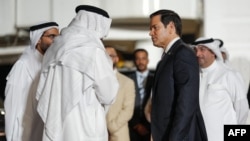
MANAMA -- US Secretary of State Marco Rubio said that a new round of US-Iran technical negotiations will resume in Switzerland at the end of June, as he wrapped the second day of a high-stakes Persian Gulf tour aimed at calming regional concerns over Washington’s tentative accord with Tehran.
“The technical group will be back, I believe, on the 29th or the 30th,” Rubio told RFE/RL in Kuwait on June 24 before arriving in Bahrain, outlining the next phase of talks involving US State Department and Department of Energy experts focused on sanctions, nuclear issues and implementation mechanisms.
His comments laid out Washington’s next steps in implementing the interim US-Iran memorandum of understanding, underscoring efforts to move quickly from a fragile truce toward a broader agreement.
Reassuring Gulf Allies
Rubio’s Gulf swing -- through the United Arab Emirates, Kuwait, and now Bahrain -- has focused heavily on reassuring Arab allies still wary of the agreement, particularly after enduring direct Iranian missile and drone strikes during the four-month conflict.
In Abu Dhabi, Rubio held a working lunch with UAE President Mohammed bin Zayed Al Nahyan, national-security adviser Tahnoun bin Zayed Al Nahyan and Foreign Minister Abdullah bin Zayed Al Nahyan, where discussions centered on the Iran memorandum, regional stability, and security guarantees.

In Kuwait, he met Emir Meshal Al-Ahmad Al-Jaber Al-Sabah and Crown Prince Sabah Al-Khaled Al-Sabah, reiterating that Washington would not strike any arrangement with Tehran at the expense of Gulf security.
“We’re not going to do anything that undermines the security of our longstanding allies in the region,” Rubio said.
He stressed that US military commitments in the Gulf remain tangible, not theoretical. “The security assurances are real," he said. "They’re not promises; they’re actual.”
Iran Sanctions Relief Remains Conditional
Rubio defended the controversial 60-day waiver on some US oil sanctions against Iran, saying the relief was temporary and reversible.
“Anytime you enter into a negotiation it’s a process of give and take,” he told reporters, warning Tehran that failure to comply with commitments made in Switzerland could trigger a snapback. “If they don’t live up to those commitments, the president has a lot of options at his disposal, including reversing these sanctions.”
Rubio also suggested the Trump administration could reconsider temporary waivers tied to Russian oil exports, introduced to stabilize global markets during the war.
“Potentially,” he said when asked by RFE/RL if those waivers may lapse, citing falling oil prices.
That comment could signal a tougher posture on Russian energy if market conditions continue to ease.
Strait Of Hormuz: No Fees, No Compromise
One of Rubio’s sharpest messages came on Iran’s reported proposal for a new Gulf “mechanism” that could involve transit fees for shipping through the Strait of Hormuz.
Rubio rejected the idea outright. “I know of no country on the planet that supports tolling or fees for the use of the straits,” he said. “The whole world will be against it.”
That stance aligns with Gulf Arab concerns and reflects Washington’s insistence that Hormuz remain an open international waterway after commercial traffic resumed following the cease-fire.
Rubio also pressed Iran to allow nuclear inspectors back in “as soon as possible,” saying inspections were a core commitment under the agreement.
“That needs to happen. That’s a commitment they made, and it’s one they need to keep.”

But major concerns remain unresolved.
The interim memorandum does not directly address Iran’s ballistic missile and drone capabilities -- a key issue for Gulf capitals -- oor the fate of Tehran’s stockpile of uranium enriched up to 60 percent, just below weapons-grade levels.
Rubio said Gulf allies would remain fully consulted as negotiations continue. “We’re going to be completely aligned with our partners in the Gulf,” he said.
Symbolic Flag-Raising, Normalization Message
In Kuwait, Rubio also attended a flag-raising ceremony at the US Embassy, where operations had been suspended during Iran-linked drone attacks.
The ceremony carried symbolism beyond diplomacy, marking the return of normal operations after months of conflict and disruption.
For Gulf capitals watching closely, the message was unmistakable: Washington wants to project continuity, resilience and normalcy even as the most sensitive parts of the Iran file are only beginning.
As Rubio arrived in Bahrain and prepares for broader consultations with Gulf Cooperation Council leaders, the challenge ahead remains balancing US President Donald Trump’s push for diplomacy with deep regional skepticism over whether Tehran can be trusted -- and whether any deal can truly hold.

