



Ukrainian Officials Begin 'Stabilization' Process In Kherson As Police, National Radio, TV Return
Local resident Valentyna Buhaiova embraces Ukrainian soldiers in the recently retaken village of Kyselivka, outside of Kherson, on November 12.
Ukrainian officials and local residents moved to stabilize conditions in the freshly recaptured southern city of Kherson, as Russian symbols were being torn down and with the restoration of Ukrainian radio and television service and a new police presence.
The action on November 12 came after months of occupation by Russian forces following their unprovoked invasion of Ukraine in February and as Ukrainian and Western officials hailed Kyiv’s latest “extraordinary” battlefield success and Moscow’s “strategic failure.”
Separately, Russian occupying forces said late on November 12 that they were preparing to leave the city of Nova Kakhovka, the site of a damaged dam on the Dnieper River, to a safer location, according to Russian state-run TASS news agency.
As jubilant Kherson residents awoke the morning following the arrival of the first Ukrainian troops, Ukraine’s military said it was putting “stabilization measures” in place to ensure safety.
Ihor Klymenko, chief of the National Police of Ukraine, said about 200 officers were at their posts in Kherson and that checkpoints had been set up. Authorities also began seeking out any evidence of possible Russian war crimes, he said in a Facebook post.
The Ukrainian communications watchdog said national TV and radio broadcasts had resumed in the strategic southern city and officials said aid supplies had begun to arrive from nearby regions.
Social media postings on November 12 showed local residents removing memorial plaques put up by Kremlin-installed authorities during the occupation.
Ukrainian President Volodymyr Zelenskiy and other officials warned that while special forces had entered central Kherson, the full deployment of Ukrainian troops was still under way and that some Russian soldiers could have shed military uniforms for civilian clothing and remained in the city.
“Even when the city is not yet completely cleansed of the enemy’s presence, the people of Kherson themselves are already removing Russian symbols and any traces of the occupiers’ stay in Kherson from the streets and buildings,” Zelenskiy said in his nightly video address.
But he said that “medicine, communications, social services are returning. Life is returning.”
WATCH: Local residents welcomed Ukrainian soldiers into Snihurivka on November 10, as advance forces of the Ukrainian military recaptured the town in the southern Mykolayiv region.

Ukrainian Foreign Minister Dmytro Kuleba, speaking to world leaders at an ASEAN summit in Cambodia, warned that the celebratory mood could turn grim with the possible discovery of war crimes evidence in Kherson.
Such evidence was discovered after Russian troops pulled out of the Kyiv and Kharkiv regions months ago.
“Every time we liberate a piece of our territory, when we enter a city liberated from the Russian Army, we find torture rooms and mass graves with civilians tortured and murdered by the Russian Army in the course of the occupation of the territories," he said. "It’s not easy to speak with people like this. But I said that every war ends with diplomacy and Russia has to approach talks in good faith.”
The White House on November 12 hailed Russia’s withdrawal from Kherson as an "extraordinary victory" for Ukraine.
"It does look as though the Ukrainians have just won an extraordinary victory where the one regional capital that Russia had seized in this war is now back under a Ukrainian flag -- and that is quite a remarkable thing," U.S. national-security adviser Jake Sullivan told reporters as he accompanied President Joe Biden to the ASEAN summit.
Russian Forces Digging Trenches, Fortifications On Banks Of Dnieper River, Satellite Imagery Shows
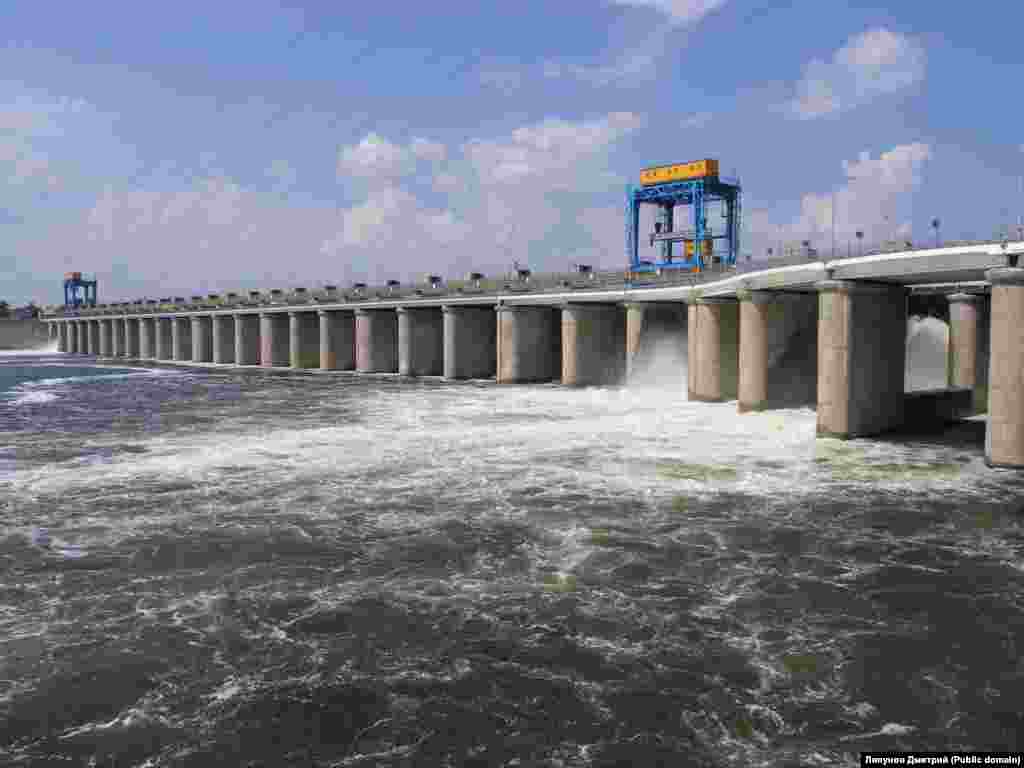
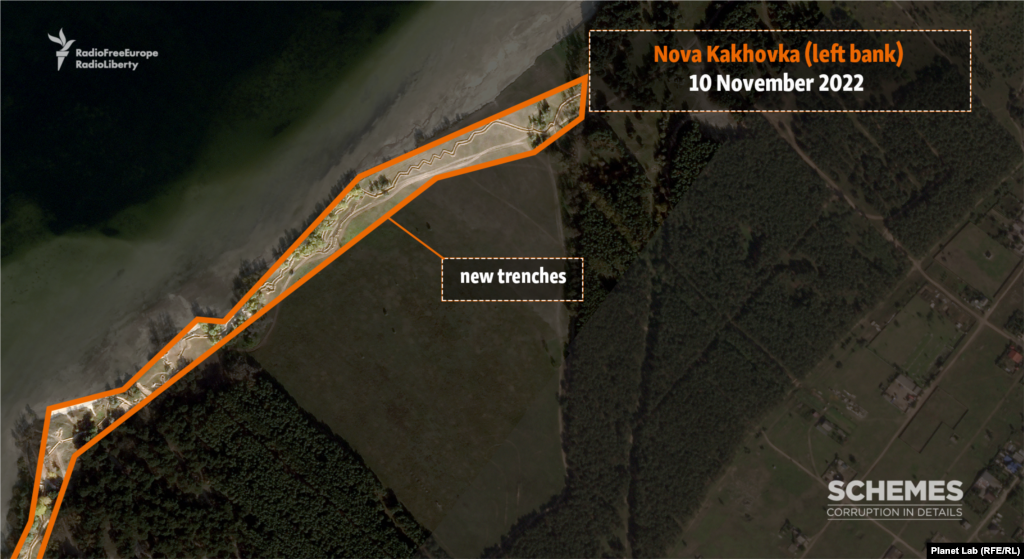
1/13Satellite images taken on November 10 by Planet Labs and obtained by RFE/RL show a network of trenches dug into the riverbanks upriver -- to the north -- of the town of Nova Kakhovka, the site of a major hydroelectric dam and the only remaining permanent crossing across the Dnieper.
Russian forces have dug extensive trenches and other fortifications on the east bank of Ukraine’s Dnieper River, new satellite imagery shows, as Russia stages a major retreat from the opposite bank and braces for further Ukrainian offensives.
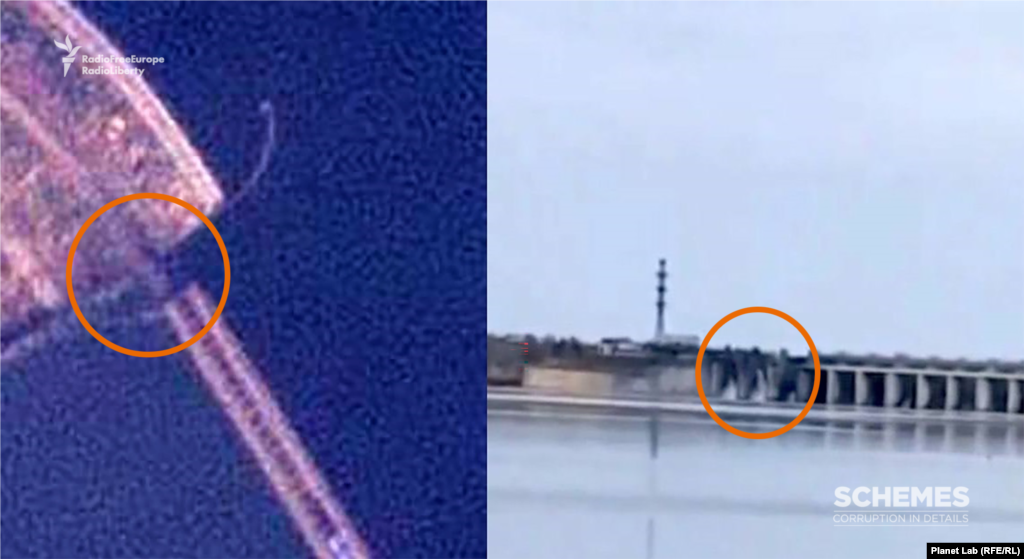
2/13Satellite photos also confirm that Russian troops blew up several spans of the bridge leading to the dam’s hydroelectric station. Ukrainian forces have pummeled the river crossings for weeks now, limiting Russia’s ability to resupply its forces on the west -- or right -- bank of the Dnieper.
That effort has also severely hindered Russia’s ability to withdraw its forces from the west bank amid an accelerating Ukrainian offensive toward the city of Kherson. On November 11, however, Ukrainian forces were reported in the city, and photographs and videos circulating on social media showed people waving Ukrainian flags, dancing, and chanting in the city’s main square.
Russian forces have dug extensive trenches and other fortifications on the east bank of Ukraine’s Dnieper River, new satellite imagery shows, as Russia stages a major retreat from the opposite bank and braces for further Ukrainian offensives.
3/13The images obtained by RFE/RL include ones taken more than a month ago, when Russian forces still controlled much of the west bank in Kherson Oblast and most of the riverfront and river crossings.
Since that time, Ukrainian forces have slowly pushed south and east, squeezing Russian forces.
Russian forces have dug extensive trenches and other fortifications on the east bank of Ukraine’s Dnieper River, new satellite imagery shows, as Russia stages a major retreat from the opposite bank and braces for further Ukrainian offensives.
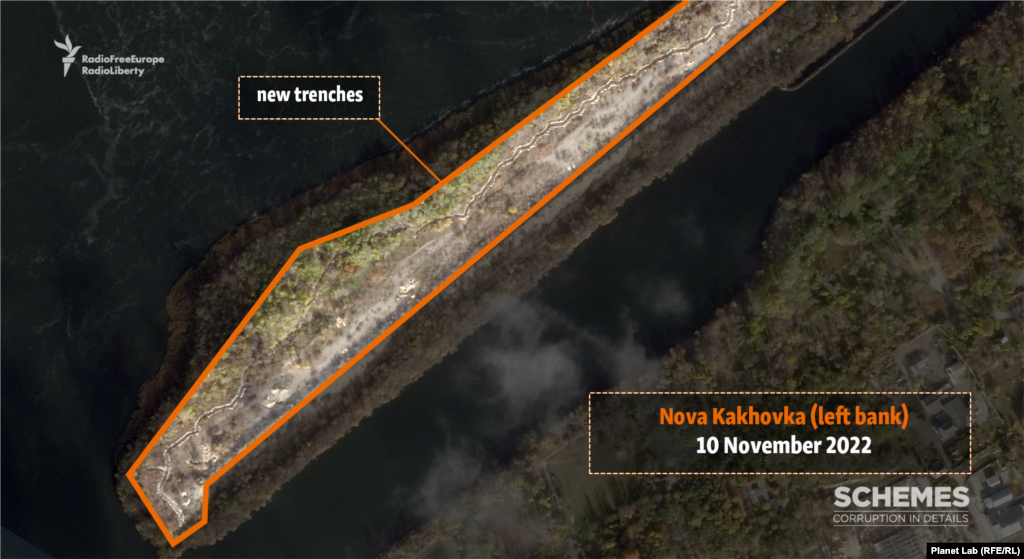
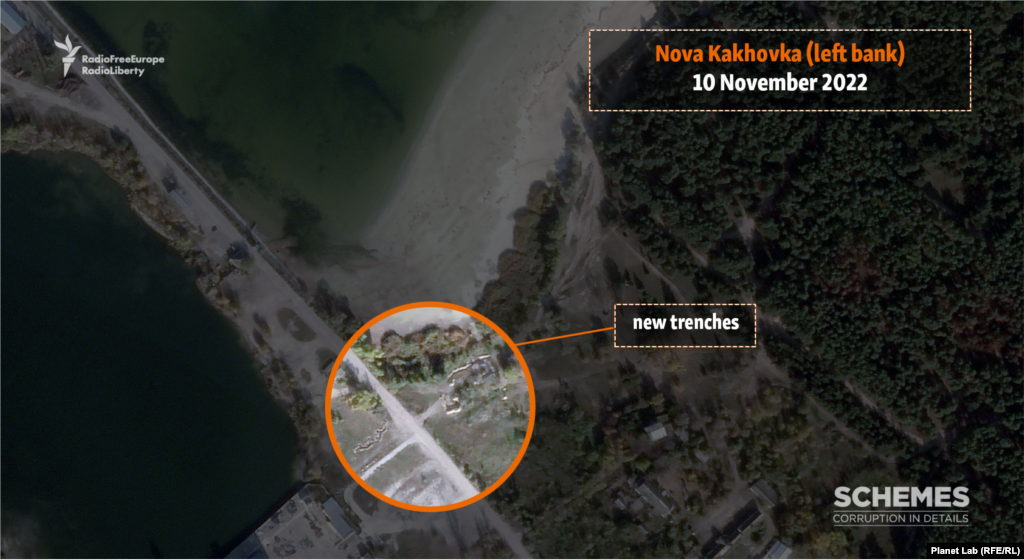
4/13At Nova Kakhovka, the images show a snaking line of trenches immediately downriver from the concrete dam itself, on an island known as Kos.
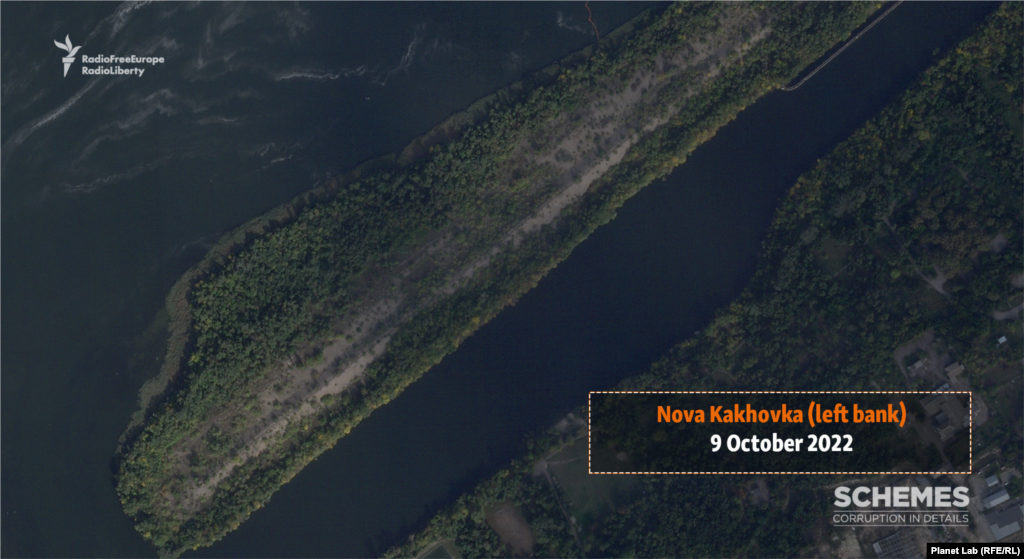
The trenches, estimated at about 2 kilometers in total, appear to have been dug sometime between October 9, when the most recent previous images were taken, and November 10.
Russian forces have dug extensive trenches and other fortifications on the east bank of Ukraine’s Dnieper River, new satellite imagery shows, as Russia stages a major retreat from the opposite bank and braces for further Ukrainian offensives.
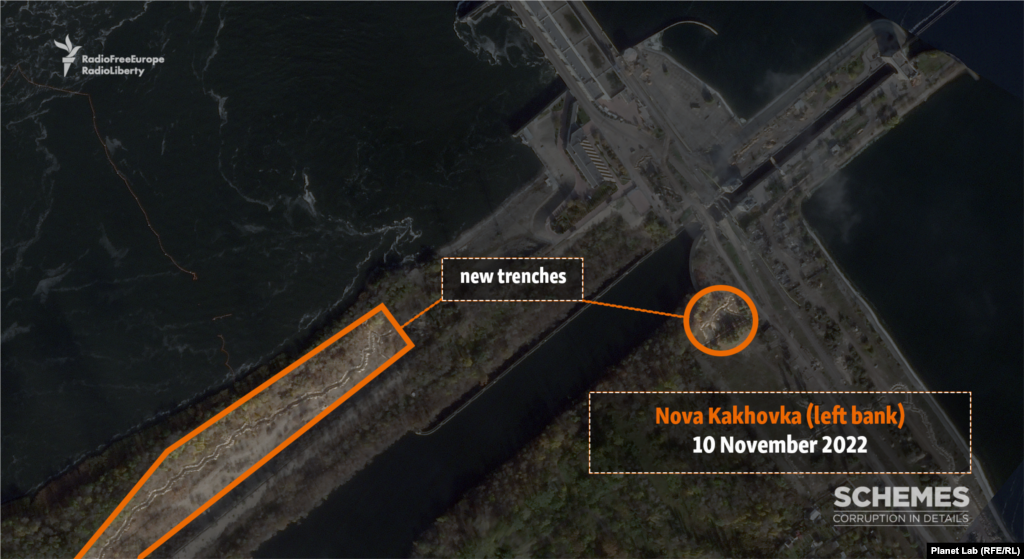
5/13A satellite image taken on November 10 showing the Nova Kakhovka hydroelectric plant, after Russian forces dug defensive trenches.
Russian forces have dug extensive trenches and other fortifications on the east bank of Ukraine’s Dnieper River, new satellite imagery shows, as Russia stages a major retreat from the opposite bank and braces for further Ukrainian offensives.
6/13Another image of a riverfront beach upriver from the dam also shows a snaking line of trenches that appear to stretch for hundreds of meters, paralleling the water.
Russian forces have dug extensive trenches and other fortifications on the east bank of Ukraine’s Dnieper River, new satellite imagery shows, as Russia stages a major retreat from the opposite bank and braces for further Ukrainian offensives.
7/13The defensive trenches do not appear in imagery taken last month.
Russian forces have dug extensive trenches and other fortifications on the east bank of Ukraine’s Dnieper River, new satellite imagery shows, as Russia stages a major retreat from the opposite bank and braces for further Ukrainian offensives.
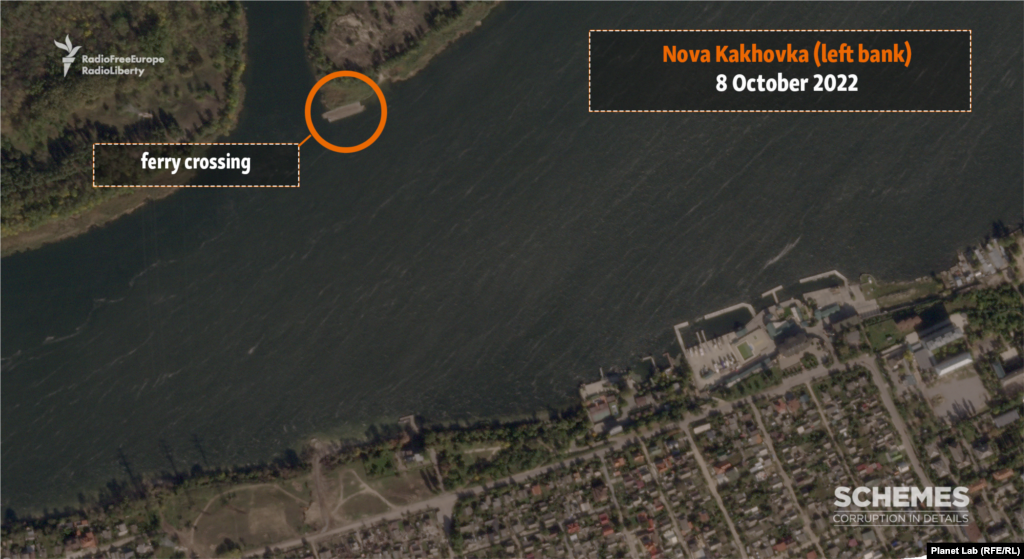
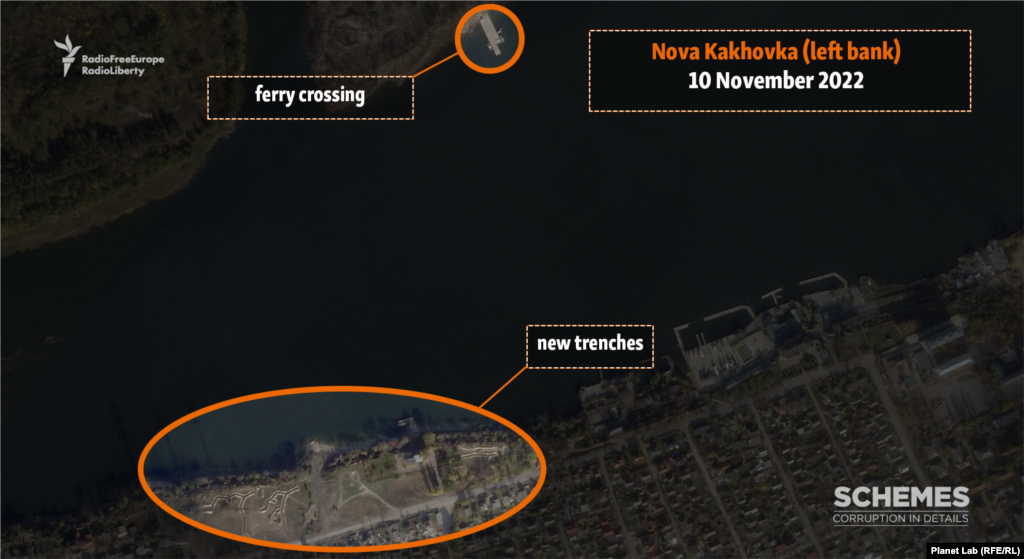
8/13About 6 kilometers downriver from the dam, more trenches can be seen on the riverbank, along with a pontoon ferry on the opposite bank to the north, beached on a sizable island close to the west bank.
Russian forces have dug extensive trenches and other fortifications on the east bank of Ukraine’s Dnieper River, new satellite imagery shows, as Russia stages a major retreat from the opposite bank and braces for further Ukrainian offensives.
9/13The ferry appears to be similar to one discovered by RFE/RL last month, based on social media videos and photographs posted by retreating Russian soldiers.
Russian forces have dug extensive trenches and other fortifications on the east bank of Ukraine’s Dnieper River, new satellite imagery shows, as Russia stages a major retreat from the opposite bank and braces for further Ukrainian offensives.
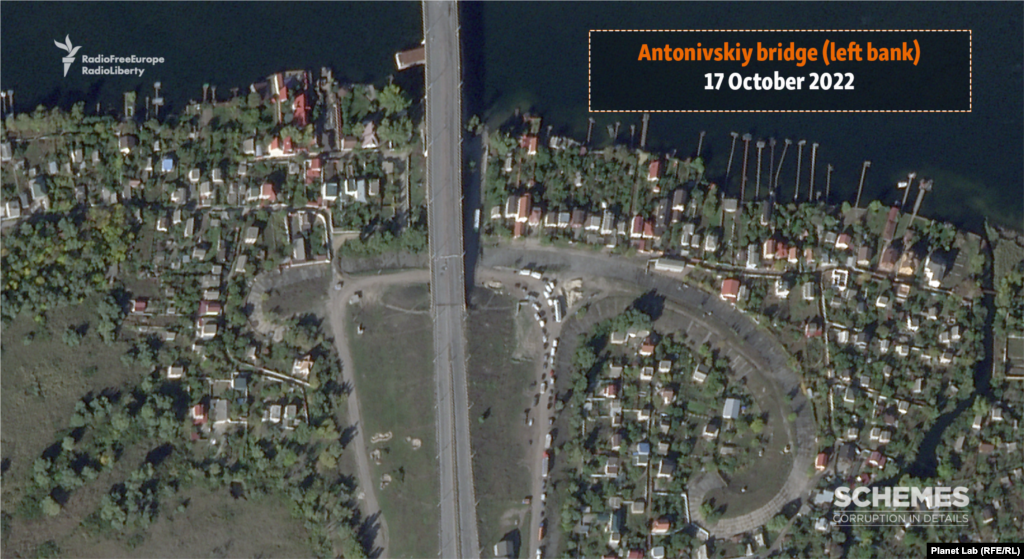
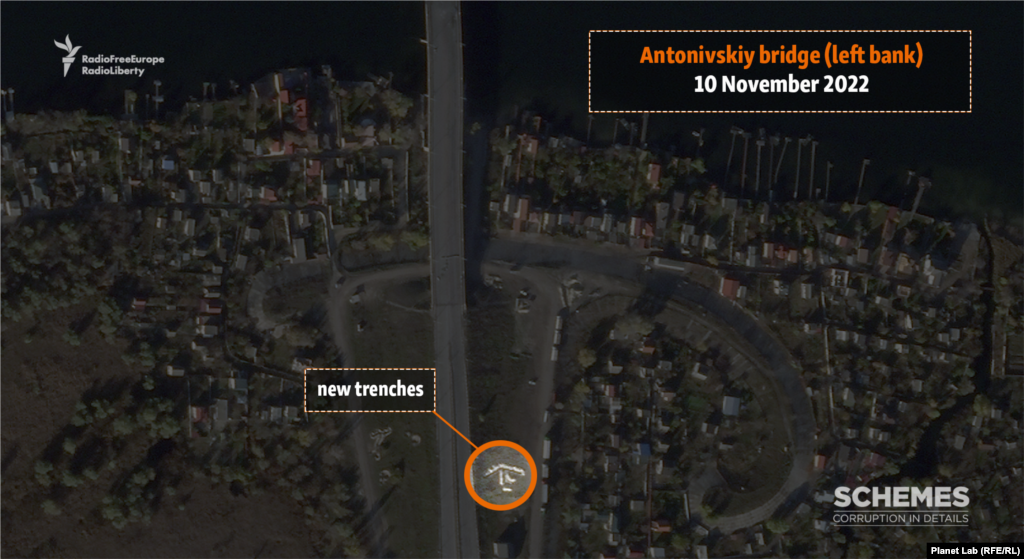
10/13Aside from the dam at Nova Kakhovka, the other major crossing linking the two banks of the Dnieper is the Antonivskiy Bridgeon the eastern outskirts of the city of Kherson.
The bridge has been repeatedly blasted by Ukrainian forces seeking to limit Russia’s ability to resupply its forces; the bridge surface spans have been heavily damaged and impassable for vehicles but have been intact until November 11.
Russian forces have dug extensive trenches and other fortifications on the east bank of Ukraine’s Dnieper River, new satellite imagery shows, as Russia stages a major retreat from the opposite bank and braces for further Ukrainian offensives.
11/13Another satellite image taken on November 10 shows the new Russian trench fortifications on the southern approach to the bridge, on the opposite side of the river from the city of Kherson itself.
Russian forces have dug extensive trenches and other fortifications on the east bank of Ukraine’s Dnieper River, new satellite imagery shows, as Russia stages a major retreat from the opposite bank and braces for further Ukrainian offensives.
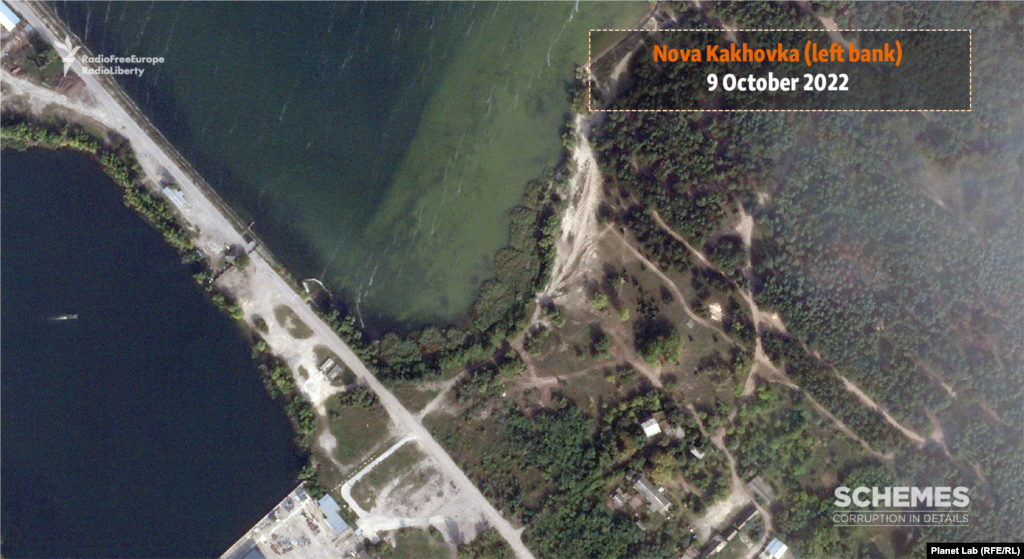
12/13A satellite image taken on October 9 immediately upriver from the Nova Kakhovka dam, before Russian forces dug defensive fortifications.
Russian forces have dug extensive trenches and other fortifications on the east bank of Ukraine’s Dnieper River, new satellite imagery shows, as Russia stages a major retreat from the opposite bank and braces for further Ukrainian offensives.
13/13A satellite image taken on November 10 from the same location adjacent to the Nova Kakhovka dam, after Russian forces dug defensive fortifications.
A day earlier, Russian Defense Minister Sergei Shoigu and the top Russian commander in charge of the Ukraine war, General Sergei Surovikin, announced a wholesale retreat from the west bank. On November 11, the Russian Defense Ministry announced that the withdrawal was completed, though that could not be immediately verified by RFE/RL.
Between 20,000 and 30,000 Russian troops were estimated to have been on the west bank in recent weeks, U.S. General Mark Milley, the chairman of the U.S. Joint Chiefs of Staff, said this week.
Russian forces have dug extensive trenches and other fortifications on the east bank of Ukraine’s Dnieper River, new satellite imagery shows, as Russia stages a major retreat from the opposite bank and braces for further Ukrainian offensives.
Previous slide
Next slide
Sullivan said that the Russian retreat would have "broader strategic implications," including relieving the longer-term threat by Russia to other southern Ukrainian cities such as Odesa.
"It's a big moment, and it's due to the incredible tenacity and skill of the Ukrainians, backed by the relentless and united support of the United States and our allies," Sullivan said.
Asked about reports that the Biden administration has started to press Zelenskiy to explore negotiations with Moscow, Sullivan said Russia, not Ukraine, was the side that has to decide whether or not to go to the table.
"This whole notion, I think, in the Western press of, 'When's Ukraine going to negotiate?' misses the underlying fundamentals," Sullivan said.
Russia, he added, continues to make "outlandish claims" about its self-declared annexations of Ukrainian lands, even as it retreats from Ukrainian counterattacks.
"Ultimately, at a 30,000-foot level, Ukraine is the party of peace in this conflict and Russia is the party of war. Russia invaded Ukraine. If Russia chose to stop fighting in Ukraine and left, it would be the end of the war. If Ukraine chose to stop fighting and give up, it would be the end of Ukraine," he said. "In that context, our position remains the same as it has been and fundamentally is in close consultation and support of President Zelenskiy.”
Separately, British Defense Secretary Ben Wallace said on November 12 that Moscow's "strategic failure" in Kherson will sow doubt among the Russian public about the point of the war in Ukraine.
"Russia's announced withdrawal from Kherson marks another strategic failure for them. In February, Russia failed to take any of its major objectives except Kherson," Wallace said in a statement. "Now with that also being surrendered, ordinary people of Russia must surely ask themselves: 'What was it all for?'"
Meanwhile, Pavel Filipchuk, the head of the occupation government in Nova Kakhovka, told administrators and residents that Russian forces will be pullng back from the city on the right bank of the Dnieper River.
He cited concerns that the key dam could be damaged by missiles, which would result in flooding.
Both Kyiv and Moscow have accused each other of planning to blast the dam, which has already been severely damaged.

RFE/RL's Ukrainian Service has seen its audience grow significantly since Russia's full-scale invasion in February 2022 and is among the most cited media outlets in the country. Its bold, in-depth reporting from the front lines has won many accolades and awards. Its comprehensive coverage also includes award-winning reporting by the Donbas.Realities and Crimea.Realities projects and the Schemes investigative unit.