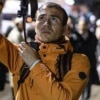




KHERSON, Ukraine -- Oleksandr gave a battle-hardened chuckle as he spoke about the constant threat of Russian drones over his hometown. But moments later, he was fighting back tears.
"This is our country. This is my home. I have tried…but I can't live without Kherson. That's how it is," he said.
The conversation was abruptly interrupted by gunfire, buzzing, and a shouted warning that a Russian Lightning drone was nearby. The RFE/RL Ukrainian Service team joined locals running across broken glass to a shelter.
Oleksandr is a resident of Kherson, a city that had some 280,000 inhabitants before Russia's full-scale invasion in 2022 but which now has a population of around 60,000.
Swiftly occupied by Russian forces, it was liberated months later and has since been repeatedly attacked by shells and drones launched by Russian forces dug in on the eastern bank of the Dnieper River on the edge of the city.
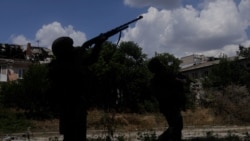

Now, municipal teams work in bulletproof vests under the cover of mobile air defense units. When the all-clear sounded, a team got back to work boarding up blasted windows in a housing block with plywood.
"Every day you understand that people are taking risks, risking their lives," said Volodymyr Tsiktor, head of the municipal works department. "There was one recent case where a garbage truck was hit. It was pretty obvious that it wasn't a military vehicle, but a drone struck it. Thankfully, everything was OK. The people inside suffered only minor injuries."
'Human Safari'
Civilians in Kherson are frequently hunted by first-person-view drones, or FPVs, in attacks dubbed a "human safari." This week, video of a Russian drone stalking and attacking a 52-year-old man selling vegetables at a local market made global headlines. The man suffered concussion and shrapnel wounds, but local authorities say Russian FPV drone attacks killed 29 civilians in July alone.
Tsiktor said the tactic was "probably to drive people into despair, into panic…. It's terror to force the population to leave."
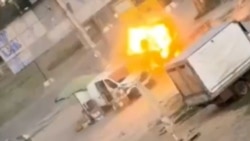
Across town, a mobile air defense unit was moving across Glory Park. Once a popular place for Kherson residents to relax, it's now a battlefield. Just a few hundred meters from the riverbank, the park is a frequent flight path for attacking Russian drones and is one of the most dangerous places in Kherson.
The air defense unit was manned by Ukrainian police officers who said they could not have previously imagined their work would one day involve shooting down drones.
"Whenever I come here and look across the river, that's where my home is. That's where I grew up. That's where I went to school. Now, all that's left are the memories," said one of the policemen, who cannot be named for security reasons.
Many of these men have relatives across the river in the Russian-occupied areas.
"I really want to see my parents, who stayed there and are suffering both emotionally and physically, when they beat my father up," said another officer.
'Attention All Units'
This conversation was also interrupted. This time, by a walkie-talkie announcement: "Attention all units, an enemy Lightning (drone) is approaching the Dnieper." The team immediately took up positions and opened fire with small arms. Explosions boomed nearby.
Many of the surrounding buildings have been scorched black by fires. In one, two women were hiding in the entrance. Nearly everybody else has fled the area.
"Our apartments are burnt out," said Klavdia, as she showed the RFE/RL team into a basement where she now lives with other local residents who refuse to leave or have nowhere else to go.

As a radio news broadcast reported on another drone strike, she spoke of the daily fear of life on the front line.
"It's so scary for us, of course. We run to take shelter, the drones are firing," she said. "We barely manage to make it to the store. We go there under fire…I don't know what's going to happen next."
Klavdia has electricity and running water in her communal basement, but public transport does not run in this part of Kherson. Elsewhere in the city, the buses are still in operation. They too are targets for Russian drone controllers.
"Every day, when our drivers set off, they realize that they are being hunted," said Vadim Melnik, head of the municipal transport authority. "About 200 drones fly over Kherson every day, so it's hard work. But the transport still functions. Drivers understand their responsibility."
And not just drivers. Melnik recounted the story of a 68-year-old mechanic who was riding his bike to work when a Russian drone locked onto him. He was, Melnik added, hardly a military threat.
"But he was attacked and, unfortunately, he died."