



In his latest Power Vertical blog, Brian Whitmore outlines the significance of recently released recordings between a Kremlin aide and Ukrainian proxies that suggest Moscow was instigating unrest in eastern Ukraine even before the annexation of Crimea.
How To Manufacture A War
Before the guns of April, came the protests of February and March.
Before the armed conflict, came the unarmed uprisings.
Before there was a war in the Donbas, there was the so-called Russian Spring.
There has long been scant doubt about the Kremlin's deep involvement in -- and instigation of -- the war in Ukraine's Donetsk and Luhansk oblasts that began in April 2014.
But the mass antigovernment demonstrations that erupted in Russophone cities in eastern and southern Ukraine in the months prior -- dubbed the Russian Spring by the pro-Kremlin media -- were always much more ambiguous.
In the hypercharged and chaotic environment after pro-Moscow President Viktor Yanukovych was ousted by the Euromaidan uprising in Kyiv, it was entirely plausible that the Russian Spring was an organic local grassroots phenomenon that the Kremlin merely exploited and piggybacked on.
But that seems a lot less plausible now.
Ukraine's Prosecutor General's Office this week released what it says are recordings of intercepted telephone conversations between Kremlin aide Sergei Glazyev and proxies in Ukraine, in which he gives them specific instructions about instigating unrest in Donetsk, Kharkiv, Zaporizhzhya, and Odesa as early as February 2014 -- before Russia had even annexed Crimea.
The intercepts suggest not only that the Russian Spring was instigated, organized, and financed by Moscow, but also that the Kremlin planned to annex large swaths of eastern Ukraine if the uprisings proved successful.
But in order to do this, they needed a "massive local insurgency, Anton Shekhovtsov of the Vienna-based Institute of Human Studies noted.
It didn't matter "whether those locals would be ideologically mobilized or bought, Moscow needed them to present a picture of a native uprising and justify the military invasion "in defence of the people," Shekhovtsov wrote on Facebook.
As it turned out, Russia only managed to stir up sufficient unrest to intervene militarily in Donetsk and Luhansk. They failed in Kharkiv, Odesa, Zaporizhzhya, and elsewhere.
But it apparently wasn't for a lack of trying.
Read Brian's entire blog here.
Or, if you'd prefer the short version, Brian also tackled the same subject in today's Daily Vertical:


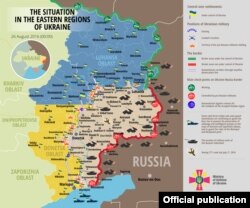
Here is today's map of the latest situation in the Donbas conflict zone, according to the Ukrainian Defense Ministry (CLICK IMAGE TO ENLARGE):