

News just in from RFE/RL's Rikard Jozwiak in Brussels:
EU Prepared To Prolong Sanctions Against Russia Over Ukraine
BRUSSELS -- European Union ambassadors appear set to prolong asset freezes and visa bans against 146 individuals and 37 entities that, according to the EU, are responsible for actions against Ukraine's territorial integrity.
EU sources have told RFE/RL that the decision to prolong the measures by six months will be taken ahead of a September 15 deadline without much discussion.
The targets of the sanctions include companies in Crimea and various battalions formed by the Russia-backed separatists in eastern Ukraine, as well as Russian politicians like Deputy Prime Minister Dmitry Rogozin and Dmitry Kiselyov, a state media executive and presenter whom many regard as the Kremlin's chief propagandist.
The sanctions were first introduced in March 2014 after Russia's seizure and illegal annexation of Ukraine's Crimean Peninsula.
The EU's economic sanctions that target Russia's energy, military, and financial sectors are up for renewal on January 31.
EU sources told RFE/RL that those sectoral sanctions will be discussed at a Brussels summit of EU leaders in October.
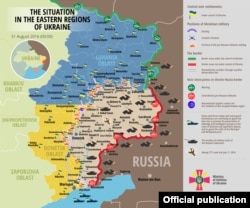
Here is today's map of the security situation in eastern Ukraine, according to the National Security and Defense Council (CLICK TO ENLARGE):
An excerpt:
On a sultry Saturday evening in August, hundreds of young Kievans have descended on a vast courtyard a few miles from the city centre. As a DJ spins electronica in front of a 20-ft LED screen, some partygoers stand in a paved open area bobbing their heads to the music, while others crowd the bar or sneak off to a leafy grotto to chat and canoodle.
The scene evokes late 90s Williamsburg, not the capital of a crisis-wracked country at war. “Lately there are so many more shows, so many more interesting parties like this,” says Ilya Myrokov, a 25-year-old dentist with a bowl cut, shaking his head as he sips beer from a plastic cup. “Compared to two years ago, it’s like an explosion.”
Last year, Ukraine’s economy shrank by 12%. Its slow-drip, two-and-a-half-year conflict with Russia has killed nearly 10,000 people and displaced about two million in the east of the country. But if the Maidan revolution, which ousted a Russia-friendly regime in February 2014, has largely failed to install the transparent, democratic government its proponents envisioned, it at least appears to have democratised Ukrainian culture.