


This rather impressive video of the Crimea blockade was uploaded to YouTube today (natural sound):
Frontline, a PBS investigative series, received an Emmy for The Battle for Ukraine, a documentary about Euromaidan and fighting in Donbas.
Interior Minister Arsen Avakov has said that Ukraine’s militia will formally cease to exist on November 7. However, it will take around six months for the new police to be fully functional.
In the former U.S.S.R. the word "militia" was used instead of the Western "police" to describe civilian law enforcement. Ukraine had its own reasons to rename the force when the reforms began. First, to distinguish the Ukrainian police from the "people's militia" that is functioning in the territories under control of the separatists in Donbas, according to earlier Avakov statements. Second, to separate the police from its past.
"On November 7 the militia will de jure cease to exist -- and across the country the police will de jure be operating. This is de jure, and de facto the transition process from old to new will last about six months. No one will automatically transfer to the police from the militia," Avakov wrote on Facebook.
First, the structure of the militia will change in accordance with the law about the new police. Then the staff will go through contests and interviews. There will be a "full recertification of the personnel," according to the minister.
"For 23 years of independence the militia was practically protecting the government from the people. Now it has to protect the people," said Anton Herashchenko, an adviser to the interior minister.
Not directly related to the current situation, but it seems the Ukraine crisis is opening up some old wounds (from RFE/RL's news desk):
A member of a Ukrainian nationalist group has been sentenced in Russia to 24 1/2 years in prison for fighting with Chechen separatists against Russian troops in the mid-1990s.
Chechnya's Shatoi district court found Oleksandr Malofeyev guilty on September 29 of being a member of the Ukrainian National Assembly-Ukrainian National Self-defense (UNA-UNSO) and killing Russian federal troops in Chechnya from 1994 to 1996.
Malofeyev pleaded guilty and testified against two other alleged members of UNA-UNSO, Mykola Karpyuk and Stanislav Klykh, whose case Chechnya's Supreme Court started hearing on September 16.
Investigators say Karpyuk and Klykh took part in military activities in Chechnya that left dozens of Russian soldiers dead and injured.
The whereabouts of the two Ukrainians is unclear.
Some reports say they were both arrested in Russia last year, although others say one was kidnapped inside Ukraine.
Where they have been held up until the start of the trial is also unknown.
Kyiv said it asked Moscow to allow Ukrainian officials to visit Karpyuk and Klykh, but Russian officials have denied the requests.
(TASS, Interfax)
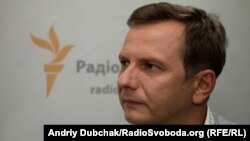
Ukraine will come out a loser in the airline sanctions war between Kyiv and Moscow, says Ukrainian economist Oleh Ustenko in an interview with RFE/RL's Ukrainian Service.
"Some experts now talk about certain numbers; that Russia will lose, for example, more than $100 million, and Ukraine $50 million-$60 million. We can't compare absolute values. We have to compare with regards to the market. Let’s say, if for Russia $100 million is peanuts, then for us $50 million, considering our GDP, is a lot of money," Ustenko said.
The Ukrainian government should think more broadly instead and emphasize the need for reforms where fighting corruption is a priority, he added.
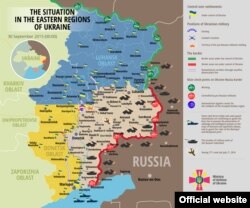
Here is today's map of the latest situation in the Donbas conflict zone -- courtesy of Ukraine's Defense Ministry (click image to enlarge):
U.S. Ambassador to Ukraine Geoffrey Pyatt writes on Twitter that President Petro Poroshenko and U.S. Vice President Joe Biden discussed the possibility of the U.S. supplying Ukraine with military radars during their latest meeting.
How many radars and when exactly they will be delivered remains unclear.
Poroshenko and Biden met on September 29 in New York.