


Dutch referendum plan threatens to derail EU-Ukraine pact:
Election officials in the Netherlands have cleared the way for a referendum that could disrupt a keystone of closer ties between the European Union and Ukraine.
The Dutch authorities said a signature drive by Euroskeptic groups succeeded in forcing the nonbinding vote to challenge the EU-Ukraine Association Agreement signed last year.
Backers regard the deal as crucial for anchoring Ukraine to the West, while Moscow views it as a challenge to Russian interests in its so-called near abroad.
Like 21 other EU governments, the Dutch have already approved the agreement, which requires passage in all 28 member states to enter into full effect.
But a "no" vote, even in a nonbinding referendum, would almost certainly force a rethink in the Netherlands and provide momentum to opponents in any states where passage is still pending.
Legislation entered into force in the Netherlands in July setting a threshold of 300,000 citizens to trigger a nonbinding referendum on laws and treaties.
The Dutch election board on October 14 declared nearly 428,000 signatures valid in the GeenPeil (No Poll) citizens movement's petition drive, setting the stage for the vote within six months.
That time frame makes it likely the referendum takes place in the first half of 2016, when the Netherlands holds the EU's rotating presidency.
The signatures were collected thanks to an intensive campaign by the political and satiric blog GeenStijl (No Style), the citizens group Burgercomite EU, and Eurocritical think tank Forum voor Democratie.
Geert Wilders, the leader of the populist anti-EU and anti-immigration PVV party, has backed the initiative.
The main party in the ruling Dutch coalition, the VVD, described the organizers as "friends of [Russian President Vladimir] Putin," a sensitive accusation in the wake of the shooting down of Malaysia Airlines Flight 17 over eastern Ukraine last year. One hundred ninety-three of the 298 people who died in that crash were Dutch.
Dutch investigators on October 14 announced their conclusion that the plane was downed by a Buk surface-to-air missile fired from a part of eastern Ukraine that was mostly under the control of Russian-backed separatists.
The campaigners against the EU-Ukrainian Association Agreement have said their aim is to give ordinary Dutch citizens a chance to have their voices heard and force a broader debate about the EU and the direction it is heading in one of the bloc's founding member states.
Despite the EU's recent expansion, GeenPeil claims, the bloc is built on a "fragile foundation" because of a lack of democratic participation by European citizens.
There are also concerns that the pact will be a precursor to Ukraine's EU membership and will commit the Netherlands to siding with Ukraine in its ongoing conflict with Russia.
The referendum's outcome would be advisory in nature, but Jan Roos, who runs the GeenStijl blog, told a press conference in The Hague on October 14 that "If people support the referendum, it will make it impossible for the cabinet not to listen to what voters have to say."
Bloomberg.com quoted Adriaan Schout of The Hague-based Institute for International Relations as saying EU negotiators might have to dilute their commitments to Ukraine or narrow their focus to improved trade terms to win back Dutch support.
"The established pro-European parties would be well-advised to take this [referendum] very seriously," professor Rudy Andeweg, a senior political lecturer at Leiden University, told the AFP news agency. (AFP, Bloomberg, EUobserver.com)
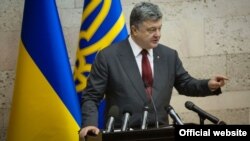
President Petro Poroshenko claimed that the Ukrainian government has already collected more than 10 billion hryvnyas (more than $465 million), which it can spend on renewing infrastructure in Donbas.
"Our European and American partners will give four, five times more," he said in an interview with Dnipropetrovsk TV channels, RFE/RL's Ukrainian Service reports.
Chancellor Angela Merkel said that Germany was ready to allocate 500 million euros that can immediately go to Donbas restoration.
"We'll do this, but there has to be peace, restoration of the Ukrainian flag, Ukrainian sovereignty," he added.
During today’s right-wing march through Kyiv, an unknown person threw a miniature explosive device into the crowd, local police reported.
"It was a squib, nobody was hurt," the police press service said.
All in all, law enforcement seized fireworks, knives, and brass knuckles from more than 10 march participants. After identifying those carrying the objects, police didn't detain anybody.
Ukrainian right-wing activists are marching through Kyiv, calling it a March of Heroes, to celebrate the Day of the Defenders of Ukraine. According to one of the organizers of the event, around 10,000 people participated. The police said 2,000 participants, RFE/RL's Ukrainian Service reports.
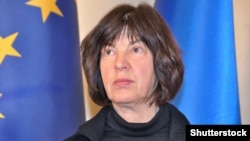
Member of the European Parliament Rebecca Harms tells RFE/RL's Ukrainian Service that the European Union has not yet considered lifting sanctions imposed on Russia after it annexed Crimea.
"Lifting sanctions imposed for Crimea’s annexation is out of the question. When people talk about softening or changing sanctions, it refers to economic sanctions imposed due to the war in Donbas. Crimea is a separate issue," Harms said.
She also added that, in her opinion, economic sanctions imposed on Russia over its actions in Donbas could not be lifted until the Minsk agreement was fulfilled.