


A tweet from the account of the political editor of Germany's Bild newspaper:
RFE/RL's Brussels correspondent has been talking to the Council of Europe's rights commissioner:
The Council of Europe's human rights commissioner, Nils Muiznieks, says conditions are dire in the section of eastern Ukraine held by Russia-backed separatists, with many people lacking water, food, or basic care and becoming increasingly isolated.
Muiznieks, who was allowed to travel to separatist-controlled areas of the Donetsk and Luhansk regions for the first time this summer, discussed his findings with RFE/RL's Rikard Jozwiak in Brussels on November 3.
RFE/RL: Today, your office released a report on the humanitarian situation in Ukraine after a visit you made there this summer. How would you describe the humanitarian situation in both the eastern part of the country and in Ukraine in general?
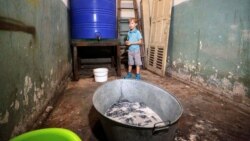
Nils Muiznieks: In the east it is quite dire. There are many who are suffering from lack of access to water. There are many internally displaced persons both in the rebel-held areas as well as the government-controlled areas. There are many people in institutions in the east who are lacking basic care -- older people, persons with disabilities, children, prisoners.
The most vulnerable, that I heard from my interlocutors, were people living at or near the contact line (Editor's note: the military separation line between government-controlled areas and areas held by Russia-backed separatists) -- many older couples living very close to the conflict line who don't want to leave their homes, but do not have regular access to food, water, health care, and so on.
There are also people displaced within [the] Donetsk and Luhansk regions as well as 1.5 million displaced persons living in the rest of Ukraine. They are very vulnerable and especially [now that] winter is coming...the situation is quite difficult with them.
And the problem which I raised there was the access of international humanitarian organizations -- both nongovernmental and international organizations. The local authorities in Donetsk and Luhansk look upon them with great suspicion. Why are they collecting data? What do they want from us? Why are they not helping more? And I tried to explain to them how the humanitarian organizations work, to urge a one-stop shop, to urge the creation of humanitarian corridors, and to make access to help people easier than it is now.
Read the entire article here
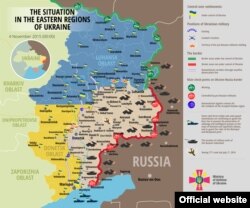
Here is today's map of the latest situation in the Donbas conflict region, courtesy of the Ukrainian Defense Ministry (CLICK IMAGE TO ENLARGE):