



Ukrainian Parliamentarian Accused Of Striking Female Lawmaker With Bottle
Fighting in Ukraine's parliament is all fun and games until a female lawmaker gets hit in the eye with a glass bottle.
The Fatherland party is boycotting parliament and a cross-party grouping of women in the Verkhovna Rada is demanding that a male lawmaker leave office after Fatherland deputy Oleksandra Kuzhel was struck with a bottle during an argument.
The 62-year-old Kuzhel suffered a black eye and a concussion as a result of the November 5 incident, which took place during an argument with People's Front party deputy head Andriy Teteruk after the day's session had ended.
The clash outside the office of speaker Volodymyr Groysman was the second physical altercation between Kuzhel and Teteruk this week.
"According to a witness -- lawmaker … Serhiy Vlasenko -- Teteruk made insulting remarks about Fatherland lawmakers and personally offended Kuzhel and hit her on the head with a glass bottle," Fatherland's press office said on November 6.
Read more of the story by RFE/RL's Farangis Najibullah here.
Ukraine's Ex-Justice Minister Lukash Arrested On Corruption Charges
By RFE/RL's Ukrainian Service
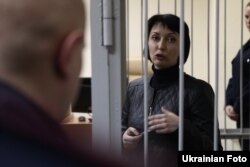
KYIV -- A Ukrainian court on November 6 ordered the arrest of former Justice Minister Olena Lukash on corruption charges, a day after she was detained in connection with an investigation into deadly Maidan shootings of February 2014.
The charges against Lukash include misappropriation of state funds worth about $2.5 million, as well as forgery and abuse of her office.
The November 6 arrest order by Kyiv's Pechersky District Court granted her the possibility of paying bail of 5.1 million hryvni ($221,000) within the next five days.
Prosecutor Vladislav Kutsenko says Lukash was not being charged in connection with the Maidan shootings during opposition protests in 2014 that brought down the pro-Russian government of then-President Viktor Yanukovych.
However, Kutsenko said Lukash was being questioned as a witness in that case.
More than 100 people were killed on and around Kyiv’s central Independence Square -- known as Maidan Square -- by sniper fire from February 18-20, 2014.
An ongoing Ukrainian investigation has not yet identified who was behind the attacks.
Lukash served as Ukraine's justice minister in 2013 and early 2014.
She was dismissed on February 27, 2014, days after Yanukovych was toppled from power and fled to Russia.
In February 2015, Ukraine's prosecutor-general requested that the Interior Ministry and Ukrainian Security Services arrest Lukash on suspicion of involvement in masterminding the shootings of antigovernment protesters.
In May, the Prosecutor-General's Office filed charges in absentia against Lukash for the alleged mismanagement of public funds, forgery, and abuse of office.
Lukash said on November 6 that she was certain her friends would deposit her bail and that the court would ultimately acquit her of the corruption charges.
She also said she considered the court order for her arrest to be unfounded.
With reporting by AP, Interfax, and UNIAN
Lavrov Says Ukraine's Minsk Deadlines Should Be Extended Into 2016
By RFE/RL
Russian Foreign Minister Sergei Lavrov says it is clear that deadlines on political reforms in Ukraine under the Minsk agreements need to be extended into 2016.
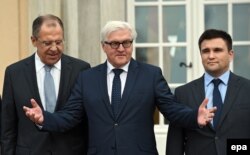
Lavrov issued the statement after meeting in Berlin on November 6 with the foreign ministers of Germany, France, and Ukraine to discuss the next steps toward ending Ukraine’s conflict.
The meeting took place amid a growing awareness that progress on a peace plan has been slower than hoped for in the conflict between Ukrainian government forces and Russian-backed separatists in eastern Ukraine, which has killed more than 7,900 people since April 2014.
The conflict also has soured relations between Russia and the West, which accuses the Kremlin of playing a direct military role in the conflict.
Russia continues to deny that it is sending its troops and weaponry into eastern Ukraine, despite growing evidence to the contrary.
The trust-building pact reached in Minsk has sharply deescalated the violence, but the situation in eastern Ukraine remains fragile.
After the November 6 talks in Berlin, Germany’s Foreign Minister Frank-Walter Steinmeier said: "We can be glad that the cease-fire regime has been observed to a certain extent."
But he said "some serious challenges" remain, including organizing fair local elections in separatist-held areas of eastern Ukraine.
He said the delivery of humanitarian assistance to eastern regions also is vital.
The chief monitor for the Organization for Security and Cooperation in Europe (OSCE), Ertugrul Apakan, said earlier in the week that the cease-fire has been "largely holding" since September but that the situation remains "volatile."
There have been sporadic outbreaks of violence, but there also have been exchanges of prisoners under the Minsk agreements.
Officials at the Berlin talks acknowledged that on many points, parties to the conflict are lagging behind the timetable set down under the Minsk agreements to end the conflict.
That suggests that the aim of completing all the steps by the end of 2015 is no longer achievable.
The German Foreign Ministry said the withdrawal of heavy weapons from front-line positions in eastern Ukraine was one possible measure that could be considered at the closed-door meeting, with recent progress on withdrawal of small-caliber artillery and mortars serving as a model.