



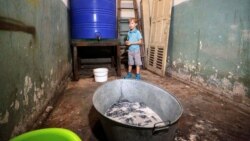

In Eastern Ukraine, A Young Life Shattered
By Christian Borys
KYIV/MARIUPOL -- On the grass outside an old Soviet-era military hospital, tucked on a side street in the capital, Kyiv, Ukrainian soldiers in camo-patterned jackets and fur hats puff on cigarettes and share laughs.
Their banter reflects the current lull in the fight against Russian-backed separatists hundreds of kilometers to the east, where a shaky cease-fire is holding despite occasional flare-ups and no sign of a lasting solution.
But just a few steps away, in a medical building surrounded by the nearly leafless trees of autumn, lies a tragic example of one of the legacies of war that could haunt Ukraine well into its future.
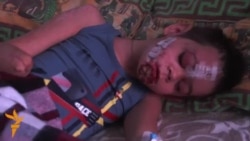
Eleven-year-old Mykola Nyzhnyakovskyy -- Kolya to his mom and friends -- is straining to scratch the itching wounds from shrapnel embedded in what's left of his legs. He is using his left hand, the one that remains.
His mother, 38-year-old Alla Nyzhnyakovska, caresses his head and tries to put a brave face on his situation since the day two months ago when an unexploded munition shattered three of Kolya's limbs and killed his 4-year-old brother, Danylo, instantly.
"I'm showing him pictures of soldiers who've lost their limbs but manage to live normal lives now," she says as she flashes a photo of a man with two prosthetic legs holding a baby. "I want him to know that he still has a life ahead of him, that there is hope to start a family and live a normal life."
It is just one facet of the 20-month-old conflict paralyzing the country since a separatism-fueled war erupted in eastern Ukraine. But unlike the shooting, it threatens to keep killing well beyond the end of the fighting.
Read the full story here.
Ukraine's Azov Regiment Opens Boot Camp For Kids
Children in Ukraine's Sumy region can attend a boot camp where they learn basic military skills like running an obstacle course and handling weapons. The camp was set up by members of the Azov Regiment, a former volunteer unit, who teach young Ukrainians to defend their country -- while also exposing them to the regiment's far right-wing ideology. (Olga Kalenichenko, RFE/RL's Current Time TV)

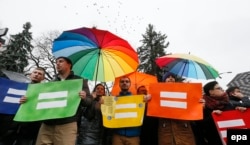
Ukraine fails again to ban discrimination against gays
Kiev, Nov 10, 2015 (AFP) -- Ukraine's parliament failed for the second time Tuesday to adopt a ban on anti-gay discrimination in the workplace, though it did vote in five other laws needed to secure visa-free travel to most EU nations.
The European Union in 2010 demanded that Ukraine clearly define the rights of gay people -- who were viewed by the country's former Soviet rulers as criminals who should either be sent to prisons or mental wards -- at work.
Though Ukraine is now run by a pro-EU administration, it remains a deeply religious and conservative country.
Kiev decriminalised gay relationships a year after the Soviet Union's 1991 breakup but it still takes a grim view of same-sex couples.
A gay pride parade held near Kiev in June lasted just minutes before a far-right group attacked it without any apparent intervention from the police.
Brussels wants Ukraine -- which overthrew its former Moscow-backed leadership last year -- to adopt a raft of legislation that takes a tougher approach on corruption and ensures broader basic rights.
Time is running out because an EU commission will review in mid-December whether Kiev has done enough to merit visa-free travel by the middle of next year.
Western-backed President Petro Poroshenko has made joining the Schengen zone -- a club of EU countries that allows visa and passport-free travel to more than 400 million people -- one of his priorities since his election last year.
But time is quickly running out on Poroshenko's dream.
In a vote held last week, the anti-discrimination law collected just 117 votes in the 450-seat parliament.
That number rose to 207 on Tuesday -- still short of the 226 majority needed for the measure to pass.
Squabbling lawmakers are expected to vote on the bill yet again later this week.
Poroshenko met parliamentary faction leaders on the eve of both last week's and Tuesday's readings to convince them of the potential significance of free travel to Europe.
Some of those who refused to back the law want concessions on completely unrelated legislation that deals with such matters as lowering taxes on oil and natural gas.
About 200 protesters defied windy, rainy weather and gathered in front of parliament to urge legislators to finally open the door to Europe.
But Poroshenko put a positive spin on Tuesday's developments because some of his measures had passed.
"Today's vote has brought Ukrainians considerably closer to visa-free travel," he tweeted.
"I hope that lawmakers show responsibility and adopt all the laws necessary for visa-free travel, including the anti-discrimination amendment."
Ukraine Sets November 29 As Date For Mariupol Elections
Ukraine's federal parliament voted on November 10 to set November 29 as the date for local elections in the eastern city of Mariupol and the nearby town of Krasnoarmiisk.
The localities, which are on government-held territory in the turbulent Donetsk region, were supposed to participate in regional elections last month.
However, hundreds of polling stations in the localities did not open for the elections because of an unspecified "mistake in the ballots," the Interior Ministry said at the time.
Much of the surrounding Donetsk region and the neighboring Luhansk region are controlled by pro-Russian separatists.
The two self-declared separatist republics agreed last month that they would postpone their own elections until sometime next year.
The concession by the separatists was made after negotiations between Ukrainian President Petro Poroshenko and his Russian counterpart, Vladimir Putin, in Paris.
No date has been set for elections in the separatist-held regions.
Based on reporting by dpa and Interfax
That concludes our live-blogging of the Ukraine crisis for Tuesday, November 10. Check back here tomorrow for more of our continuing coverage.
Congress Passes Bill Giving Lethal Aid to Ukraine
By RFE/RL
WASHINGTON -- Congress has passed a defense policy bill that authorizes up to $50 million in lethal military aid for Ukraine and mandates a White House response if Russia is deemed to be violating a key arms control treaty.
The White House said hours after the $607 billion bill was passed by the Senate on November 10 that President Barack Obama was likely to sign the legislation.
The House of Representatives passed a similar version of the bill last week.
Obama vetoed the previous bill over provisions that forbade the White House from moving the remaining prisoners at the Guantanamo Bay military base in Cuba to U.S. prisons.
But he appears to not be threatening a veto on this bill over the Guantanamo prisoner issue this time.
Among other things, the package appropriates $300 million to help Ukraine in its fight against Russian-backed separatists.
That includes $50 million for lethal weaponry such as antiarmor weapon systems, mortars, grenade launchers, small arms, and ammunition.
The Obama administration has previously resisted calls to provide Ukraine with lethal aid, fearing that could provoke Russia.
The legislation also sets a deadline for the administration to tell Congress whether Russia continues to be in violation of the Intermediate-Range Nuclear Forces treaty, which eliminated an entire class of nuclear-capable missiles from Europe in the late 1980s.
The State Department’s most recent arms control report released in June said Russia was testing a missile system that violated the treaty.
Moscow, for its part, has denied the allegations and accused the United States of deploying banned weapons systems.
The legislation also includes $715 million for Iraqi forces battling Islamic state militants.