


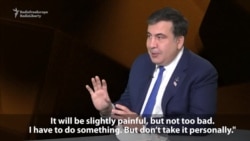
Here's a video from Vitaly Portnikov of RFE/RL's Russian Service who was speaking with Mikheil Saakashvili. The fomer Georgian President, who now governs the Odesa region in Ukraine, says Kremlin animosity toward his country was driven by the success of his pro-Western reforms.

What's Behind Italy's Step Back On Extending Sanctions Against Russia?
By Rikard Jozwiak
BRUSSELS -- It was supposed to be a done deal: European Union envoys had been expected to approve a six-month extension of sanctions against Russia over its interference in Ukraine, as agreed by EU leaders last month.
But the Italian ambassador upended that plan at a meeting on December 9, telling the others that Rome wanted more debate on the matter.
A high-ranking EU diplomat told RFE/RL that EU ambassadors would not discuss the sanctions at their December 10 meeting. That means the issue is unlikely to be resolved this week, dragging the discussion closer to an EU summit on December 17-18, the holiday recess, and the January 31 deadline for a final agreement to prolong the sanctions through July 31, 2016.
So far only Rome has spoken out, but diplomats suspect countries such as Hungary, Austria, Greece, and Cyprus may be in the same camp.
Italian Prime Minister Matteo Renzi was among the leaders who agreed on the sanctions extension at a meeting on the sidelines of a G20 summit in Turkey on November 16 -- so why the unexpected change of heart?
EU sources say that Renzi may have been driven by one of the following motives, or a combination of all three:
1. He wants to put pressure on EU member states from the east to be more helpful on another crucial issue facing the 28-member grouping -- migrants -- in the run-up to the EU summit next week.
2. He wants to show the Italian business community and Russia -- whose foreign minister, Sergei Lavrov, is visiting Italy on December 10-11 -- that he is fighting to the end, not just giving in to the EU majority.
3. He dislikes European Council President Donald Tusk and wants to annoy him, knowing that the former Polish prime minister cares deeply about the issue and is determined to keep sanctions against Russia in place.
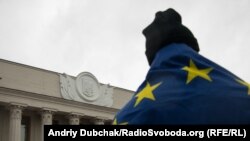
Ukrainian deputies have voted for a revised law on civil service with 261 members in favor.
The law reforms the civil service in Ukraine. In particular, it establishes open contests for public-service positions. A number of regulations also increase officials' level of responsibility. At the same time, the law reduces the number of civil servants in the country.
The document also states that there will be three categories of civil servant. Category A officials can't be political party members and will hold the position for five years. Category B and C officials may not be leaders of political parties. All officials may only serve for two terms.
The law will come into force on May 1, 2016. Before that, it must go through technical and legal revision.
Ukrainian deputies debated extensively about the law -- during the second reading, it contained more than 1,300 amendments.