




Here's a link to a report in English on the Russian blogger who's been jailed for criticizing Moscow's involvement in Ukraine (among other things):
Bloomberg columnist Leonid Bershidsky has been suggesting that Kyiv and Moscow may be parting ways forever. Here's an excerpt:
Russia and Ukraine have spent most of their post-Soviet history as Siamese twins, but for the last two years they've been undergoing political and economic separation surgery. It will probably be more or less complete in 2016, and though both twins are in for a grim period, the weaker one, Ukraine, has the better prospects in some ways.
Ever since Ukraine declared independence in August, 1991, it sought to establish an identity that would set it apart from Russia. Its second president, Leonid Kuchma, even published a book called "Ukraine Is Not Russia" in 2003. In practice, however, Ukraine kept following its bigger neighbor even through its failed Westernization period of 2005 to 2010. It inherited the same basis for its legal system and government -- the Soviet bureaucracy -- and even attempted reforms often imitated Moscow's moves. When I moved from Moscow to Kiev in 2011, I felt no discomfort: Everything, from bureaucratic procedures to the pervasive corruption that made a mockery of them, was largely the same in the two countries.
Economically, Ukraine remained Russia's colony. In 2013, its trade turnover with Russia, at $31.8 billion according to the official Ukrainian statistics agency, reached 28 percent of its total trade. For Moscow, Ukraine wasn't as important, but it was still its fifth biggest trading partner with a 5 percent share of turnover. That last peaceful year, 6.1 million Ukrainians, out of a total population of 45.5 million, visited Russia, about two-thirds of them to work. Only Poland, Ukraine's entry point to the EU, received slightly more visitors.
Russian rulers got used to this. Even this year, Russian President Vladimir Putin contended that "Russians and Ukrainians are one nation." It's no longer true: The last two years, since Ukraine's "Revolution of Dignity," the Russian annexation of Crimea and the Russian-backed insurgency in eastern Ukraine, have seen perhaps the biggest break-up between neighboring, closely interconnected countries in post-World War II history. In 2014, only 4.6 million Ukrainians traveled to Russia -- less than two-thirds as many as to Poland. This year's statistics are not in yet, but another drop in travel to Russia is highly likely, because Moscow has been tightening regulations to make it harder for Ukrainian migrant workers to stay indefinitely and because, as of last summer, there are no more direct flights between the two countries. Besides, starting in mid-2016, Ukrainians will be able to travel visa-free to the European Union, which will likely make travel to Europe vastly more popular.
Read the entire piece here
This would presumably raise some hackles, if confirmed:
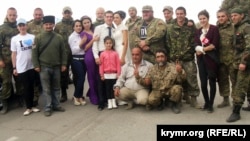
The Crimean blockade will reformat and the number of participants reduce reduce, said Refat Chubarov, one of the blockade’s organizers and the head of the Crimean Tatar Mejlis.
“Our people [will be] in far smaller numbers and will stay very close to customs officers [and] to border guards. They will only observe that the governmental decree is carried out, that there is no smuggling,” Chubarov said.
The blockade, organized by activists, began on September 20. On December 16, the Ukrainian government adopted a resolution "on limiting supplies of certain goods from temporarily occupied territory of Ukraine and/or from other territories of Ukraine to temporarily occupied territory." The document comes into force 30 days after its publication.