



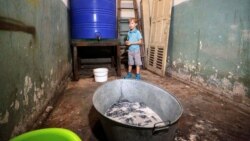
The main news is that Crimea electricity situation does not seem at all close to resolution:
Residents of Crimea face several more months of power shortages as Russia appears to have ended a contract with Ukraine to deliver electricity to the peninsula it annexed in 2014.
A Kremlin spokesman said January 1 that Russian President Vladimir Putin will not renew the contract, which expired on New Year's day, as long as Kyiv keeps insisting on stipulating in the contract that the peninsula belongs to Ukraine.
"It can be assumed with a great degree of probability that the president will opt not to sign a contract on such terms," which would amount to an abnegation of Russia's annexation, Kremlin press secretary Dmitry Peskov said.
After a month of on-and-off electricity supplies from Ukraine due to sabotage of the high-voltage transmission lines feeding the peninsula, power to Crimea was officially cut off at midnight December 31 when the contract expired, Russian media reported.
If Kyiv agrees to drop its demand for a clause designating Crimea as part of Ukraine, Peskov said, then Russia would be more inclined to renew the contract.
To support the Kremlin's apparent decision not to renew the contract, Putin commissioned an opinion poll to determine whether Crimean residents want to be a part of Ukraine to continue getting power supplies from the Ukrainian company Ukrenegro.
Russian news agencies reported on January 1 that Crimeans voted overwhelmingly by over 90 percent against renewing the contract under those circumstances, even if it meant experiencing more minor disruptions in supply.
The Kremlin said Putin will be guided by the results of the poll, which was conducted by a state-owned polling organization, in making a decision about the now-lapsed power supply contract with Ukraine.
Without power from Ukraine, officials have warned that Crimeans will continue to experience at least minor electricity shortages and rolling blackouts for three or four months until Moscow can complete construction of undersea cables transmitting more power supplies from Russia.
Russian Energy Minister Alexander Novak has said the power shortages will be particularly acute at peak times of usage, when shortfalls of up to 10 percent are possible.
Bits of gas-related news this morning:
Russian Prime Minister Dmitry Medvedev approved a discount in the price of natural gas for Ukraine to bring Russian gas prices closer to prices in European markets.
Russia will discount its previous gas price of $230 per one thousand cubic meters (TCM) by $17.8, bringing it to $212.2 per TCM, an official Russian government notice said January 1.
Ukraine's energy minister Volodymyr Demchyshyn previously said Ukraine was ready to buy Russian gas in the first quarter of 2016 if the price was reduced to under $200 per TCM.
Currently, gas is trading at a price of around $170 per TCM in European markets.
"Russians understand that in order to be competitive they need to decrease the price," Medvedev said, noting that the discount was intended to reflect "market conditions."
Whether the discount will be enough to attract Ukraine remains to be seen. Ukraine halted gas purchases from Gazprom in July 2015 after Kyiv and Moscow failed to reach a deal on gas deliveries for the third quarter of the year.
and then this...
A gas pipeline leaked in the Zakarpattia region of western Ukraine, but the leak is not affecting consumers, Ukrainian gas transmission system operator Ukrtransgaz reported January 1.
Ukrtransgaz said the leak has not affected supplies to the European Union and repairs are underway.
The incident, which occurred on the Soyuz pipeline near the village of Gorodilovo or Horodylove, led to a gas flare to prevent a dangerous buildup of leaked gas. But it did not result in any injuries or gas cutoffs, the gas company said.
Barring any major developments, that ends the live blog for today.
Reported truce violations in eastern Ukraine:
The Ukrainian military and Russian-backed separatists in eastern Ukraine accused each other on January 1 of violating a shaky holiday truce between the warring sides.
Over the past 24 hours, Ukrainian army positions in Donbas came under attacks 22 times, including assaults by mortars and grenade launchers, the Ukrainian military said.
The army said there were no casualties among the Ukrainian forces.
The separatists said one "serviceman" was killed in the early hours on January 1 as Ukrainian forces shelled the Donetsk airport and the Kominterenovo village.
The separatists claimed Ukrainian forces had breached the cease-fire 11 times over the past 24 hours, including with shelling of residential areas that damaged five private houses.
Kyiv and the separatists reached an agreement for a truce during the Christmas and New Year holidays that went into effect at midnight on December 22.
Most Orthodox Christians in Ukraine and Russia celebrate Christmas on January 7.
However, the warring sides accused each other of breaching the truce within hours after it came into effect.
German Foreign Minister Frank-Walter Steinmeier has warned that the holiday cease-fire is becoming "increasingly fragile," and urged both sides to stick with their pledges to stop the war, at least temporarily.
Latest
Russia says it's suing Ukraine for defaulting on a $3 billion Eurobond debt owed to Moscow.
Russia's Finance Ministry said in a statement on January 1 that Kyiv is "in a state of default" regarding its obligations toward Moscow and legal proceedings would ensue.
The ministry said it is filing a lawsuit against Ukraine with a British court.
Ukrainian Prime Minister Arseniy Yatsenyuk said on December 18 a "moratorium" on any debt repayments to Russia. He did not indicate when Ukraine would be ready to repay the debt, which matured in December.
The debt stems back to 2013 when Russia loaned $3 billion to the Kremlin-backed President Viktor Yanukovych, before pro-European protests that led to his downfall.
Kyiv says it is not a sovereign loan by one state to another but rather a transaction made via the financial markets that is subject to terms agreed with other creditors.
In August, Kyiv reached a restructuring deal with private creditors, including major banks, which agreed to reduce their claim by 20 percent.
Moscow insists that the loan cannot be considered private debt and has refused such conditions.
Relations between the two neighbors soured after Russia annexed the Crimean peninsula in March 2014 and threw its backing behind separatists in eastern Ukraine.
Ukrainian leaders have accused Moscow of sending troops and weapons to the east, a claim the Kremlin has denied.
Based on reporting by AFP and Interfax
More on the Christmas debate from Reuters: