


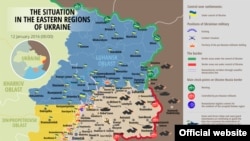
And speaking of an escalation in the east, here is today's map of the situation in the Donbas conflict zone, courtesy of the Ukrainian Defense Ministry (CLICK IMAGE TO ENLARGE):
Good morning. We'll start the live blog today by pointing you in the direction of an interesting piece by Serhii Plokhy for The Daily Beast on whether there is any truth to the controversial notion that Russians and Ukrainians are actually pretty much the same people. Here's an excerpt:
The Russian annexation of the Crimea and the propaganda intended to justify Russian intervention in the Donbas have proceeded under the slogan of defending the rights of ethnic Russians and Russian speakers in general. The equation of the Russian language not only with Russian culture but also with Russian nationality has been an important aspect of the world view of many Russian volunteers who have come to Donbas. One problem with that interpretation of Russianness is that while ethnic Russians are indeed a majority of the population in the Crimea and make up large minorities in parts of the Donbas, most of the population of the projected New Russia consists of ethnic Ukrainians. While Russian and separatist propaganda has had an appeal for many ethnic Ukrainians, most have refused to identify themselves with Russia or with Russian ethnicity even as they continue to use the Russian language. That was one of the main reasons for the failure of the creation of a buffer state of New Russia by extending the rebel holdings in Donbas to Odesa and Kharkiv in southern and eastern Ukraine.
The expansionist model of Russian identity, which stresses the indivisibility of the Russian nation, closely associated with the Russian language and culture, presented a fundamental challenge to the Ukrainian nation-building project. From its beginnings in the nineteenth century, that project placed the Ukrainian language and culture at its center, but from the outset it also allowed for the use of other languages and cultures, as attested, for example, by the Russian-language writings of Taras Shevchenko, whom many regard as the spiritual founder of the Ukrainian nation. Bilingualism and multiculturalism have become a norm in post-Soviet Ukraine, extending membership in the Ukrainian nation to people of various ethnic and religious backgrounds. This has had a direct impact on the course of the Russo-Ukrainian conflict.
Contrary to the Kremlin’s expectations, Russia-sponsored “hybrid war” failed to mobilize the support of ethnic Russians outside the areas either directly controlled by the Russian army, as has been the case in the Crimea, or those parts of the Donbas seized by Russian mercenaries and Russia-backed insurgents. According to data provided in the middle of the crisis by the respected Kyiv International Institute of Sociology, with Russians constituting 17 percent of the Ukrainian population, only 5 percent of those polled considered themselves exclusively Russian: the rest gave their identity as both Russian and Ukrainian. Even those who considered themselves exclusively Russian often opposed Russian interference in Ukrainian affairs, refusing to associate themselves with Putin’s regime. “Ukraine is my Homeland. Russian is my native language. And I would like to be saved by Pushkin. And delivered from sorrow and unrest, also by Pushkin. Pushkin, not Putin,” wrote one of Kyiv’s ethnic Russians in her Facebook account.
Read the entire article here
That concludes our live-blogging of the Ukraine crisis for Monday, January 11, 2016. Check back here tomorrow for more of our continuing coverage.