

Bloomberg columnist Leonid Bershidsky has been making waves yet again with this piece on how Ukraine has been weaning itself off Russian gas:
Not so long ago, Russia could bend Ukraine to its will by threatening to cut off natural gas supplies. Now, Russia is offering discounts, but Ukraine is not interested because it's getting plenty of gas in Europe. This change reflects developments in the European gas market that don't augur well for one of Russia's biggest sources of export revenue.
The decline in Ukraine's imports of Russian gas is partly the result of economic stagnation under former President Viktor Yanukovych, a huge drop in output after the 2014 "Revolution of Dignity" and Russia's annexation of Crimea. Ukraine's gross domestic product has shrunk around 19 percent since 2013, and its industrial sector needs less fuel.
That, however, is not the most important reason for the decline in Ukrainian imports. The government is determined to end its dependence on Russia as the two countries are in a semi-official state of war. More than once, Russian threats to stop supplies or raise prices as winter approached forced Ukrainian governments to accept political concessions that slowed the country's drift toward the European Union. In response, Ukraine sought "reverse supplies" from Slovakia in 2014.
It was a good year to experiment: The winter of 2014 was warm in Europe, and there was a surfeit of gas. In Slovakia, the gas was Russian, delivered by the state-owned monopoly Gazprom through the Ukrainian pipeline system. Gazprom had tried to ban resale, but those conditions were in violation of European rules. In April 2015, the European Commission cited such stipulations as an example of Gazprom's abuse of its dominance in eastern and central European gas markets. Gazprom, which is trying to avoid steep fines and arrive at a settlement with the commission, could do nothing to prevent its customers from supplying Ukraine.
In the fall of 2014, Gazprom tried to cut exports to Europe to eliminate "reverse supplies," but, according to a Ukrainian estimate, that cost $5.5 billion in lost revenue and another $400 million in discounts to customers as compensation for failing to meet contractual obligations. In March 2015, Russian exports resumed in full.
Read the entire article here
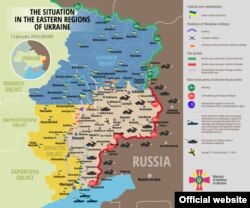
Here is a map of today's situation in the Donbas conflict zone, courtesy of the Ukrainian Defense Ministry (CLICK IMAGE TO ENLARGE):