



Relatives Of MH17 Crash Victims Demand Release Of Key Data
By RFE/RL
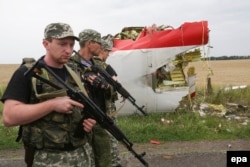
Relatives of those killed in the MH17 air disaster are demanding the release of what they say is key evidence that could shed light on the tragedy over eastern Ukraine in July 2014.
Malaysia Airlines flight MH17 was shot down over the eastern Ukrainian region of Donetsk with the loss of all 298 lives on board, most of them Dutch.
The Dutch Safety Board said in its final report released on October 13 that the jet was destroyed by a Russian-made surface-to-air missile, fired from an area at the time under the control of pro-Russia separatists.
A separate criminal probe is also being conducted in the Netherlands to determine who was responsible and bring them to justice.
Now, Dutch relatives of the MH17 tragedy have written to Dutch Prime Minister Mark Rutte to protest that primary radar data was not made available to the investigators by either the Russian or Ukrainian authorities.
"We can't accept that people have refused to provide crucial information," the families said in the letter, published on January 13.
They are urging Rutte to push either the United Nations or the International Civil Aviation Organization to demand that the data is handed over.
The families hope that may help pinpoint who fired the missile at the plane.
The EU, the United States, and Ukraine believe the plane was downed by Russia-backed separatists using a Buk missile system provided by the Russian military.
Moscow denies providing such equipment and has suggested that the aircraft was shot down by a Ukrainian fighter jet or with a Buk fired by the Ukrainian military -- claims roundly dismissed by Kyiv and Western governments.
With reporting by AFP
White House: Obama’s Puzzling Ukraine Comment Referred To Kremlin Ally Yanukovych
By Carl Schreck
The White House has clarified U.S. President Barack Obama’s puzzling reference to Ukraine in his final State of the Union address, in which he said Russia is “pouring resources in to prop up” its ex-Soviet neighbor.
Obama raised eyebrows with the phrase in the January 12 speech to a joint session of the U.S. Congress because it appeared to contradict his administration’s position that Russia is stoking unrest in Ukraine by supporting armed separatists.
But a senior U.S. administration official told RFE/RL on January 13 that Obama was referring in part to Moscow’s support for former Ukrainian President Viktor Yanukovych, who fled to Russia in February 2014 amid mass street protests that helped usher in a pro-Western government.
ALSO READ: Many Puzzled By Reference To Ukraine As Russian 'Client State'
“The president was referring in his remarks to Russia’s previous long-term efforts to bolster the regime of former President Yanukovych as a way to prevent Ukraine from pursuing further integration with Europe,” said the official, who could not be identified under White House protocol.
Yanukovych’s ouster triggered events that led to Russia’s seizure and annexation of Ukraine’s Crimean Peninsula, which a majority of UN member states deem illegitimate. It also led to war between Russia-backed separatists and Kyiv’s forces in the east of the country that has killed more than 9,000 since April 2014.
Before Yanukovych’s ouster, Russia had offered billions in financial incentives, in what was widely seen as an effort to dissuade him from signing an agreement for closer relations with the European Union. Moscow feared the deal would have tugged Ukraine out of its orbit, economically and politically.
The U.S. official also told RFE/RL that Obama’s remarks about Ukraine referred to Russia’s “current occupation of Crimea, extensive efforts to support armed groups operating in eastern Ukraine, and other efforts to destabilize the country.”
Obama veered only slightly from his prepared remarks on Ukraine in the annual address, which is thoroughly vetted by the U.S. president’s staff and speechwriters.
"Even as their economy contracts, Russia is pouring resources in to prop up Ukraine and Syria -- client states they saw slipping away from their orbit," he said in the speech. "And the international system we built after World War II is now struggling to keep pace with this new reality."
The phrase “prop up Ukraine” was also included in the prepared version of the speech distributed to the media by the White House.
The administration official reiterated Washington’s support for Ukraine’s government and citizens.
“Over the past two years, the United States has led an international coalition to help Ukraine defend its democracy and territorial integrity, and the United States remains firmly committed to helping the Ukrainian people build a country that is peaceful, prosperous, and free to chart its own destiny,” the official said.
Overall, Ukraine and Russia got scant mention during the hourlong speech, which instead focused on other pressing foreign policy issues such as terrorism, the Islamic State in Syria, the Iran nuclear deal, and warming relations with Cuba.
Many Puzzled By Obama's Reference To Ukraine As Russian 'Client State'
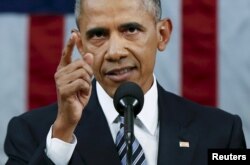
KYIV -- U.S. President Barack Obama raised eyebrows around the world with a difficult-to-interpret reference to Ukraine in his final annual State of the Union address that lumped the post-Soviet state and its West-leaning government together with Syria as Russian "client states."
"Even as their economy contracts, Russia is pouring resources in to prop up Ukraine and Syria -- client states they saw slipping away from their orbit," Obama said on January 12. "And the international system we built after World War II is now struggling to keep pace with this new reality."
In the transcript of the speech posted by the White House, the confusing reference remains, although the word "client" does not appear and the transcript uses the present tense ("states they see slipping away from their orbit").
The annual address to a joint session of the U.S. Congress is one of the U.S. president's most comprehensively prepared and vetted speeches. Obama's chief speechwriter, Jon Favreau, told National Public Radio earlier in the day his office had been working on the speech since "around Thanksgiving."
"Once the new year came and went, there would be a frenzied couple of weeks writing and editing and rewriting, right up until the final speech and then practicing the speech on the last day," Favreau said.
So the president's infelicitous comment about Ukraine is all the more difficult to understand. Was Obama referring to Russia's support for former Ukrainian President Viktor Yanukovych, the pro-Russian leader who was driven from office by pro-democracy demonstrations in February 2014? Or did he have in mind Moscow's economic, political, and military support for separatists in eastern Ukraine and Crimea, the Ukrainian Black Sea peninsula that Moscow annexed in March 2014?
Read more of the story by RFE/RL's Robert Coalson and Tetiana Iakubovych here.
An excerpt:
For outside observers and pundits alike, interpreting the myriad of recent Ukraine-related headlines might be a difficult if not impossible task:
-- A visit by the US Vice-President Biden, who delivered a heartfelt message of continued support for Ukraine, but also recognized that corruption remains as big a threat for the country as the Kremlin's aggression.
-- The Prime Minister Yatsenyuk being carried from the Parliamentary stage by an MP who is member of the governing coalition.
-- The public scandal between Mr. Saakashvili (former Georgian president and currently Governor of Odessa region) and Mr. Avakov (Minister of Internal Affairs and a close ally of Yatsenyuk).
-- A very heated debate between the Parliament and the government on the issue of tax reform and budget, which may put Ukraine's IMF program at risk.
-- Resignation of a notorious MP -- Mr. Martynenko, who was publicly accused of corruption by others in the Parliament and by the civil society activists.
What can one make of it? To an optimist, healthy debate represents the growing pains of a budding democracy. To a pessimist, this is chaos and a relapse into the old habits. As with most things in life, the truth is somewhere in the middle.
Ukraine To Ship Goods To Kazakhstan, Bypassing Russia
Ukraine says it will for the first time ship goods to Kazakhstan along a route bypassing Russia, due to the Kremlin’s trade embargo on Kyiv.
Russia this month slapped fresh sanctions on Ukraine in response to its decision to enter a much disputed free-trade and political Association Agreement with the European Union.
Ukrainian Infrastructure Minister Andriy Pyvovarskiy said on January 13 that “experimental” deliveries via Georgia and Azerbaijan would be shipped to Kazakhstan on January 15.
"This Silk Road will not only give Ukrainian goods alternative access to markets in which we have historically been very strong, but also create a new [trade] route between Asia and Western Europe," Pyvovarskiy said in televised remarks during a meeting with Prime Minister Arseniy Yatsenyuk.
The Dutch international banking corporation ING predicts that Ukraine will become Kazakhstan's third-largest source of imports by 2017.
ING said the energy-rich Central Asian nation primarily imports Ukrainian vehicles and transport equipment.
Pyvovarskiy did not disclose what would be shipped to Kazakhstan via the two Caucasus nations this week.