



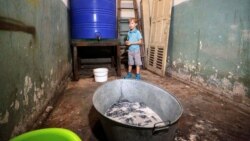
Winter freeze leaves 300 Ukraine towns without power
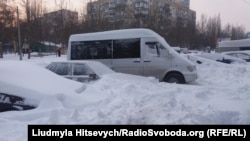
Kiev, Jan 19, 2016 (AFP) -- Almost 300 Ukrainian towns were left without power on Tuesday while snowdrifts and blizzards trapped hundreds of vehicles and dozens of ambulances across the former Soviet state.
Ukraine's emergency service said most of the outages were recorded on Monday evening and urgent repair works were underway.
It did not disclose how many homes or people were left without power.
But the service said its teams had rescued 322 people from 148 vehicles on Monday in the Black Sea region of Odesa alone.
They also pulled out 42 ambulances and two passenger buses from snowdrifts that have been hitting the eastern region of Kharkiv since the weekend.
The weather forecast centre predicted more clement weather in the days ahead. But night temperatures in the Ukrainian capital Kiev were still expected to plunge to minus 15 degrees Celsius (5 degrees Farenheit) into the start of next week.
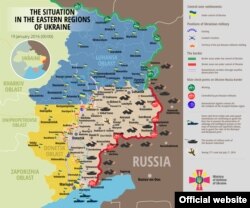
Here is today's map of the security situation in eastern Ukraine, according to the National Security and Defense Council (CLICK TO ENLARGE):
From the article: Is Ukraine-Russian Peace Deal Brewing Behind The Scenes? by Timothy Garton Ash:
Something significant might be happening in the Ukraine peace process.
First, we had the appointment of Boris Gryzlov, a real Kremlin heavyweight as Moscow’s representative to peace talks. One read is that the appointment of a serious Kremlin insider to such a role suggests that Russian President Vladimir Putin is now willing to seriously negotiate towards some kind of settlement, which might just be acceptable to Kyiv – rather than the previous policy which seemed to be to demand concessions which were never really deliverable in Kyiv, and which were just meant to destabilize domestic politics in Ukraine, or to undermine the security situation and macro stability and financing with it.
Second, President Petro Poroshenko last week spoke about securing control over Ukraine’s borders again this year – with some suggesting that he would not have made this claim unless he thought there was a reasonable chance of delivering on it.
Third, the U.S. assistant secretary of state, Victory Nuland, had a meeting late last week in the Russian enclave of Kaliningrad, with Vladislav Surkov, another close adviser to Putin. The session was described as a “brainstorming” session over possible resolutions over the crisis in Ukraine, and generally feedback from both sides was that the discussions were “constructive.” U.S. officials also spoke about the prospect of sanctions on Ukraine over Donbas being relieved if they see Minsk implementation – albeit retaining those over Crimea.
Fourth, French and German envoys to the Ukrainian “Normandy” peace process are due in Kyiv this week for high-level discussions.
Fifth, Russia seems to be holding back from pursuing the nuclear, legal, card over the $3 billion in monies lent to the former Yanukovych regime, due in December, but now in effect in default.
Read more in the Kyiv Post here.
With one eye on Moscow, Europe presses Ukraine on reforms
By Robin Emmott
BRUSSELS, Jan 18 (Reuters) - The European Union pressed Ukraine authorities on Monday to overcome political feuding and implement promised reforms as it looks to shore up the country's democratic and economic credentials.
Having so far failed to end the Russian-backed war in eastern Ukraine, Kiev's western supporters are now seeking to shift the focus onto modernisation, concerned that the West's huge political investment in Ukraine could go to waste.
"We understand the pressures the Ukrainian government is under internally," said Britain's Foreign Secretary Philip Hammond at a meeting of EU foreign ministers. "But we continually remind them of their obligations under Minsk," Hammond told reporters, referring to the peace deal signed in February last year in the Belarusian capital.
Reforms tied to the Minsk accord, which was extended beyond its end-2015 deadline, would give Kiev more credibility, Hammond said.
That included changing Ukraine's constitution to grant special status to the Donbass industrial regions of eastern Ukraine now under rebel control.
Russia denies it has provided weapons to the rebels or that it has troops engaged in the conflict that has killed more than 8,000 people since it broke out April 2014, following Russia's annexation of Ukraine's Crimea peninsula.
Rebels and the Ukrainians complain of violations of the ceasefire negotiated as part of the Minsk deal. Both say heavy artillery, meant to have been withdrawn, is still being used.
Seeking to cement Ukraine's historic shift away from Russia, senior U.S. and EU officials are trying to help Ukraine's leadership modernise the former Soviet state, where the shadow economy accounts more than half of output by some estimates.
In a note seen by Reuters on Monday, nine EU countries including Germany and Britain said Europe needed to show even more support for Ukraine, as well as calling for reforms.
While political rifts and the danger of the ruling Ukrainian coalition breaking up is less of an imminent threat since the government passed a 2016 draft budget in late December, other difficult reforms outside of the Minsk accord, ranging from the tax code to the judiciary, are pending.
"There are deficits in the justice system, especially in the fight against corruption," German Foreign Minister Frank-Walter Steinmeier told a news conference. "That has to be corrected as soon as possible ... Ukraine has to become more attractive for foreign investors."
Ukraine has already received almost $10 billion in 2015 from the International Monetary Fund and other international lenders to shore up its finances, crippled by the conflict and years of mismanagement and corruption.