

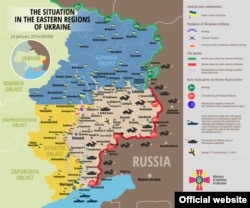
Here is today's map of the security situation in eastern Ukraine, according to the National Security and Defense Council (CLICK TO ENLARGE):
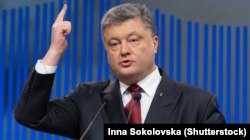
Poroshenko Says 'Torpedoing' Minsk Deal Could Lead To Full-Scale War With Russia
President Petro Poroshenko has warned Ukrainian politicians that the collapse of the Minsk agreements aimed at ending a war with Russia-backed separatists could set off a "full-scale conflict" with Russia.
Poroshenko was speaking at a conference of local leaders in Kyiv on January 23.
"Those political forces that want to torpedo the Minsk agreements at any cost...and to block the constitutional process, must clearly understand the consequences of their actions," he said.
"They will lead to the resumption of the 'hot phase' of the conflict, including a full-scale -- and not local, as it has been so far -- conflict with Russia," he added.
His words appeared to be aimed at foes of "decentralization" legislation that Ukraine is required to pass under the peace deal signed in February 2015 by Ukraine, Russia, and separatists who hold parts of the eastern Donetsk and Luhansk regions.
The Minsk deal is crucial for Kyiv because it calls for the restoration of Ukrainian control over the state border between the separatist-held territories and Russia, which has backed the separatists in a conflict that has killed more than 9,000 people since April 2014.
Ukraine's parliament gave preliminary approval to constitutional changes granting more power to the regions in August, but their adoption requires a two-thirds vote in the 450-seat legislature.
Poroshenko said he hopes the legislation will be passed in the first half of this year, in the next parliament session, which begins after February 1.
However, some lawmakers say the legislation must be passed during the current session to be valid, but that is highly unlikely to happen. As a result, Poroshenko's allies have asked the Constitutional Court for a ruling that would effectively extend the deadline for the vote indefinitely.
Poroshenko also said that adopting decentralization obviates any need to for laws granting "special status" to the separatist-held regions or any others, a remark that is not likely to please the separatists.
Based on reporting by RFE/RL's Ukrainian Service, Unian, and Interfax
That concludes our live-blogging of the Ukraine crisis for Saturday, January 23. Check back here tomorrow for more of our continuing coverage.
Ukraine Finance Minister Says Deal With Russia Over $3 Billion Debt Still Possible
Ukraine's finance minister says there is still a chance to avoid a court battle with Russia over $3 billion of debt that Kyiv defaulted on in December.
U.S.-born Finance Minister Natalie Jaresko spoke to Bloomberg News on the sidelines of the World Economic Forum in Davos, Switzerland.
Jaresko said Ukrainian and Russian Finance Ministry officials may meet "in the near future" to discuss the issue, Bloomberg reported on January 23.
She said she thinks "it’s still very possible to reach a consensual agreement out of court with Russia."
Russia bought a $3 billion Ukrainian bond late in 2013 as part of an aid package widely seen as a reward for then-President Viktor Yanukovych's decision to scrap plans for a landmark deal with the European Union and tighten ties with Russia instead.
But Yanukovych was pushed from power in February 2014 by huge protests over that decision. The debt became a bone of contention after Russia seized the Crimean Peninsula and supported separatists in eastern Ukraine.
Russia’s Finance Ministry said on January 1 that it had taken measures to start legal proceedings over the debt.
Based on reporting by Bloomberg and Interfax

Interpol Explains Removal Of Yanukovych Figures From Public Wanted List
By RFE/RL's Ukrainian Service
Interpol says it has removed the names of several suspects from the time that former Ukrainian President Viktor Yanukovych was in power from its public wanted list in response to a legal complaint Yanukovych has filed.
Vasyl Nevolya, head of Ukraine's Interpol bureau, issued a statement on January 22 saying that information about the Yanukovych-era suspects remains available in Interpol's restricted-access databases.
He said Yanukovych's lawyers had filed a complaint in a French court and with Interpol's control commission asking for the investigation against the suspects to be dropped, leading Interpol to restrict access until the complaint is resolved.
Earlier in the day, Ukrainian anticorruption activists noted that Yanukovych, former Prime Minister Mikolay Azarov, former Finance Minister Yuriy Kolobov, and others seemed to have been removed from Interpol's wanted list.
Most are wanted on a variety of corruption and abuse-of-office charges.
Vitaliy Shabunin, head of the Anticorruption Action Center, wrote on Facebook: "Now these monsters can easily enjoy life, for example, on the Cote d'Azur in France."
Interpol placed 12 Yanukovych-era figures on its wanted list in January 2015, most of them with a "red notice," indicating an extradition request. The listing came almost one year after the suspects fled Ukraine under pressure from the Euromaidan mass protests.
In July 2015, Yanukovych himself was removed from the wanted list after he argued before Interpol that the case against him was politically motivated.
Yanukovych and most of the other suspects are currently believed to be in Russia.