

Merkel Presses Putin On Ukrainian Separatists
German Chancellor Angela Merkel has urged Russian President Vladimir Putin to use Moscow's influence with separatists in eastern Ukraine to help secure progress toward a political solution of the crisis.
Merkel's office said the two leaders spoke by phone on February 2 at Putin's request.
The call came one day after Merkel met Ukrainian President Petro Poroshenko in Berlin and nearly one year after Germany and France helped to broker the Minsk peace deal for Ukraine.
Merkel said the security situation in eastern Ukraine must be improved, a cease-fire observed, and international observers given unrestricted access to the conflict zone to enable further progress.
Merkel said on February 1 that she doesn't see grounds for lifting economic sanctions against Russia at the current time.
In December, the European Union extended the sanctions through July 31.
More than 9,100 people have been killed in eastern Ukraine since government forces and Russia-backed separatists began fighting in early 2014.
Based on reporting by AP, AFP, and TASS
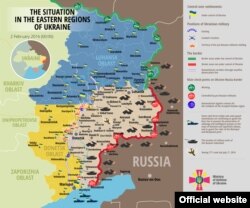
Here is today's map of the security situation in eastern Ukraine, according to the National Security and Defense Council (CLICK TO ENLARGE):
Kyiv Criticizes French TV Documentary On Maidan Protests
By Tony Wesolowsky
The film Ukraine: The Masks Of The Revolution tells the “real” story of the Euromaidan protests. At least that’s what filmmaker Paul Moreira claims.
In a nutshell, according to Moreira, it was right-wing extremists who ousted Viktor Yanukovych during the 2013-14 Euromaidan demonstrations, not the tens of thousands of ordinary and peaceful Ukrainians who took to the streets day after day.
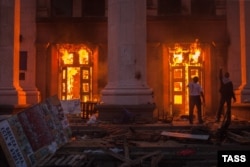
The West is complicit as well, turning a blind eye to the extremists’ crimes, including deadly violence in the southern city of Odesa in May 2014.
Why? Because Ukraine was merely a "pawn" -- albeit a crucial one -- in the greater geopolitical tug-of-war between the Kremlin and the West.
If that sounds familiar, it should. It’s essentially the narrative that the Kremlin and its followers have been spinning -- that is, blood-lusting neo-Nazi Ukrainians preying on unsuspecting Russian-speakers and other vulnerable minorities.
On its Facebook page, the Ukrainian Embassy in France said the film, which is set to air on the French Canal Plus television channel on February 1, is “not only dishonest, but completely disrespectful to our compatriots murdered in the heart of Kyiv while defending the democratic aspirations of their country.”
The embassy did not demand Canal Plus pull the film, as has been reported by RT, but says the channel “would be well-advised to reconsider the dissemination of the film.”
In an opinion piece on January 29 in The Kyiv Post, Halya Coynash, a member of the Kharkiv Human Rights Protection Group, pans the film as bad propaganda, filled with “manipulative reporting and outright lies.”
Read more here.
Pentagon Wants More Funds To Fight IS, Boost NATO Defenses In East
The Pentagon on February 2 will provide a preview of its 2017 budget requesting more funds to beef up U.S. forces in Eastern Europe and fight the Islamic State extremist group.
The Pentagon's request for the fiscal year beginning October 1 will total $583 billion, U.S. officials said, including $59 billion of "contingency funds" to pay for military actions in Afghanistan, and more than $7 billion for fighting IS in Iraq and Syria, in a 35 percent increase over 2016's budget.
In a speech unveiling the budget request, which will be detailed in full on February 9, the officials said Defense Secretary Ash Carter will highlight the world's changing "threat environment," underscoring the new risks presented by Russia since its 2014 annexation of Crimea and support of pro-Russian separatists in Ukraine.
Carter will announce big increases to the European Reassurance Initiative aimed at countering the Russian threat, and the extra money will be used to pay for significant U.S. troop and equipment increases in countries such as Estonia and Romania, the officials said.
Based on reporting by AP and AFP
Ways out of a blind alley in Ukraine
Almost one year after the Minsk agreement to resolve the Ukraine crisis, diplomats are working frantically behind the scenes but the two sides are still entrenched. Frank Hofmann reports from Kyiv.
Since the end of Orthodox Christmas in the first week of January, diplomats have again been meeting every Wednesday in Minsk. Also present at the meetings are representatives of the Organization for Security and Co-operation in Europe (OSCE) and moderators from its member states, including Germany and France. Several "working groups" then discuss political and economic questions and breaches of the ceasefire between Ukrainians, Russians, and the Russian-backed rebels.
The OSCE observers have plenty to worry about, because fighting is on the increase again, and weapons are being brought back into the buffer zone. Economic issues are being negotiated with a German representative from the Foreign Office in Berlin as mediator. The rebels' representatives and Russia are mostly demanding an end to Kyiv's economic blockade of the occupied territories. Kyiv points out that "hardly any banks will be prepared to send a security van there full of money" - which could be used to pay people's pensions or social security benefits. Kyiv's argument is that you might as well transfer the money directly to the rebels.
Read more by Deutsche Welle here.
Dutch support grows for EU-Ukraine deal
Dutch voters are opposed to the Netherlands’ ratification of the European Union’s association agreement with Ukraine, but the gap between Yes and No is getting smaller.
According to a poll published in De Volkskrant Monday, 44 percent intend to vote in favor of the agreement, and 55 percent would vote No. In a poll in December 2015, the figures were 38 percent Yes and 62 percent No. The Yes campaign was formally launched Monday.
Read more here.