



Minister says IMF loan on hold till political crisis over:
The International Monetary Fund (IMF) has put aid to Ukraine on hold until it becomes clear whether the current government survives, the country's finance minister says.
The government is reeling from the abrupt exit of its economy minister last week, and Finance Minister Natalie Jaresko's comments on Ukrainian ICTV show how the political crisis threatens to derail Ukraine's relationship with creditors that have provided a lifeline to the recession-wracked country.
Low approval ratings for the government of Prime Minister Arseniy Yatsenyuk have raised expectations of a major ministerial reshuffle. The government also could face a no-confidence vote in parliament in the middle of February.
Ukraine has been waiting since October for the IMF to dispense more aid as part of a $40 billion package from the IMF, the European Union, and the United States. Aid payments are linked to Ukraine adopting reforms that make its economy more competitive and reduce corruption.
Even before the political crisis resistance to the reforms had delayed the disbursement of a third tranche worth $1.7 billion.
Jaresko said the cash-strapped nation was paying a heavy price for the political turmoil set off by the abrupt resignation of Economy Minister Aivaras Abromavicius last week, citing corruption within the ruling party.
The IMF "is not political, but they will wait until it becomes clear who the executive authorities are and whether these authorities will take the responsibility to fulfill the conditions under which they have already provided us with $6.7 billion," she told ICTV on February 8.
"They can provide [aid] to another government, but another government must take the responsibility and commitment that we took on a year ago," she said.
Abromavicius in quitting said he would not become a "puppet" for corrupt vested interests, and accused a close ally of President Petro Poroshenko of trying to hijack control of his ministry.
His departure put a spotlight on Ukraine's fitful efforts at enacting the reforms promised by the Western-backed government when it came to power in 2014. The IMF, the United States and other Ukraine backers in the West had viewed Abromavicius as a leading reformer.
IMF managing director Christine Lagarde last week said Abromavicius's resignation was "of concern," but mentioned no changes to Ukraine's funding program.
Ukraine relies on money from the IMF, the United States and the European Union, to stay afloat. Its economy shrank by more than 10 percent last year, dragged down by a deep recession and war against Russia-backed separatists, who have taken control of parts of the country's eastern industrial heartland. (Reuters, ICTV, Ukraine Today)
That concludes our live-blogging of the Ukraine crisis for Monday, February 8. Check back here tomorrow for more of our continuing coverage.
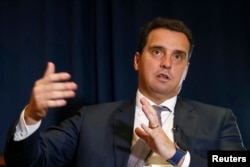
Ukraine's Ex-Economy Minister Sharing Evidence With Anticorruption Investigators
By RFE/RL
Former Ukrainian Economy Minister Aivaras Abromavicius says he is providing anticorruption investigators evidence of influence peddling involving key government officials and state companies.
Abromavicius made the comments on February 8 ahead of his expected testimony to Ukraine's top antigraft investigation agency and just days after his resignation brought the government to the brink of collapse.
The Lithuanian-born Abromavicius was one of several foreign-born officials brought in by President Petro Poroshenko as part of efforts to clean up endemic government corruption.
But the push to improve transparency and eliminate problems like bribery, kickbacks, and preferential hiring for wealthy insiders has proceeded at a glacial pace, resulting in growing frustration both inside Ukraine and among Western officials and lenders.
In his February 3 resignation letter, Abromavicius singled out Ihor Kononenko, a wealthy tycoon who is a member of Poroshenko's political party, saying he had lobbied to get his people appointed to head state companies and to top government positions.
Kononenko rejected the allegations as "completely absurd."
Abromavicius told reporters in Kyiv that he had collected ample information that he intended to share with the National Anticorruption Bureau.
Russian troops put on high alert as part of massive drills
MOSCOW (AP) -- President Vladimir Putin has scrambled troops across southwestern Russia for large-scale military drills intended to test the troops' readiness amid continuing tensions with the West.
Defense Minister Sergei Shoigu said that military units were put on combat alert early Monday, marking the launch of the exercise that involves troops of the Southern Military District.
The district includes troops stationed in Crimea, the Black Sea peninsula that Russia annexed from Ukraine in 2014, as well as forces in the North Caucasus and southwestern regions near the border with Ukraine.
Shoigu said the maneuvers will also engage airborne troops and military transport aviation, as well as the navy. He noted that the drills are intended to check the troops' ability to respond to extremist threats and other challenges.
According to Shoigu, who spoke at a meeting with the top military brass, the war games would include redeployment of air force units and bombing runs at shooting ranges.
The exercises are the latest in a series of major drills intended to strengthen the military's readiness. They have continued despite the nation's economic downturn.
Even though a drop in global oil prices has drained the government's coffers and helped drive the economy into recessions, the Kremlin has continued to spend big on the military, funding the purchase of hundreds of new aircraft, tanks and missiles.
Russia has demonstrated its resurgent military might with its air campaign in Syria, which helped President Bashar Assad's military win a series of victories in recent weeks. The military used the Syrian operation to test new types of weapons in actual combat for the first time, including long-range air- and sea-launched cruise missiles.
The air blitz in Syria has badly strained Russia's relations with Turkey, which shot down a Russian warplane at the border with Syria in November. The latest drills could be part of muscle flexing amid the tensions with Ankara.
They also come at a time when a peace deal intended to end fighting between Ukrainian government troops and Russia-backed rebels in eastern Ukraine appears to be in jeopardy amid increasingly frequent clashes in recent weeks.