



This just in from RFE/RL's news desk:
Police In Crimea Arrest Crimean Tatars After Home Raids
Russian authorities that control Crimea have arrested at least nine Crimean Tatars after a series of raids on their homes on the Russian-occupied peninsula.
Prosecutors in the Russia-imposed government, said four had been charged with belonging to Hizb ut-Tahrir, a Sunni political organization that is banned across Central Asia and Russia.
The detentions come after 12 homes of Crimean Tatars were raided by police in the cities of Yalta and the town of Bakhchesaray earlier on February 11.
Reports say some of the individuals whose homes were targeted had met with a delegation from the Council of Europe that recently visited Crimea to assess the human rights situation there.
Emil Kurbedinov, a local human rights activist, accused the Russian Federal Security Service (FSB) of fabricating new "terrorist cases" against Crimean Tatars.
Russia annexed Crimea from Ukraine in March 2014 after a referendum dismissed in the West as bogus.
Since Russia's land grab, fundamental freedoms have "deteriorated radically" for many in Crimea, especially for pro-Ukrainian activists, journalists and the Crimean Tatar community.
That was the finding of a report issued in September 2015 by the Office for Democratic Institutions and Human Rights of the Organization for Security and Cooperation in Europe (OSCE) and the OSCE High Commissioner on National Minorities.
HRW: Hundreds Of Schools Destroyed In Ukraine War, Military Use Must Stop
By Eugen Tomiuc
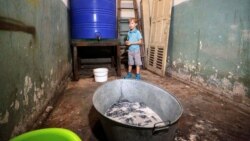
Hundreds of schools have been destroyed during the war in eastern Ukraine, including many that were used for military purposes by both sides in the conflict, Human Rights Watch (HRW) says in a new report.
Schools that have survived the war operate in dangerous and often overcrowded conditions, while many children have been forced to stop attending school altogether, says the report titled Studying Under Fire: Attacks On Schools, Military Use Of Schools During the Armed Conflict In Eastern Ukraine.
It urges the sides in the conflict between government forces and Russia-backed separatists to take steps to protect children's safety and access to education and to prevent the use of schools for military purposes.
"All parties to the conflict have a responsibility to protect children and to make sure that their hostilities don't cause further harm to their safety and education," New York-based HRW says in the report released on February 11.
During visits to 41 schools and kindergartens and interviews with 62 students, teachers, principals, and witnesses, HRW documented attacks on schools located in both government-controlled and separatist-held areas.
Yulia Gorbunova, Ukraine researcher at HRW, told RFE/RL that both sides have used schools for military activities, deploying forces and armaments in and near schools.
"Using those schools for military purposes led to them basically turning into legitimate military targets and increasing the possibility of them being attacked and destroyed," Gorbunova said.
Other schools damaged during the conflict were not occupied or used by the fighting forces, and therefore did not appear to be "legitimate" military targets.
"We've found cases which we documented in the report also very clearly showing indiscriminate attacks, which is a very common [occurrence] in this conflict where the combatants did not distinguish between military and civilian targets," Gorbunova said.
More than 9,000 civilians and combatants have been killed since the war erupted in April 2014. Fighting has diminished markedly under a cease-fire that took effect in September 2015, but violations are frequent and a deal aimed at resolving the conflict has gone largely unimplemented.
The report describes an artillery attack from the direction of rebel-controlled areas which caused extended damage to a school in Krasnohorivka, a government-controlled town in the Donetsk region, in June 2015. School No. 3 was located some 700 meters from a Ukrainian military checkpoint.
"Well, there was a very heavy artillery attack in which that school was hit many times -- repeatedly, and the military checkpoint was not hit at all, not even once. So that either shows very, very bad aiming [skills], or it shows that the school was targeted deliberately," Gorbunova told RFE/RL.
The report warns that targeting such institutions is prohibited under the laws of war, and can be prosecuted as a war crime.
It also documents cases when the Ukrainian military occupied schools, and "frequently broke or burned school furniture, including classroom doors, chairs, and desks."
It says that, on several occasions, troops left behind heavy artillery or unused ammunition.
The report says Ukraine's Ministry of Education and Science has acknowledged in meetings with HRW that government troops have used schools for military purposes.
In urging both sides to protect children's safety and access to education and deter military use of schools, HRW says Ukrainian authorities should do that by endorsing and adhering to the international Safe Schools Declaration -- a statement that was opened for endorsement by countries at a conference in Norway in May 2015. So far, 51 states have signed it.
Gorbunova told RFE/RL that Kyiv had shown openness and a willingness to endorse the declaration. "We do not have a clear time frame [for the signing] yet, but we will continue working with the government toward it and hope that it will happen in the very near future."
The report also urges the separatists to follow the principles of the Safe Schools Declaration's Guidelines For Protecting Schools And Universities From Military Use During Armed Conflict.
Gorbunova said that, in the separatists' case, adherence to the guidelines should be proven by concrete action.
"While we cannot call on the militants to actually officially endorse the declaration because they are nonstate actors, we can definitely call on them to follow best practices laid out in the guidelines, and issue very clear orders to all the forces under their command to stop using schools for military purposes," she said.
Poroshenko has assured the IMF he's still committed to reform:
Ukrainian President Petro Poroshenko has assured the International Monetary Fund (IMF) he remains committed to pursuing economic reforms and purging corruption from his government.
After receiving a sharp warning from the lender that Ukraine's $17.5 billion bailout is at risk on February 10, Poroshenko spoke with IMF managing director Christine Lagarde by phone and agreed to draw up a "road map" aimed at keeping reforms on track.
"The president noted the necessity of rebooting the government without snap elections, which would only deepen the political crisis and worsen conditions for carrying out reform," a statement on Poroshenko's official website said.
Separately, Lagarde said Poroshenko "reassured me of his unwavering commitment to reforms, including improving governance and fighting corruption."
"We agreed on the principle of a roadmap of actions and priority measures to ensure prompt progress," she said.
Lagarde had strongly warned that "without a substantial new effort to invigorate governance reforms and fight corruption, it is hard to see how the IMF-supported program can continue and be successful," in a highly unusual statement from Washington.
The warning followed the abrupt resignation last week of Ukraine's widely praised economy minister, Aivaras Abromavicius, who cited corruption within the ruling coalition.
The departure set off a political crisis and highlighted the government's tepid performance on reforms, which have been linked to $40 billion in loans from the IMF, European Union, and United States.
Lagarde in her statement stressed that she was concerned about slow progress on corruption.
Ukraine's Western backers have warned it not to repeat the mistakes of the past when the euphoria of 2004's pro-European Orange Revolution waned as a result of political infighting and a failure to stamp out graft.
Ukraine has been hoping to receive a third tranche of IMF loans worth $1.7 billion since October, but it was delayed by political squabbles and incomplete reform efforts.
Ukraine's central bank urged the government to work with the IMF to ensure the country's financial stability and give it a chance to recover from a deep recession.
"Further delay in resuming cooperation with the IMF could have negative consequences as much for the financial stability of our country as for the welfare of citizens," it said.
While Poroshenko expressed his preference for a cabinet reshuffle, his government's approval ratings have plummeted and it could face a no-confidence motion in parliament in mid-February.
The political crisis has weighed heavily on the Ukrainian bond market and has helped push the hryvnia currency close to 11-month lows. (Reuters, TASS)
This ends our live blogging for February 10. Be sure to check back tomorrow for our continuing coverage.