



Lots of Ukraine news coming out of the Munich Security Conference today. Here's another dispatch from our correspondent there, Steve Gutterman:
Ukrainian President: 'Mr. Putin, This Is Your Aggression'
By RFE/RL
MUNICH, Germany -- Ukrainian President Petro Poroshenko sharply criticized his Russian counterpart, Vladimir Putin, and said the security of Europe and the world are at stake in Ukraine.
Speaking at the Munich Security Conference on February 13, Poroshenko called on Russia to fulfill its obligations under a deal aimed to end the conflict in eastern Ukraine by withdrawing Russian troops and ceding control of the border.
"Mr. Putin, this is not a civil war in Ukraine, this is your aggression...this is your soldiers who have entered my country," Poroshenko said in English.
More than 9,000 combatants and civilians have been killed in eastern Ukraine since fighting between government forces and Russia-backed separatists began in April 2014, following Russia's seizure of the Crimean Peninsula from Ukraine.
Fighting has decreased dramatically since September 2015, but main aspects of the Minsk II deal to resolve the conflict have gone unfulfilled amid mutual recriminations.
Poroshenko said that it is "not only Ukraine, not only Ukrainian security" that is at stake. "This is European and global security," he said.
He warned that Putin is threatening Europe and its values, saying there is an illiberal "alternative Europe" and its "name is Vladimir Putin."
Putin did not attend the annual Munich conference. Russian Prime Minister Dmitry Medvedev, speaking earlier in the day at the conference, blamed Ukraine for problems with implementation of the Minsk II agreement.
Russia's Ukraine Interference In Focus At Security Conference
By RFE/RL
MUNICH, Germany -- German Foreign Minister Frank-Walter Steinmeier delivered a rebuke to Russia at a prominent security conference, saying that "the question of war and peace has returned to the European continent" following Moscow's seizure of Crimea and backing for separatists in eastern Ukraine.
Steinmeier's remarks opened the second day of the annual Munich Security Conference.
He did not identify Russia by name. But he said that after the end of the Cold War and the violent 20th century, "we had thought that peace had returned to Europe for good" and that "borders would not be put into question."
The "turbulence" on Europe's eastern edge is one of several major challenges the European Union is facing, Steinmeier said.
EU unity is also being threatened by a refugee crisis fueled by the five-year war in Syria.
NATO Chief Says Russia Destabilizing Europe, Criticizes 'Nuclear Rhetoric'
By RFE/RL
MUNICH, Germany -- NATO chief Jens Stoltenberg said that an "assertive Russia is destabilizing Europe" and that Moscow's "rhetoric and posturing" about its nuclear might is "aimed at intimidating its neighbors" and undermining trust.
Speaking at the Munich Security Conference on February 13, Stoltenberg said that NATO does not want "confrontation" with Russia or a "new Cold War," but that its response must be firm.
He said that NATO's moves to strengthen defenses on its eastern flank are just that -- defensive -- and designed "not to wage war but to prevent war."
Stoltenberg said he expects further moves to strengthen those defenses at a NATO summit in Warsaw in July.
He called for "more defense" as well as "more dialogue" with Russia.
Stoltenberg voiced concern about an increase in Russian references to the country's nuclear might. He said "nobody should think that" nuclear weapons can be used in a conventional war.
Russia occupied and seized control of Crimea from Ukraine in 2014 and has given military backing to separatists whose war with Kyiv's forces has killed more than 9,000 people in eastern Ukraine.
Foreign Ministers Discuss Eastern Ukraine Conflict, Minsk Deal
By RFE/RL
MUNICH -- Senior diplomats from Ukraine, Russia, Germany, and France met in Munich on February 13 to discuss the situation in eastern Ukraine and implementation of the Minsk II agreement on steps to end the conflict there.
The meeting took place on the sidelines of the Munich Security Conference. The foreign ministers of Ukraine, Germany, and Russia took part, along with a senior French diplomat.
German Foreign Minister Frank-Walter Steinmeier delivered a rebuke to Russia, saying that "the question of war and peace has returned to the European continent" following Moscow's seizure of Crimea and backing for separatists in eastern Ukraine.
Steinmeier's remarks opened the second day of the conference.
He did not identify Russia by name. But he said that after the end of the Cold War and the violent 20th century "we had thought that peace had returned to Europe for good" and that "borders would not be put into question."
The "turbulence" on Europe's eastern edge is one of several major challenges the European Union is facing, Steinmeier said.
The war between Kyiv's forces and Russia-backed separatists has killed more than 9,000 people since April 2014.
Fighting has diminished substantially since September 2015, but many aspects of the Minsk deal have not been implemented.
The deal calls for elections under Ukrainian law in separatist-held areas of the Donetsk and Luhansk regions, withdrawal of foreign forces, and the return of Ukrainian control over the border with Russia, among other things.
Ukrainian Foreign Minister Pavlo Klimkin said before the meeting that Russia is not adhering to its obligations. He said he hoped to focus on security, prisoner exchanges, and discussions of how to hold "free and fair elections."
Russia denies it has sent weapons and troops into eastern Ukraine despite what Kyiv and NATO say is overwhelming evidence.
With reporting by Unian and RIA
That concludes our live-blogging of the Ukraine crisis for Friday, February 12. Check back here tomorrow for more of our continuing coverage.
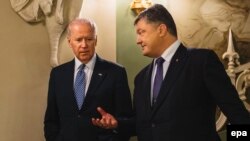
Biden, Poroshenko Again Discuss Corruption, Reforms
By RFE/RL
With concern growing about Ukraine’s government and its commitment to cleaning up corruption and cronyism, U.S. Vice President Joe Biden has spoken to Ukrainian President Petro Poroshenko for the second time in as many days.
The February 12 phone call from Biden -- the White House’s point man on Ukraine -- came just days after the resignation of reformist Economy Minister Aivaras Abromavicius, who angrily accused top officials in the Poroshenko administration of hindering badly needed reforms.
Western ambassadors have been vocal in urging Poroshenko to do more, and the International Monetary Fund has signaled that $1.75 billion in bailout funds could be in doubt.
The White House said Biden told the Ukrainian leader that reforms need to be passed quickly to ensure the IMF funds.
"The two leaders agreed on the importance of unity among Ukrainian political forces to quickly pass reforms in line with the commitments in its IMF program, including measures focused on rooting out corruption," it said in a statement.
Poroshenko had been seen as committed to cleaning up Ukraine’s notorious corrupt and untransparent government, and Abromavicius had been one of several foreign-born officials brought in as part of that effort.
But the push to eliminate problems like bribery, kickbacks, and preferential hiring for wealthy insiders has proceeded at a slow pace, resulting in growing frustration both inside Ukraine and among Western officials and lenders.
The resignation of Abromavicius sparked fears that the government of Prime Minister Arseniy Yatsenyuk might collapse. That would undermine efforts to cement the Minsk accords that brought a shaky cease-fire to the fighting in eastern Ukraine between Russia-backed rebels and government troops.