




As fighting flares, situation for residents in east "dire," says OSCE chief:
By Steve Gutterman
MUNICH, Germany - Fighting between Russia-backed separatists and government forces has flared in eastern Ukraine and the humanitarian situation is "dire," the head of Europe’s main security organization told RFE/RL.
Combatants have moved heavy weaponry back up closer to the front line and the separatists in particular have been conducting “military activities” including exercises under cover of night, Lamberto Zannier, the secretary-general of the Organization for Security and Cooperation in Europe (OSCE), said on February 14.
“The cease-fire is not holding as we would like it to,” Zannier said in an interview on the sidelines of the Munich Security Conference, where Russia traded angry accusations with Ukraine and the West over a war that seemed unthinkable just over two years ago but has killed more than 9,000 people since April 2014.
A cease-fire that was agreed as part of the February 2015 Minsk II accord took hold in September, but fighting increased later last year and has surged again after a truce for the New Year and Christmas holidays, Zannier said.
“It’s still, unfortunately, an active conflict,” he said. “We see...ongoing military activities, especially on the separatist side, we’ve seen rather large night exercises – military exercises. So there is a lot of dynamic, a lot of movement there, and that’s of course a concern.”
He said the OSCE, which has 700 unarmed monitors observing the conflict with equipment including drones, had recorded “the use of multiple-rocket launchers and field howitzers.”
Ukrainian forces and the Russia-backed separatists, who seized control of parts of the Donetsk and Luhansk regions after Moscow-friendly President Viktor Yanukovych fled to Russia in the face of protests over his abandonment of a landmark deal with the European Union, pulled heavy weaponry back last year under Minsk II.
The accord also set out steps to resolve the conflict and was supposed to be completed by the end of 2015, with the return of Ukrainian control over its border with Russia in the separatist-held areas.
Few of the steps have been carried out, however, and Zannier said that elections under Ukrainian law in the separatist-held areas – another key point of the settlement plan – could probably not be held until after the summer. A senior separatist, meanwhile, said it would be at least 10 months before voting could be held.
At the Munich Security Conference on February 13, Russian Prime Minister Dmitry Medvedev accused Kyiv of foot-dragging on its obligations under the accord. Ukrainian President Petro Poroshenko said it was Russia that is blocking a resolution, and U.S. Secretary of State John Kerry said Western sanctions imposed on Moscow will remain in place until Russia fulfills its commitments. Western governments fear Russia is using the conflict to destabilize Ukraine, undermine its pro-Western government, and keep it from drawing closer to NATO and the European Union.
Despite powerful evidence, Russia denies accusations by Kyiv and the West that it has sent troops and weapons into eastern Ukraine to support the separatists.
Zannier said it is difficult for the OSCE monitors to determine whether Russian soldiers and arms are crossing into Ukraine now because they only have a mandate to observe at two border crossings, where they are positioned on the Russian side.
In separatist-held areas on the Ukrainian side, “we are being systematically prevented from reaching the border, especially in the Luhansk area,” he said, adding that “because it’s rather flat territory, obviously there are possibilities for men and equipment to cross that border in places where we are not there to see it.”
The ability of the monitors to record violations is also restricted by the fact that they operate only in the daytime, while “many of the violations occur at night,” Zannier said.
He also said that the OSCE monitors are now experiencing “systematic limitations” to their freedom of movement, and in some cases “threatening behavior” on the part of separatists at checkpoints.
“As people stop them, they also point guns, and this is obviously something we don’t like,” Zannier said. “It’s not, you know, a kind of friendly warning.”
He said that 90 percent of the incidents of this kind of limitation of movement in the past few weeks have been on the separatist side.
He said the frequency of such incidents "is making our role more complicated, but it’s also pointing to the general deterioration of the situation."
The cases of heavy weaponry use are “on both sides, and it’s understandable because if one side starts using heavy weaponry again, it’s inevitable that the other reacts,” Zannier said. “It’s a general dynamic that we are assessing, and it’s a worrying one, of course.”
Ukrainian military spokesman Oleskandr Motuzyanyk said on February 14 that seven Ukrainian military personnel were wounded over the previous 24 hours, and had no information on civilian casualties. Citing Ukrainian military intelligence, Motuzyanyk said that one Russian serviceman was killed and died and one wounded near Zaytsevo, in Donetsk region. There was no comment from Russia on the claim.
Many of the people killed or maimed in the war have been civilians, and hundreds of thousands have been driven from their homes.
For those who remain, Zannier said, “the humanitarian situation is dire.”
He said that “we really feel that there is a need to open up channels to facilitate the movement of the population,” improve access to humanitarian assistance, and repair vital infrastructure for supplies of gas, power, and water.
Zannier said that people living in the war zone “are increasingly tired, and they want this thing to finish.”
He said he was speculating, but that there may be “increasingly a gap between the militant side of the separatist movement and the normal people, many of whom have left.”
Those people are “bitter about everything, but they also don’t seem to think that this is sustainable any longer, this kind of situation,” he said.
That should “push us to find ways to help bring this to an end,” Zannier said. (w/ RFE/RL’s Ukrainian service, TASS, and Interfax)
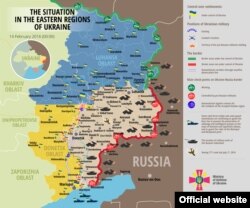
Here is today's map of the security situation in eastern Ukraine, according to the Defense Ministry (click on map to enlarge):
Ukraine separatists say 10 Months needed before elections:
Russia-backed separatists in eastern Ukraine say that local elections mandated by the Minsk process on ending the conflict in the region can only be held toward the end of this year.
Separatist official Vladislav Deinego said in the Ukrainian city of Donetsk on February 14 that first the political situation must "stabilize" and economic concerns must be addressed.
"It will take at least half a year to complete constitutional reform and at least a month to adopt a law on elections and begin preparing," he said. "It turns out it will take at least 10 months."
Russian Foreign Minister Sergei Lavrov, speaking in Munich on February 13, urged Kyiv to adopt "constitutional reform that will reinforce the permanent status of Donbas."
In an interview with TASS on February 14, Lamberto Zannier, secretary-general of the Organization for Security and Cooperation in Europe (OSCE), said his organization was prepared to facilitate elections on the separatist-held territory.
He said he had discussed with Ukrainian officials the possibility of creating an international police mission to "help creating a secure environment for the elections." (TASS, Interfax)
Putin and Obama discussed Ukraine:
Russian President Vladimir Putin and U.S. President Barack Obama have agreed to intensify joint diplomatic efforts following the agreement struck in Munich earlier this week to defuse the conflict in Syria.
The two leaders spoke by telephone on February 14, according to a statement released by the Kremlin. The statement said Putin also stressed to Obama the need to create a united international front against global terrorism.
Putin reportedly said that closer contacts are needed between U.S. and Russian military officials in order to successfully counter Islamic State and other terrorist groups.
Putin also expressed the hope that authorities in Ukraine will "promptly fulfill their obligations" under the Minsk process to regulate the conflict in eastern Ukraine between Kyiv and Russia-backed separatist militants, according to the statement.
Western countries have blamed Russian air strikes in Syria and support for the government of President Bashar al-Assad for the worsening security situation there.
And on February 13, U.S. Secretary of State John Kerry said Moscow had failed to implement its obligations under the Minsk process, including the withdrawal of Russian forces from Ukraine and handing over to Kyiv complete control over Ukraine's borders. (Reuters, Interfax, and TASS)